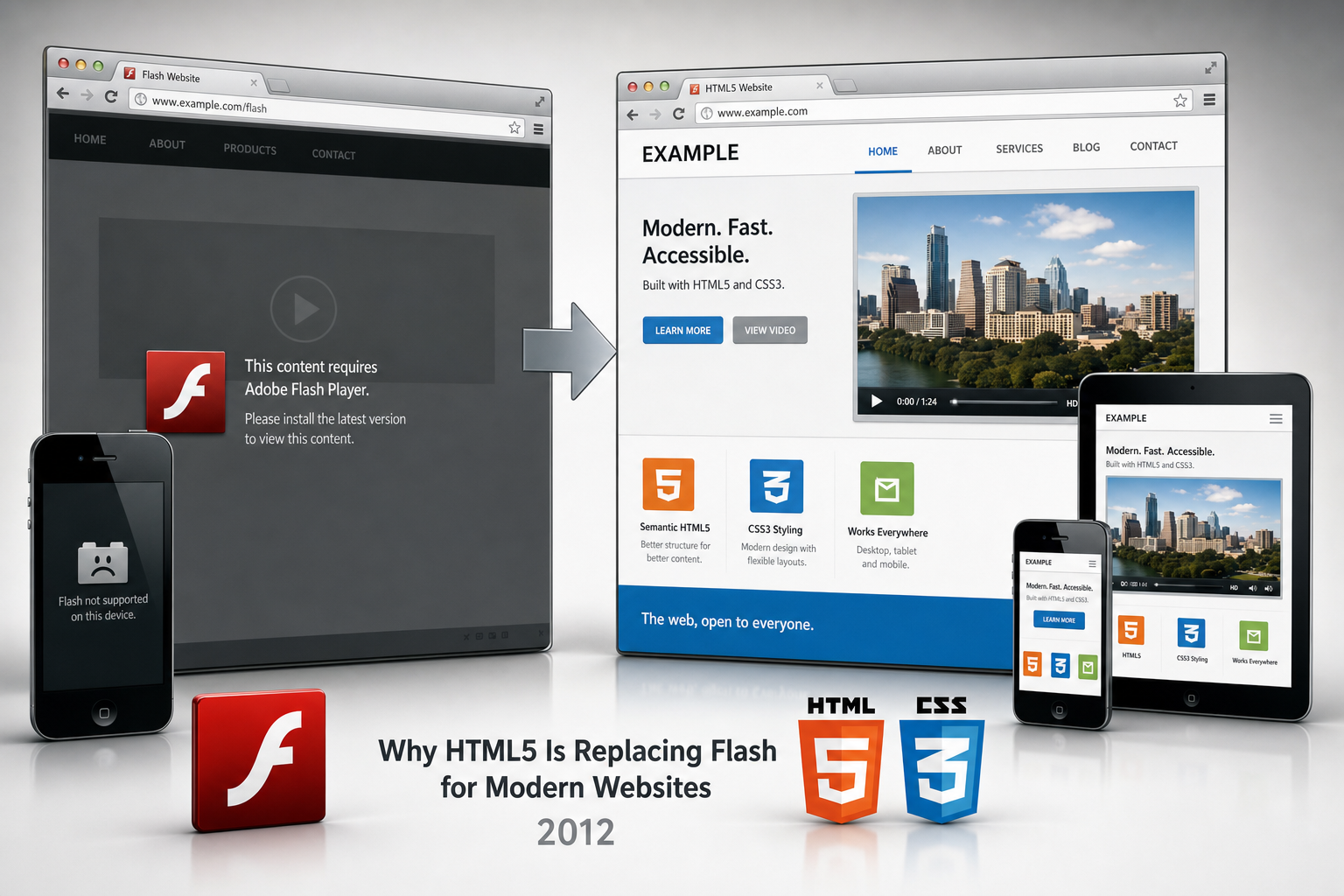
For many years, Flash has been the familiar choice for animated website introductions, interactive banners, embedded video and rich online experiences. It helped make the web more visual at a time when ordinary HTML felt limited. However, the web has moved on quickly. For UK businesses planning a new website or reviewing an existing one, why HTML5 is replacing Flash for modern websites is no longer a distant technical discussion; it is a practical design and marketing decision that can affect mobile visitors, search visibility, loading times, maintenance and long-term brand presentation.
Why Flash is losing its place on business websites
Flash is still used widely, and in some specialist cases it can still deliver impressive interactive work. The issue for most business websites is not whether Flash can look attractive. The issue is whether it is the most reliable, accessible and commercially sensible way to present information to prospective customers.
The biggest pressure on Flash is mobile browsing. Smartphones and tablets are becoming a normal part of the buying journey, especially for people checking opening times, comparing services, reading reviews, viewing portfolios or following links from social media. Apple’s iPhone and iPad do not support Flash in the browser, which means a Flash-led website may simply fail to show important content to a significant group of visitors. Adobe has also shifted its focus away from Flash Player for mobile browsers, which reinforces the need to think carefully before building a new website around Flash.
There is also the question of user patience. A website that begins with a long animated introduction may impress a business owner in a presentation, but it can frustrate a visitor who simply wants to find a telephone number, product detail, address or enquiry form. The most effective business websites usually make the next step obvious. Flash can get in the way if it is used as the foundation rather than as a carefully chosen enhancement.
What HTML5 brings to website design
HTML5 is the latest development of the core language used to structure web pages. It is supported to varying degrees by current versions of major browsers, including Internet Explorer 9, Firefox, Chrome, Safari and Opera. It is not a single magic feature, and browser support still needs to be checked properly, but it gives designers and developers a much better native toolkit for building richer websites without relying on a separate plug-in.
One of the most useful changes is the ability to handle video and audio more naturally through the browser. In 2012, video formats still require careful planning because different browsers support different formats, such as H.264, WebM and Ogg. A well-built site may need more than one video file and a suitable fallback for older browsers. Even so, the direction is clear: media is becoming part of the page itself rather than something that must be locked inside a Flash player.
HTML5 also supports more meaningful page structure. Elements for sections, articles, navigation and footers help developers organise content in a cleaner way. Used correctly, this can make a website easier to maintain and easier for search engines and assistive technologies to interpret. Combined with CSS3 for visual presentation and JavaScript for interaction, HTML5 makes it possible to create attractive, animated and responsive-feeling interfaces without making the whole experience dependent on Flash.
The business value of HTML5 replacing Flash
For business owners, the most important question is not whether HTML5 sounds fashionable. It is whether it helps the website do its job. In many cases, HTML5 replacing Flash can support several commercial goals at once.
Better reach across devices
A website should not turn away visitors because they are using the wrong device. If a restaurant, professional service, retailer, venue or local trade relies on a Flash-only menu, gallery or contact area, mobile users may be left with gaps. HTML5, when implemented with sensible fallbacks, helps present core information across desktop computers, laptops, tablets and smartphones.
Improved search visibility
Search engines have improved their ability to process different types of content, but ordinary HTML text remains the clearest way to explain what a page is about. A Flash website that hides key headings, service descriptions, product information or location details inside an animation can make search engine optimisation harder than it needs to be.
HTML5 encourages content to sit within the page in a more readable structure. This does not guarantee rankings, and it is not a substitute for good keyword research, relevant copy, inbound links, local signals and regular marketing activity. However, it gives SEO work a stronger base. Pages can be titled properly, headings can be used logically, internal links can guide both visitors and search engines, and each service or topic can have its own indexable page.
More flexible content management
Many businesses need to update websites frequently. New case studies, seasonal offers, staff information, blog posts, event details and social media links all need to be handled without rebuilding a complex animation. A website based on HTML, CSS and well-managed content is usually easier to update than one where important content is embedded inside Flash files.
This matters for marketing. A site that is easy to update is more likely to stay current. Current content gives visitors confidence and creates more opportunities to attract long-tail search traffic.
Design considerations when moving away from Flash
Moving from Flash to HTML5 does not mean accepting a plain or static website. The aim is to keep the useful parts of rich design while removing unnecessary barriers. Animation, transitions, image galleries, video, maps and interactive forms can all be created in ways that fit more naturally with the wider web.
The best approach is to begin with content and visitor needs. What should a visitor do first? Call, enquire, book, download, register, visit a shop, share a page or read more? Once that priority is clear, design can support the journey. Animation should guide attention, not distract from it. Video should explain or persuade, not delay access to the page. Navigation should be simple enough for a first-time visitor to understand within a few seconds.
Older browsers also need consideration. Not every customer will be using the latest software. In 2012, Internet Explorer 8 is still common in many offices, and it does not support HTML5 in the same way as newer browsers. This does not mean avoiding HTML5, but it does mean planning progressive enhancement. The core content and actions should remain available, while newer browsers receive the richer presentation.
HTML5, social media and shareable content
Social media marketing is becoming more closely connected to website design. Facebook, Twitter, LinkedIn and YouTube can all send valuable visitors to a business website, but those visitors often arrive quickly and with limited patience. If they tap a link on a mobile device and find that the main content depends on Flash, the campaign has lost momentum before the message has been delivered.
HTML5 helps create pages that are easier to share, view and discuss. A blog post, landing page, video page or product guide can have a clear address, a readable title, descriptive text and images that support the message. This is far more useful for social media than a single Flash experience where individual sections cannot be linked to easily.
Businesses should also consider how campaigns connect. A tweet may point to a short article. A Facebook post may link to a competition page. A LinkedIn update may direct people to a white paper or professional guide. In each case, the page should load quickly, display the message clearly and make the next step obvious. HTML5-based pages are generally better suited to this style of marketing than Flash-only pages.
Domain names, branding and long-term digital strategy
When planning a new HTML5 website, it is also worth reviewing the domain name and broader brand structure. A domain should be memorable, easy to spell, suitable for print and radio use, and closely connected to the organisation’s trading name where possible. For a UK-focused business, a UK domain can help reinforce location and trust, while a broader domain may be suitable for organisations with international ambitions.
Avoid choosing a domain purely because it contains a keyword. Search visibility depends on much more than the domain name, and a brand that feels credible is usually more valuable in the long term. It is sensible to register obvious variations where appropriate, such as common misspellings or relevant UK and international extensions, but the main website should have one clear primary domain so that marketing activity is not scattered.
Before registering a domain, check that it will not cause confusion with another organisation and that matching social media names are available where possible. Consistency across the website, email addresses and social profiles makes a business easier to recognise and easier to recommend.
When Flash may still have a role
It is important to be fair: Flash is not useless. Some games, advanced animations, interactive presentations and specialist applications may still rely on it. Existing Flash assets may also have value and do not always need to be discarded immediately. The question is whether Flash should sit at the centre of a new business website.
For most brochure sites, e-commerce support pages, local business websites, professional service sites, blogs, portfolios and marketing landing pages, the safer direction is to build the essential experience in HTML and enhance it where necessary. If Flash is used at all, it should not contain the only version of important content and should not prevent visitors from completing basic actions.
Practical steps for business owners
If your current website depends heavily on Flash, start with an audit. Identify which parts of the website contain Flash and decide whether they are decorative, informative or essential. A small decorative animation may be low priority. A Flash-only navigation menu, contact form, product catalogue or homepage message is much more urgent because it can affect usability and search performance.
- Check the site on mobile devices. View important pages on an iPhone, iPad and Android handset where possible.
- Review search visibility. Make sure key services, locations and product descriptions exist as readable HTML text.
- Plan video carefully. Use suitable formats and fallbacks so visitors are not excluded unnecessarily.
- Keep design purposeful. Use animation to improve communication, not as a barrier before the content.
- Think beyond launch. Choose a structure that supports blogging, social media campaigns, landing pages and ongoing optimisation.
A good website is not simply a collection of effects. It is a business tool that should support enquiries, sales, trust, recruitment, customer service and brand reputation. HTML5 gives businesses a more open and flexible foundation for those aims.
A more durable foundation for the web
The movement towards HTML5 is not about chasing novelty. It reflects a wider shift towards websites that work across more devices, expose content more clearly, integrate more easily with search and social media, and remain easier to maintain over time. Flash helped shape the creative web, but it is increasingly difficult to justify as the main structure for a business website.
For UK businesses considering a redesign, HTML5 replacing Flash should be viewed as an opportunity to improve the whole digital presence. The strongest projects will combine clear content, a sound technical build, search-friendly structure, effective design, social media planning and a domain strategy that supports the brand. The result is a website that looks professional, works harder and gives more visitors a fair chance to become customers.