Every business website should do more than look presentable. It should help people find you, understand what you offer, enquire with confidence and return when they need you again. Website analytics gives business owners the evidence needed to see whether that is happening. Rather than relying on guesswork, opinion, or the loudest voice in the room, analytics helps show how visitors arrive, what they do, where they hesitate, and which parts of the website contribute to real business goals.
For UK businesses investing in website design, search marketing, social media or a new domain name, this information is invaluable. A website is not a printed brochure that is finished once approved. It is a working business asset. With the right measurements in place, it can be improved month by month, based on how customers actually behave.
What can website analytics tell a business
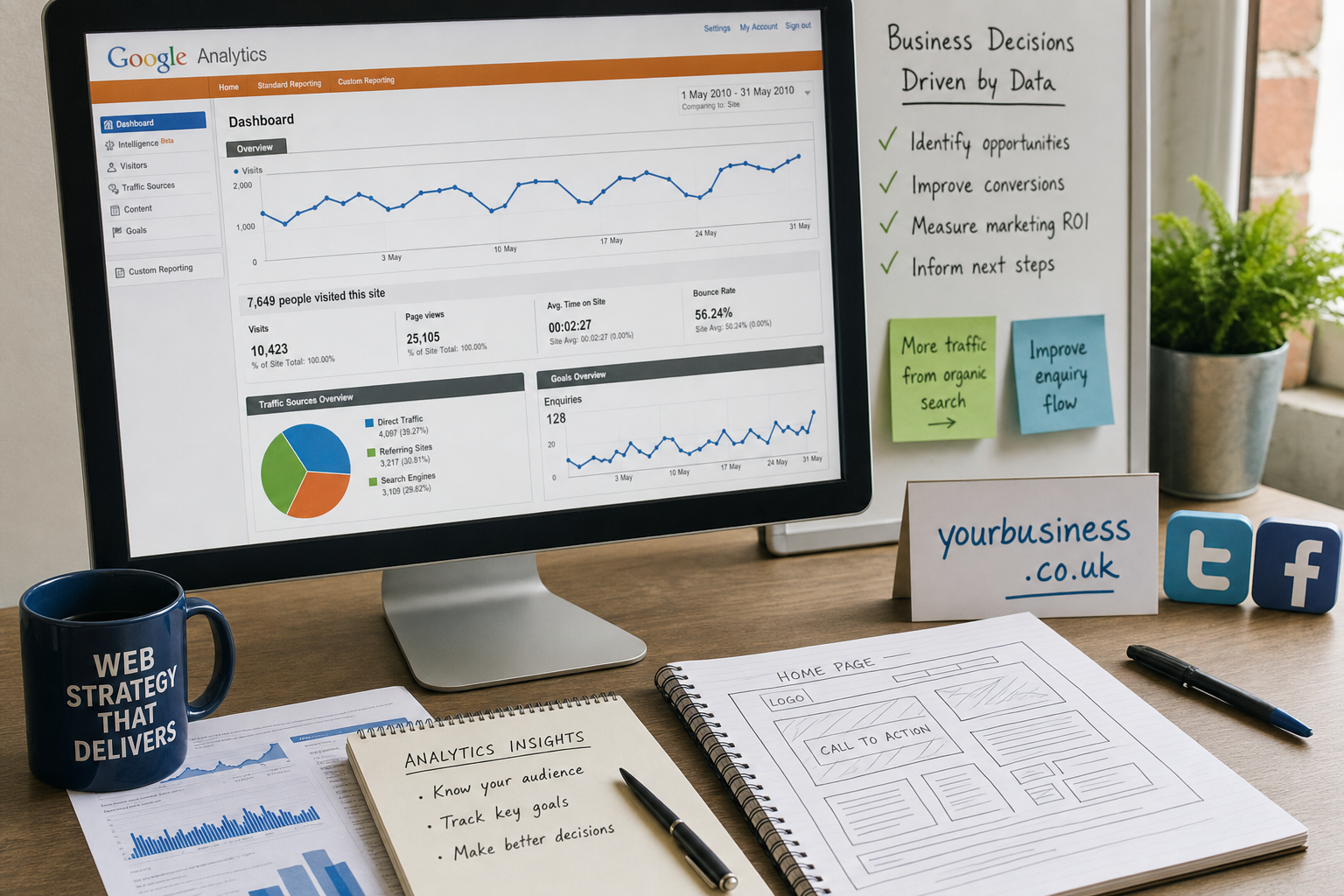
Website analytics is the process of collecting and interpreting information about how people use a website. Common measurements include visits, page views, traffic sources, search phrases, time on site, bounce rate and enquiries. On their own, these figures are only numbers. Their value comes from asking sensible business questions of them.
For example, a local service business may want to know whether people are finding its contact details. An online retailer may want to see which products attract visits but fail to sell. A professional firm may want to understand whether its articles are bringing in relevant enquiries. A charity may need to know which campaigns encourage people to sign up or donate. In each case, website analytics can help connect online behaviour with business priorities.
Analytics should not be seen as a technical report reserved for web developers. It is a management tool. It can help answer questions such as:
- Which marketing activity is bringing useful visitors to the website?
- Which pages encourage enquiries, downloads, bookings or sales?
- Where do visitors leave before completing an important action?
- Are search engines sending traffic for the right phrases?
- Is the website working for visitors using different browsers and screen sizes?
- Which content appears to build trust and which content is being ignored?
Once these questions are being asked regularly, the website becomes easier to improve. Decisions are no longer based purely on preference. They are supported by evidence.
Turning visitor numbers into business decisions
A common mistake is to focus only on the total number of visits. More traffic can be useful, but only if it is the right traffic. A thousand visitors who leave immediately are less valuable than fifty visitors who read carefully and make an enquiry. Website analytics helps separate activity from progress.
Business owners should begin by deciding what success means. For some organisations, success is a completed sale. For others, it may be a telephone call, a brochure request, an email enquiry, a quote form, a newsletter sign-up or a visit to a key page. These actions should be treated as goals. Once goals are in place, analytics can show which sources, pages and campaigns are helping people reach them.
Consider a company that receives traffic from search engines, paid advertising, directory listings and social media. If search traffic produces most enquiries, the business may decide to invest further in search engine optimisation. If paid advertising brings plenty of visitors but few conversions, the advert copy, landing page or choice of keyword may need attention. If social media delivers fewer visits but those visitors spend longer reading advice pages, social activity may be valuable for awareness and trust rather than immediate enquiries.
This is where analytics becomes commercially useful. It helps owners decide where to spend time, where to reduce waste and where to improve the customer journey. It can also prevent unnecessary redesign work. If a website is underperforming, the problem may not be the visual style. It may be the wording, navigation, form layout, page speed or mismatch between advertising promises and page content.
Using analytics to improve website design
Good website design is not only about appearance. It is about clarity, usability and persuasion. Analytics provides useful clues about whether a design is helping or hindering visitors.
A high bounce rate on a key landing page may suggest that visitors are not seeing what they expected. The page headline may be unclear, the offer may be hidden, or the page may load too slowly. If visitors repeatedly leave a form page, the form may be asking for too much information or may appear untrustworthy. If important pages receive very few visits, the navigation may be making them hard to find.
In 2010, many websites still rely heavily on large images, complex scripts or Flash elements. These can sometimes create a strong visual impression, but they should not get in the way of the visitor. Analytics can reveal whether visitors are leaving before content loads, whether certain browsers are producing problems, or whether mobile users are struggling to complete tasks. With more people using phones to browse while travelling or away from the office, even a simple check of mobile visitor behaviour can be worthwhile.
Design choices should be tested against user behaviour. If a prominent contact button increases enquiries, that is a strong argument for keeping it. If a large animated feature attracts attention but reduces clicks to the main services, it should be reconsidered. Analytics cannot replace good design judgement, but it can sharpen it.
Website analytics and search engine optimisation
Search engine optimisation is another area where analytics is essential. It can show which search phrases bring visitors, which pages receive search traffic and whether those visitors take meaningful action. This is particularly useful because ranking well for a phrase is only part of the job. The phrase also needs to attract people who are genuinely interested in the business.
A business may discover that it ranks for broad phrases that deliver traffic but very few enquiries. It may also find that more specific phrases, perhaps including a location or service detail, bring fewer visitors but better quality leads. For many UK businesses, these specific search phrases can be highly valuable because they reflect stronger intent.
Analytics can also help guide content planning. If advice articles on a particular subject receive steady search traffic, it may be sensible to produce more useful content around that area. If a service page attracts visitors but receives few enquiries, the page may need clearer benefits, stronger evidence, better internal links, or a more obvious call to action.
Search marketing should be reviewed alongside analytics, not separately. Ranking reports can show visibility, but website analytics show what happens after the click. The combination gives a much better view of whether SEO is supporting the business.
Measuring social media without being distracted by noise
Social media is becoming a regular part of business marketing, with many organisations using platforms such as Twitter, Facebook, LinkedIn and YouTube to share news, advice and updates. These channels can help build familiarity and encourage people to visit a website. However, it is easy to become distracted by follower counts or comments alone.
Website analytics helps bring social media back to business outcomes. It can show how many visitors arrive from social platforms, which pages they view and whether they enquire, subscribe or return later. Not every social media visit will convert immediately. A person may read an article today and make contact next month. Even so, analytics can show whether social activity is sending interested people to the right content.
Useful questions include: which updates encourage visits, which topics produce longer engagement, and whether visitors from social channels view service or contact pages. If the answer is no, the business may need to improve the link between social updates and website content. A good social media post should not simply create a brief moment of attention; it should lead interested people towards a helpful next step.
Domain names, branding and measurable marketing
A domain name is often one of the first digital branding decisions a business makes. It should be clear, memorable and appropriate for the organisation. For UK businesses, a relevant UK domain can support trust, while a well-chosen alternative may be useful for a campaign, product or international audience. The important point is to choose a domain that customers can spell, remember and associate with the business.
When registering a domain name, avoid making the decision purely on keyword value. An awkward name, too long or easily confused may cause problems in print, on the telephone and in search results. It is also sensible to consider common variations and to keep registration details well organised, so that renewals and ownership are not overlooked.
Analytics is useful when a business uses more than one domain or runs a specific campaign address. Rather than assuming a campaign has worked because a short address was printed on leaflets or adverts, track the visits and enquiries it produces. If a campaign domain or landing page receives traffic but no action is taken, the message may need refinement. If it performs well, the business has evidence to guide future marketing.
Practical analytics habits for business owners
The greatest value from website analytics comes from regular review. Looking at reports once a year is rarely enough. A simple monthly review can reveal patterns, problems and opportunities before they become costly.
Business owners do not need to study every available report. It is better to choose a small set of meaningful measurements and review them consistently. These may include total visits, traffic sources, search phrases, goal completions, enquiry form performance, popular pages and pages with high exit rates. For businesses running paid search or email campaigns, campaign performance should also be reviewed.
A practical monthly review might include the following steps:
- Check whether overall traffic has risen or fallen, and identify likely reasons.
- Review which sources are producing enquiries or other goals.
- Identify the most-visited pages and consider whether they clearly guide visitors.
- Look for pages where visitors leave unexpectedly.
- Compare search phrases with the services or products the business wants to promote.
- Note any technical issues suggested by browser, device or screen information.
- Agree one or two improvements to test during the following month.
This approach keeps analytics manageable. The aim is not to produce reports for their own sake. The aim is to turn information into action.
Avoiding common mistakes
Although analytics is powerful, it can be misleading if used carelessly. One common mistake is making large decisions based on too little data. A single quiet week may not mean a campaign has failed. Seasonal behaviour, public holidays, press coverage and offline activity can all affect traffic. Look for patterns over time before making major changes.
Another mistake is treating averages as the whole story. Average time on site may mask that some visitors are highly engaged while others leave immediately. Segmenting traffic by source, page or visitor type can reveal more useful detail. A visitor from a branded search may behave very differently from someone arriving through a broad search phrase or social media link.
It is also important to ensure that the tracking is installed correctly. Missing tracking code, duplicated pages, untracked enquiry forms or staff visits from the office can distort the picture. A little care at the start prevents confusion later.
Website analytics is most useful when it is connected to clear business questions. The figures matter because they help owners decide what to improve next.
Making better decisions with evidence
A successful website is rarely created by one large decision. It is usually the result of many informed improvements: clearer navigation, better content, stronger calls to action, faster pages, more relevant search phrases and more useful campaign landing pages. Website analytics provides the feedback needed to make those improvements with confidence.
For UK business owners, the message is straightforward. If your website is important to your marketing, analytics should not be an afterthought. It should guide design choices, SEO activity, social media planning, domain and campaign decisions, and ongoing digital strategy. By measuring what visitors do and responding thoughtfully, a website can become a more effective business tool and a stronger part of your overall marketing.