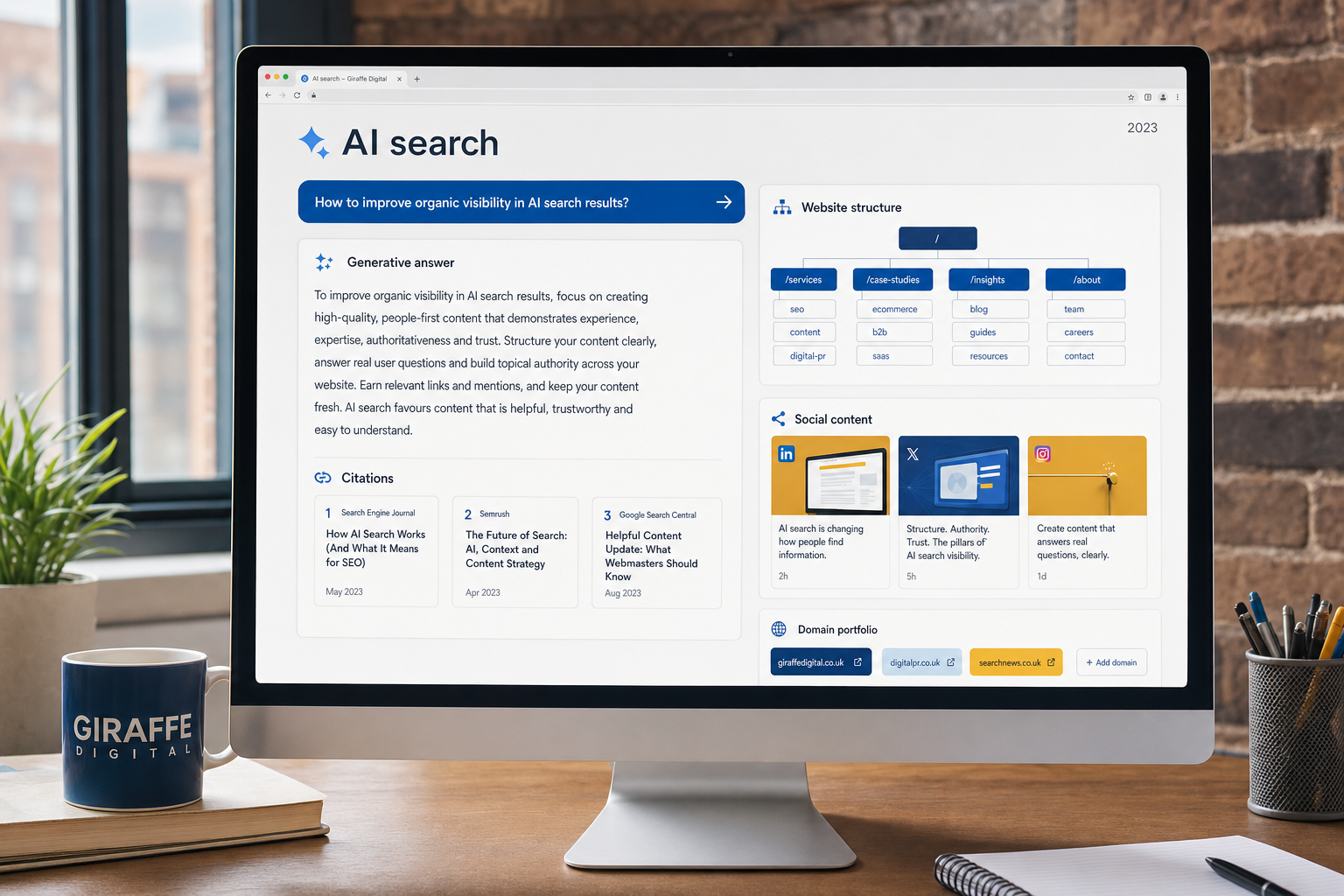
AI search is beginning to change how people discover businesses, compare services and decide which websites are worth visiting. For UK business owners, this does not mean abandoning established SEO, content marketing or website design principles. It does mean planning content with a clearer understanding of how AI-assisted search tools summarise information, select sources and guide users towards their next action.
Search is no longer only a list of blue links. In 2023, generative AI features are being tested in search results, conversational search tools are becoming more familiar, and users are increasingly comfortable asking longer, more specific questions. A potential customer may not search simply for web design agency. They may ask which type of website is best for a growing local business, how long a redesign usually takes, what should be included in an SEO-friendly site, or how to choose a memorable domain name. This shift has practical implications for content planning, website structure, social media marketing and wider digital strategy.
What AI search means in November 2023
AI search refers to search experiences that use artificial intelligence to interpret a query, generate a summary, suggest follow-up questions or provide a conversational answer. Search engines and AI assistants are not all the same, but they share an important feature: they are designed to provide users with more direct answers to complex questions.
Google is testing generative AI features in selected search markets, Microsoft has integrated AI-assisted answers into Bing and Edge, and tools such as ChatGPT and other answer engines are influencing how people research products and services. These experiences still rely heavily on web content, brand signals, structured information and trustworthy sources. The difference is that the answer may be compiled from multiple pages before the user decides whether to click through.
For businesses, the main point is not to chase every new feature. The stronger approach is to make your website easier for both people and machines to understand. Clear service pages, well-organised guides, accurate business information, helpful FAQs and consistent brand messaging all become more valuable when AI systems are trying to identify reliable sources.
Why content planning needs to move beyond basic keywords
Traditional keyword research still matters. People continue to search for services, locations, products and problems using short phrases. However, AI search encourages more conversational and intent-led queries. Instead of only planning around isolated keywords, businesses should consider the full decision-making journey.
For example, a business considering a new website may search for information across several stages. At the early stage, they might ask what makes a website look professional. Later, they may compare brochure websites, ecommerce websites and booking systems. Closer to enquiry, they may look for evidence of process, technical capability, ongoing support and an understanding of their sector. A good content plan should support each of these stages.
This is where topic clusters are useful. A main service page might explain website design in a clear commercial way, while supporting articles answer related questions such as how to prepare for a redesign, what pages a service business needs, how SEO should be considered during design, or what to check before registering a domain. The aim is to create a connected body of content rather than a collection of disconnected blog posts.
AI search is also likely to reward clarity. If a page tries to cover too many subjects at once, it may be harder for search engines and AI tools to understand its purpose. Each page should have a clear focus, useful headings, direct answers and supporting detail. This helps users skim the page and helps search systems identify whether the content is relevant to a query.
Practical ways to create AI-friendly website content
There is no need to write for robots. In fact, content written solely for search engines is becoming less useful. The best approach is to write for real customers while making the page structure clear enough for search systems to interpret.
Answer specific questions clearly
AI search tools often respond to detailed questions. Your content should therefore include direct, useful answers to the questions your customers actually ask. If you design websites, explain what affects project scope, what content a client usually needs to provide, how mobile design is handled and why SEO should be considered before a site is built. If you offer social media marketing, explain how platform choice, content format and audience behaviour influence the plan.
Short introductory answers can be followed by deeper explanation. This format works well because it provides a quick response for users in a hurry while still offering enough detail for those who want to understand the topic thoroughly.
Show expertise without overcomplicating the page
Google's emphasis on helpful, reliable content means expertise should be visible. That does not require jargon-heavy writing. It means demonstrating that you understand the practical decisions a business owner has to make. Use examples, explain trade-offs and be honest about what depends on the business model.
For instance, a local service business may need strong location pages, clear calls to action and persuasive trust signals. An ecommerce business may need product filtering, technical SEO, conversion-focused category pages and a more detailed content plan. A membership or booking-based business may need integrations, automation and a careful approach to user experience. These distinctions help visitors recognise that your advice is grounded in real commercial needs.
Keep information accurate and current
AI search can surface older content if it appears relevant, but users still expect accuracy. Content planning should include reviews of important pages, especially where technology, platform features or search guidance changes. A blog post about social media formats, for example, should not be left untouched for years if the platform behaviour has moved on. A guide to website planning should reflect current expectations around mobile experience, accessibility, speed, analytics and consent.
Website design matters more when answers are summarised
If AI search gives users more information before they click, the visit to your website becomes even more important. A user who arrives after reading an AI-generated summary may already have a clearer idea of what they want. Your website needs to establish credibility and make the next step obvious quickly.
Strong design is not only about appearance. It is about hierarchy, trust, readability and performance. A service page should immediately communicate what you do, who you help and why the visitor should continue reading. Key information should not be buried beneath vague slogans. Calls to action should be clear but not aggressive. Navigation should support the user journey rather than forcing visitors to guess where to go next.
Technical quality also plays a role. Fast-loading pages, secure browsing, mobile-friendly layouts and clean code all contribute to a better user experience. Search engines have long considered aspects of page experience, and users are unlikely to wait for a slow or confusing website when competitors are easy to compare. AI search may change the route to your site, but the fundamentals of good website design remain essential.
Structured content is particularly helpful. Well-labelled service areas, logical headings, concise summaries and relevant internal links make it easier for users and search systems to understand your site. Where appropriate, structured data can help search engines interpret business details, articles, products, reviews, or frequently asked questions. It should be used accurately and only where it genuinely reflects the visible page content.
How social media supports AI search visibility
Social media marketing is not a replacement for a well-built website, but it can strengthen brand visibility and content distribution. In 2023, customers often move between search engines, social platforms, review sites and websites before making contact. A business that appears consistently across these channels is easier to recognise and trust.
AI search tools may not treat social posts in the same way as indexed website pages, but social activity still contributes to demand, awareness and engagement. Sharing useful articles, short explanations, project insights, behind-the-scenes processes and practical tips can help your audience understand your expertise before they need to enquire.
For content planning, social media can also reveal useful topics. Questions in comments, common objections in direct messages and popular post themes can all feed into website content. If a short post about choosing the right website platform performs well, it may justify a fuller guide on your website. If followers frequently ask about branding, photography, copywriting, or search visibility, those questions can be structured as content that supports SEO and AI search discovery.
The key is to avoid treating each channel in isolation. A strong digital strategy connects website content, search visibility, email marketing, social media and brand positioning. AI search makes that connection more important because users gather information from multiple sources before making a decision.
Domain names, trust and discoverability
Domain registration is a small decision with long-term implications. A domain name should be easy to say, easy to spell and closely connected to the business or brand. For UK businesses, it is common to consider a UK-focused domain as well as broader options where appropriate. The right choice depends on the audience, expansion plans and brand identity.
Avoid names that are unnecessarily long, confusing, or too similar to those of other established organisations. Hyphens and unusual spellings can cause problems when people hear the domain name aloud or try to type it from memory. If your business name is distinctive, securing the most relevant domain variations can help protect the brand and reduce confusion.
Domain names alone do not guarantee search performance, and exact-match domains are not a substitute for a strong website. Search visibility depends on content quality, technical health, authority, relevance and user experience. However, a clear and credible domain can support brand trust, especially when it is used consistently across the website, email addresses, social profiles and printed materials.
Before registering a domain, check that it aligns with the proposed brand name, avoids awkward wording when written as a web address, and can be used consistently across key channels. It is also sensible to think ahead: a domain that feels suitable for a sole trader today should still make sense if the business grows, hires staff or expands its services.
Technology choices should support the content plan
AI search encourages businesses to think more carefully about the technology behind their website. A content plan is only effective if the site can publish, structure and maintain that content properly. The content management system, hosting environment, analytics setup, form handling, and integrations should all support how the business intends to market itself.
For many businesses, the website needs flexible page templates, editable headings and metadata, clean blog publishing, image optimisation and sensible internal linking options. E-commerce sites may need more advanced product data, category management and filtering. Service businesses may need landing pages, case study structures, enquiry forms and integration with customer relationship management or email marketing tools.
Measurement is also important. Analytics can show which pages attract visitors, which enquiries convert and which content supports the customer journey. With privacy expectations and consent requirements in mind, businesses should ensure they collect useful data appropriately. Content planning should not be based only on guesswork; search data, customer questions, sales conversations and website performance should inform it.
A practical content planning framework for AI search
Businesses do not need a complicated process to adapt. A clear framework can make content planning more useful and easier to maintain.
- Map your core services. Identify the main products or services people need to understand before they enquire.
- List real customer questions. Use sales calls, emails, social media comments and search data to collect the questions people ask at each stage.
- Create focused pages. Build clear service pages and supporting articles that answer one main topic well.
- Strengthen internal links. Connect related pages so users and search engines can follow the subject naturally.
- Review credibility signals. Make sure contact details, team information, process explanations, testimonials where appropriate, and policies are easy to find.
- Update important content. Schedule reviews for pages affected by changes in technology, search behaviour, platforms or regulation.
- Repurpose intelligently. Turn strong website content into social posts, email topics, short videos or downloadable guides without diluting the original message.
This framework supports AI search by creating a website with clear topics, reliable answers, and useful context. It also supports human visitors, which remains the most important measure of success.
What UK businesses should do next
AI search is not a reason to panic, but it is a reason to improve the quality and structure of your digital presence. Businesses that rely on thin service pages, irregular blog posts and unclear messaging may find it harder to stand out as search experiences become more answer-led. Businesses that invest in useful content, strong design, technical quality and consistent branding will be better placed to benefit.
Start by reviewing your website from a customer's perspective. Can visitors quickly understand what you offer? Do your pages answer the questions people ask before buying? Is your content specific enough to be useful, or does it sound like it could belong to any competitor? Are your social channels reinforcing the same expertise? Is your domain clear and trustworthy?
The best content plans in 2023 combine search insight with business understanding. AI search may change how answers are displayed, but it still depends on information that is clear, credible and well organised. For UK businesses, the opportunity is to create content that helps people make confident decisions and gives search systems every reason to recognise the value of your website.