Publishing a few blog posts, sending the occasional email and posting on social media can feel like content marketing, but activity alone is not a strategy. For content to support a business properly, it needs a clear purpose, a defined audience and a practical plan for how it will be created, published, promoted and measured. A strong content strategy helps your website work harder, gives your search marketing more direction and makes your brand easier for customers to understand.
For many UK businesses, the challenge is not a lack of ideas. It is knowing which ideas deserve time, which pages should be improved first and how each piece of content connects to commercial goals. Good content can help people discover your business, compare your services, trust your expertise and take the next step. Poorly planned content, on the other hand, can leave a website cluttered, inconsistent and difficult to maintain.
Start with the purpose of your content
Before deciding what to write, design or share, define what the content is expected to do. Different content has different jobs. A service page may need to explain benefits and encourage enquiries. A blog article may answer a common question and attract visitors from search engines. A case study may reassure a potential buyer. A social post may start a conversation or draw attention to a useful resource.
It is helpful to separate broad business goals from content goals. A business goal might be to increase enquiries from local companies, build awareness for a new service or reduce time spent answering the same pre-sales questions. A content goal should explain how content will contribute to that outcome. For example, a web design company might create a guide explaining what to prepare before commissioning a new website, while a professional services firm might publish plain-English articles that explain complex topics for first-time clients.
Purpose also helps you avoid producing content simply because a competitor has done so. If a topic does not serve your audience or support your positioning, it may not be worth publishing. A useful content strategy gives permission to say no as well as yes.
Understand the audience before choosing topics
Effective content starts with an understanding of the people you want to reach. UK business owners are often busy, cautious with investment and keen to know whether a digital project will produce practical value. Content should respect that. It should answer real questions, use language your customers recognise and give enough detail to help people make decisions.
Audience planning does not need to be complicated. Begin with the questions your team hears during enquiries, meetings and after-sales support. Look at the words customers use when describing their problems. Review your website analytics to see which pages attract attention and where visitors leave. Search data can also reveal the terms people use when researching your products or services, although it is important to write for humans rather than chase keywords mechanically.
Once you understand the audience, map content to their stage in the decision-making process. Someone at the start may need an educational article, such as what makes a website effective for a local business. Someone comparing suppliers may need evidence of process, capability and reliability. Someone ready to enquire may need a clear contact route, reassurance about next steps and confidence that their message will be handled professionally.
Build a website structure that supports content
Content strategy is closely linked to website design. A well-designed website is not only attractive; it organises information in a way that feels natural to visitors and search engines. If important content is hidden, duplicated or poorly labelled, even strong writing can underperform.
Start by reviewing the core pages of the website. These usually include the home page, about page, service pages, sector pages where relevant, contact page and any key conversion pages. Each page should have a clear role. A service page should not simply list features; it should explain what the service solves, who it is for, how the process works and what action the visitor should take next.
Navigation should be simple and descriptive. Avoid vague labels if clearer alternatives are available. A visitor should be able to understand what your business does within a few seconds and find the most relevant information without hunting through several menus. Internal links are also important. A helpful blog article should point readers towards a related service page where appropriate, while service pages can link to guides, FAQs or examples that support the buying decision.
Mobile usability is now a major consideration for any business website. More customers are browsing and researching on phones and tablets, and search engines are placing increasing emphasis on mobile-friendly pages. Content should be easy to read on smaller screens, with sensible headings, concise paragraphs and clear calls to action. If your website requires pinching, zooming or awkward navigation, it may undermine trust before the visitor has even read your message.
Create an editorial plan that is realistic
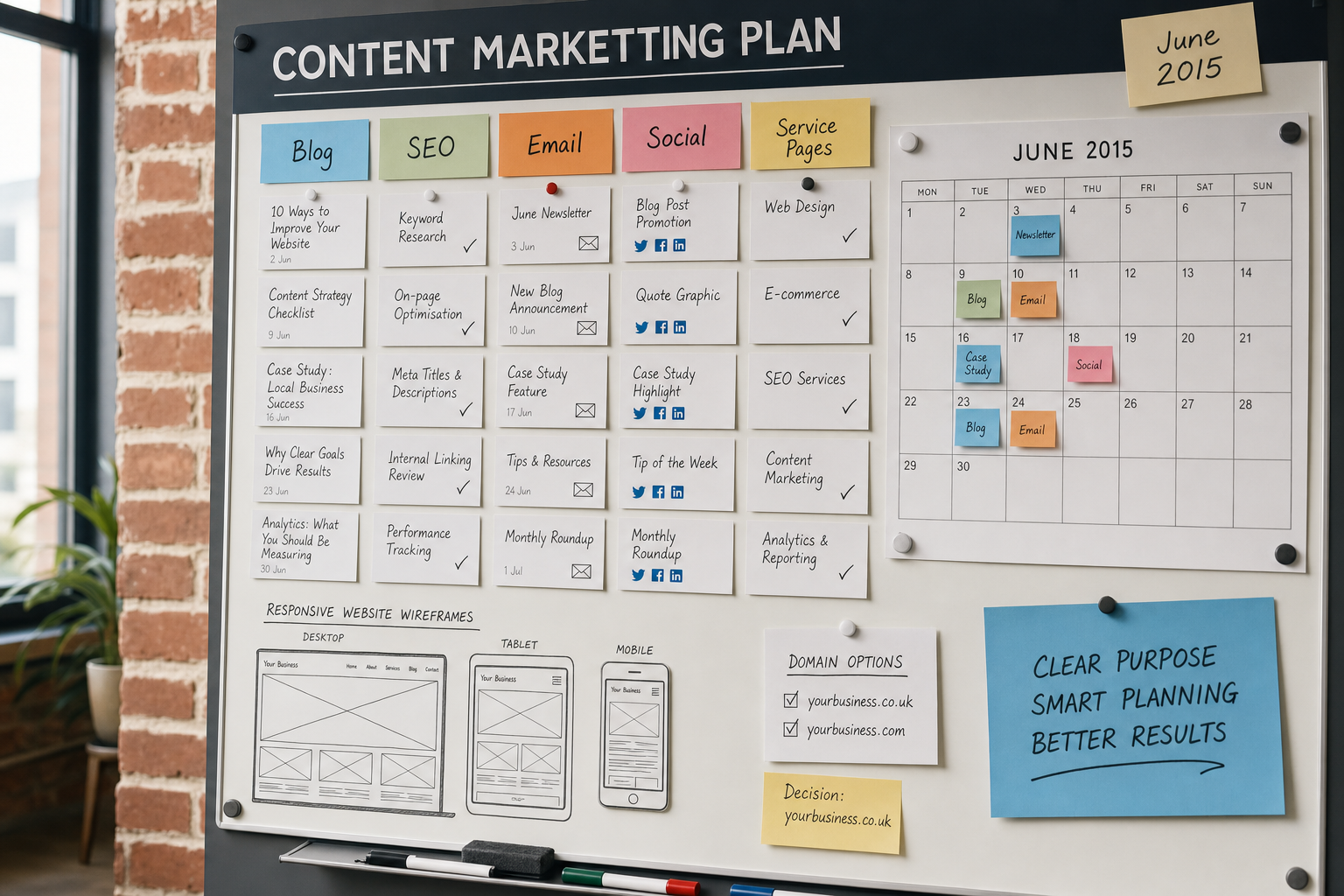
A content strategy becomes useful when it turns into a manageable plan. An editorial calendar helps you decide what will be published, when it will be produced and who is responsible. It also prevents the common pattern of publishing several articles at the start of a campaign and then going quiet for months.
Realistic planning is better than ambitious planning that cannot be sustained. A small business may achieve more with one strong article per month than four rushed posts that add little value. Consider seasonal demand, trade events, product launches, common customer questions and changes within your sector. If June, July and August are quieter months for enquiries, that may be a good time to prepare evergreen content that will support the business later in the year.
A simple content plan might include:
- Core website improvements, such as rewriting service pages or adding clearer calls to action.
- Educational blog posts that answer questions customers ask before making an enquiry.
- Downloadable resources where appropriate, such as checklists or buying guides.
- Email topics for keeping existing customers informed without overwhelming them.
- Social media messages that promote content, encourage discussion and show the personality of the business.
Every planned item should have a reason. If you cannot explain why a piece of content matters, who it is for and where it will lead the reader next, it may need refining before production begins.
Write for search engines without losing the reader
Search marketing in 2015 rewards relevance, quality and usefulness more than repeated keyword placement. Keywords still matter because they reveal how people search, but content should not be written as a list of phrases. The primary keyword should appear naturally in important places, such as headings, opening copy and page titles where appropriate, but the page must still read well.
For a business website, good search content often means creating the best answer to a specific question. If someone searches for advice on choosing a web design agency, a useful article might explain preparation, goals, timescales, content requirements and common mistakes. It should not simply say that your business is the best choice. Search visitors need help first and persuasion second.
Technical basics also support content performance. Each important page should have a unique title tag and meta description, clean URLs, logical headings and fast-loading images. Avoid duplicating large blocks of content across multiple pages, as this can confuse both visitors and search engines. If you serve local customers, make sure your address, telephone number and service area information are consistent across your website and other trusted online profiles.
Quality inbound links remain valuable, but they are best earned through useful content, genuine relationships and industry relevance. Avoid shortcuts that promise quick ranking improvements through low-quality links or automated submissions. A carefully planned article, resource or guide that people genuinely want to reference is more likely to support the long-term health of your website.
Use social media with a clear role
Social media can support content marketing, but it should not be treated as a separate activity with no connection to the website. Platforms such as Facebook, Twitter, LinkedIn, Google+, Pinterest and Instagram can all be useful in different contexts, but the right choice depends on your audience and message. A business-to-business consultancy may find LinkedIn and Twitter more valuable than image-led platforms, while a retailer or hospitality business may benefit from more visual channels.
The purpose of social media is not only to broadcast links. It can be used to test ideas, listen to customer questions, share short tips, highlight new resources and give people a reason to return to your website. However, social posts are usually brief and temporary. Your website should remain the centre of your content strategy because it is the place where you control the structure, message and conversion path.
When planning social content, adapt the message to the platform. A LinkedIn update may take a professional angle and explain the business issue behind an article. A tweet may focus on a concise question or statistic. A Facebook post may use a more conversational tone. The underlying content can be the same, but the presentation should feel appropriate for the audience.
Consider domain names and digital foundations
Content strategy works best when the digital foundations are sound. A clear, memorable domain name supports trust and makes offline promotion easier. When choosing a domain, aim for something that is easy to say, spell and remember. For many UK businesses, a .co.uk domain remains a natural choice, while a .com may also be useful if it is available and relevant to future plans.
Avoid overly long domain names, unnecessary hyphens and spellings that need constant explanation. If your business name is difficult to secure exactly, consider a sensible variation that still feels professional. It is also worth registering important variations where appropriate to protect the brand, but do not buy numerous domains without a clear reason. A strong website on one well-managed domain is usually more valuable than several neglected websites spread across different addresses.
Technology choices matter as well. Your content management system should allow your team to update pages, publish articles, manage images and adjust key page information without unnecessary difficulty. It should also be secure, maintained and suitable for the way the business intends to grow. If adding a new case study or editing a service page is slow and awkward, content strategy will be harder to maintain.
Make content part of the customer journey
Content should not stop when someone first contacts you. The same principles can improve the whole customer journey. Clear proposal information, onboarding guides, support articles and helpful email communication can reduce confusion and strengthen confidence. For example, a business commissioning a new website may appreciate a checklist covering copy, images, domain access and approval stages. This type of content saves time for both the client and the supplier.
Think about the points where customers hesitate, misunderstand or ask for reassurance. These moments are often ideal opportunities for content. A frequently asked questions page, a short guide or a well-structured email can remove friction. Content that supports existing customers can also encourage repeat business and referrals, especially when it demonstrates care beyond the initial sale.
Brand consistency is important throughout this journey. The tone used on the website should feel connected to the tone used in emails, brochures and social media. If the website sounds formal but the social feed is overly casual, the brand may feel disjointed. A practical tone of voice guide can help everyone in the organisation communicate clearly and consistently.
Measure what matters and improve over time
Measurement is essential, but it should be tied to the purpose of the content. Page views alone do not tell the whole story. A specialist service page may attract fewer visitors than a broad blog post, but it may be more valuable if those visitors are more likely to enquire. Look at a combination of indicators, such as organic search traffic, time on page, enquiry form submissions, telephone calls, email sign-ups, downloads and assisted conversions.
Website analytics can show which articles bring people in, which pages lead to enquiries and which content may need improvement. Search query data can reveal whether your pages are appearing for relevant terms. Social media engagement can help you understand which topics attract interest, although likes and shares should not be mistaken for business results on their own.
Review content regularly. Some articles may remain useful for years with only small updates, while others may become inaccurate as services, regulations or technology change. Outdated content can damage trust, particularly if it relates to technical advice or business-critical decisions. A quarterly content review is a sensible starting point for many organisations.
Keep the plan focused and useful
The best content strategy is not necessarily the largest or most complicated. It is the one that helps the right people understand your business, trust your expertise and take sensible next steps. For a UK business owner, that might mean clearer service pages, a modest but consistent blog, better internal linking, a more helpful email process and a social media presence that supports rather than distracts from the website.
Good planning also makes content production less stressful. When topics, audiences, responsibilities and objectives are agreed in advance, content becomes part of normal business activity rather than a last-minute task. Over time, the website becomes more useful, search visibility improves and customers have fewer unanswered questions.
Content marketing needs creativity, but it also needs discipline. Start with purpose, build around your audience and connect every piece of content to a clear commercial role. With the right content strategy, your website can become more than a brochure. It can become a practical business asset that supports visibility, credibility and growth.