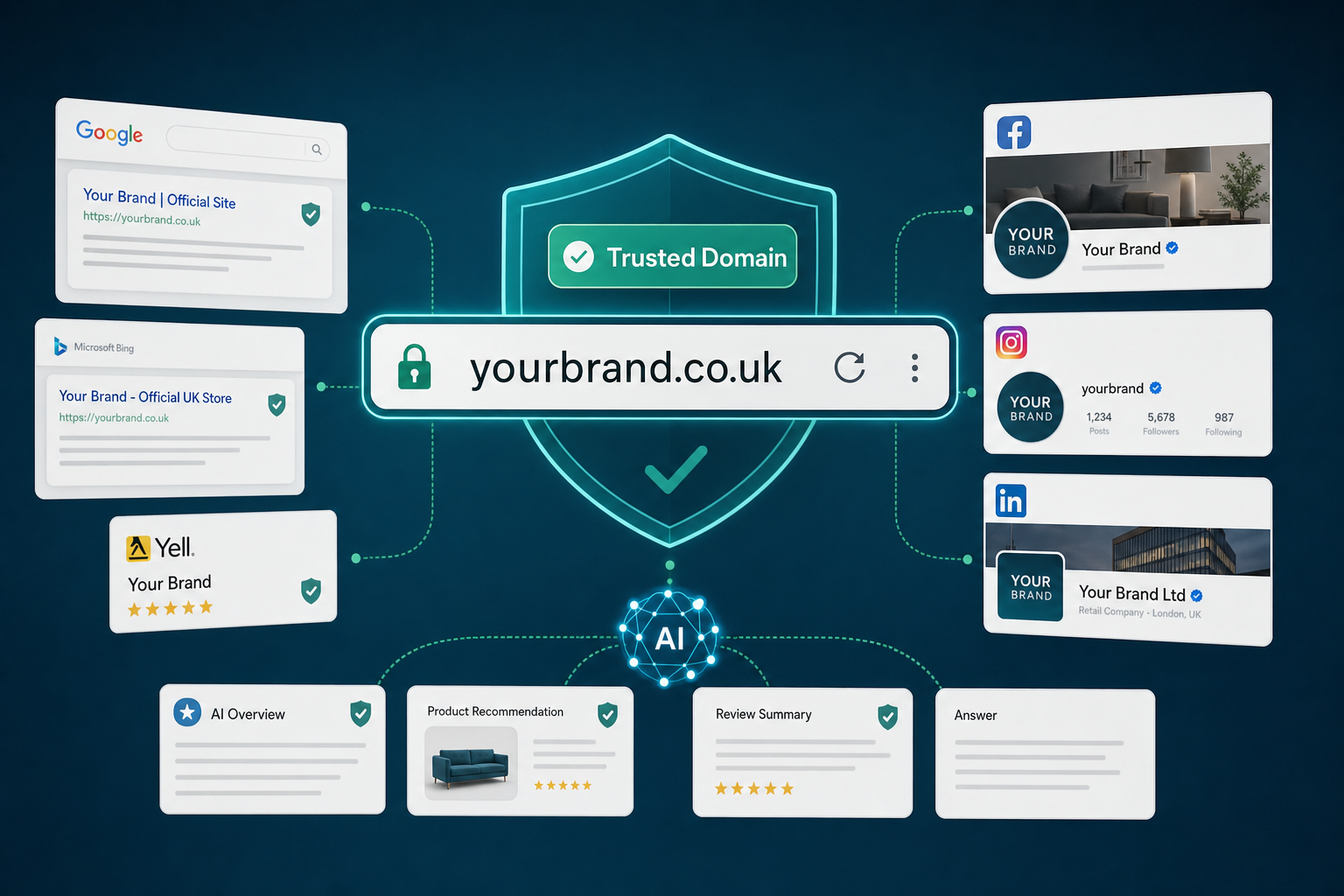
Choosing and registering a domain name can feel like a quick administrative task, but it has a lasting effect on your brand, search visibility, email, advertising and customer trust. For many UK businesses, the domain is the first thing a potential customer sees before visiting the website, reading a brochure, clicking a search result or typing an email address. A careful domain registration checklist helps you avoid awkward rebrands, confusing web addresses and technical problems that can slow down a website launch.
Whether you are planning a new website design, refreshing an existing brand or launching a new service, it is worth reviewing your domain strategy before any design or development work goes too far. A strong domain should be memorable, easy to spell, suitable for marketing and properly controlled by the business that depends on it.
Why your domain name matters before launch
Your domain name is more than a web address. It influences how customers remember you, how confidently they share your details and how easy it is for search engines to understand your website. A tidy, relevant domain can support a professional brand presence across search, social media and printed marketing.
For example, a local accountancy firm using a clear business name and a suitable UK-focused domain is likely to appear more established than one using a long, hyphenated or unclear address. A wedding venue, restaurant, building contractor or professional services firm may also rely on word-of-mouth recommendations, so the domain must be easy to say aloud and write down without confusion.
Domain decisions also affect your website design process. The final address may be used in page titles, email signatures, stationery, signage, photography briefs, advertising artwork and social media profiles. If the chosen domain changes late in the project, it can cause avoidable delays and extra checks across the wider digital marketing plan.
Domain registration checks before launching a website
Before registering a domain, work through the following checks. They are designed to help business owners make a sensible decision that supports branding, SEO and long-term control.
1. Check that the name is easy to spell and pronounce
A good domain should pass the radio test: if someone hears it spoken once, can they type it correctly? Avoid unusual spellings unless they are already central to your brand. Numbers, repeated letters and words that sound similar to other words can all create friction.
If your business name is commonly misspelt, consider whether you should also register a common variation and redirect it to the main website. This can help customers who type the address from memory and protect a small amount of branded traffic that might otherwise be lost.
2. Keep it short, but not vague
Shorter domains are often easier to remember, but clarity matters more than cleverness. A name that is too abbreviated may be difficult to understand, especially for a new business without established brand recognition. Aim for a balance between brevity and meaning.
For instance, a Bristol-based commercial cleaning company may choose a domain that includes its trading name rather than a string of initials. The best option is usually the one that can be printed on a van, read on a mobile screen and recalled after a conversation.
3. Choose the right extension for your audience
For many UK businesses, a UK-focused domain extension can reinforce location and trust. A widely recognised commercial extension may also be appropriate if you trade internationally or want a broader brand presence. The right choice depends on your audience, growth plans and availability.
If your customers are mainly in the UK, consider whether your domain clearly feels relevant to them. If you sell overseas, think about whether a more international option is needed as part of a broader plan. It is also sensible to check whether closely related extensions are available, as registering a small number of important variations can prevent confusion later.
4. Avoid unnecessary hyphens and awkward punctuation
Hyphens can sometimes make a domain more readable, but they often make it harder to explain and easier to mistype. A customer may forget the hyphen or place it in the wrong position. If the non-hyphenated version belongs to another organisation, the risk of lost traffic and brand confusion increases.
In most cases, a clean domain without hyphens is preferable. If the only available option is long, cluttered or difficult to say, it may be better to revisit the name rather than force an unsuitable registration.
5. Search for brand conflicts and lookalike names
Before registering, look beyond domain availability. Search for businesses with similar names, especially in your sector or region. A domain may be technically available but still create confusion if another business is already trading under a similar name.
This is particularly important if you plan to invest in SEO, paid search, printed materials, signage or social media marketing. A name that is too close to another brand can make it harder to build recognition and may create avoidable legal or reputational issues. If in doubt, seek appropriate professional advice before committing to a brand name.
6. Check social media handle availability
A strong domain should work alongside your social media presence. Before launch, check whether consistent profile names are available on the platforms most relevant to your audience. They do not need to be identical in every case, but they should be close enough to feel connected.
For a restaurant, venue, shop or consumer brand, consistent naming across social channels can make promotion much easier. For business-to-business organisations, consistency still matters because prospects may look you up after a networking event, referral or search result. If the domain, social handle and email address all feel aligned, the brand appears more credible.
7. Think about email from the start
Your domain will usually form part of your professional email addresses. Before choosing it, consider how addresses will look for directors, sales teams, customer service and general enquiries. A domain that is too long can make email addresses difficult to fit on business cards, adverts and mobile screens.
Professional email using your own domain is important for trust. It also helps create consistency between your website, proposals, invoices and ongoing customer communication. During the registration and website planning process, make sure email requirements are included so that launch work does not interrupt day-to-day communication.
8. Make sure the business controls the registration
One of the most important checks is ownership and access. The domain should be registered in a way that gives the business appropriate control. Keep accurate records of the registrant details, renewal date, account access and associated email address.
Problems often arise when a domain is registered using an old personal email address, a former employee’s details or an account that nobody can access. This can delay website launches, email changes, security updates and renewals. Store domain details securely with other essential business information, and review them whenever key staff or suppliers change.
9. Set a clear renewal process
Domain expiry can cause a website and email to stop working, which may lead to missed enquiries and reputational damage. Renewal reminders should go to a monitored business email address, not an individual inbox that may be abandoned later.
It is good practice to keep a simple register of digital assets, including domains, hosting, email services, analytics access, advertising accounts and social media profiles. This is especially useful for businesses with more than one website, multiple branches or separate campaign domains.
Technical checks before connecting the domain
Once the domain has been chosen and registered, there are several technical checks to complete before launch. These checks help protect search visibility, maintain security and ensure the website works reliably for visitors.
Plan the preferred version of the website address
Decide whether the main address will use the www version or the non-www version, then make sure the alternative redirects correctly. This avoids splitting traffic between duplicate versions of the same website. The decision itself is mostly a matter of preference, but consistency is important for SEO, analytics and printed marketing.
The same principle applies to secure and non-secure versions. A business website should use a secure connection, particularly if it includes contact forms, login areas, online payments or any other feature that collects personal information. Security indicators in browsers are increasingly visible to users, so this is also a trust consideration, not just a technical one.
Check redirects from old domains or old pages
If you are replacing an existing website, do not simply point the new domain at a new design and hope for the best. Existing pages may already have search visibility, inbound links, bookmarks and referral traffic. Plan redirects from important old URLs to the most relevant new pages.
This is especially important during a redesign. A new website can look excellent but still lose traffic if established pages disappear without a plan. Before launch, review the current site structure, identify valuable pages and map them carefully to the new website. This helps preserve search value and gives visitors a better experience.
Review domain history where possible
If you are registering a domain that has been used before, check its history. A previously used domain may have old links, outdated content associations or a reputation that does not fit your business. This does not automatically make it unsuitable, but it should be reviewed before you build a brand around it.
Look for signs of irrelevant past use, suspicious backlinks or content that could confuse search engines and users. A clean, relevant domain is usually preferable for a new business launch, particularly if you intend to invest in long-term SEO.
Prepare DNS changes carefully
Domain Name System settings control where your website, email and related services point. These records must be changed accurately. A small mistake can cause email delivery issues or prevent the website from loading.
Before launch, confirm who is responsible for DNS changes and when they will be made. If your website is going live at a specific time, allow for propagation and testing. Keep a record of existing settings before making changes, especially where the business relies heavily on email.
Branding, SEO and marketing considerations
A good domain supports wider digital marketing, but it does not replace a proper strategy. The domain should sit comfortably alongside your brand messaging, website content, search optimisation and social media activity.
Do not rely on keyword stuffing
It can be tempting to register a domain made entirely of search terms, such as a location plus a service. While this may describe what you do, it can also feel generic and limit future growth. Search engines consider many factors beyond the domain name, including content quality, technical structure, relevance, links and user experience.
A domain that includes a natural service or location reference can be useful, but it should not come at the expense of brand strength. For many businesses, a memorable brand-led domain supported by well-structured service pages is a better long-term approach.
Make the domain work in offline marketing
Your domain may appear on vans, signs, menus, leaflets, exhibition stands, uniforms and press adverts. It should be legible at a glance. Avoid tiny punctuation, confusing word breaks or wording that only makes sense when typed in lowercase.
Before registering, write the domain in different formats: uppercase, lowercase, on one line, in an email address and as part of a social profile. If it becomes confusing, consider whether a different option would be stronger.
Consider campaign domains carefully
Some businesses register separate domains for campaigns, events or product launches. This can be useful in specific cases, but it can also fragment marketing effort. If you use a campaign domain, make sure it is connected clearly to the main brand and has a plan for what happens after the campaign ends.
For long-term SEO, it is usually better to build authority on the main website rather than spreading content across multiple small sites. Campaign domains should be used with a clear purpose, not as a substitute for a well-organised main website.
Common mistakes to avoid
Many domain problems are preventable. The most common issues tend to come from rushing the decision or treating the domain as separate from the wider website project.
- Registering too late: If you have settled on a business name, check domain availability early before investing in design work or printed materials.
- Choosing a confusing spelling: Clever spellings can create constant explanation and missed traffic.
- Ignoring similar brands: A similar name in the same sector can cause confusion in search results and social media.
- Losing access details: Keep domain login and renewal information secure, current and accessible to the right people.
- Forgetting email: Website launch plans should include email continuity and professional domain-based addresses.
- Skipping redirects: Existing websites need a migration plan to protect useful search visibility and user journeys.
- Using too many domains: Multiple domains without a clear strategy can dilute marketing effort and create maintenance problems.
Final checks before your website goes live
In the final days before launch, review the domain in the same way a customer will experience it. Type it manually into a browser. Read it aloud. Check it on mobile. Test the secure version. Send and receive email from domain-based addresses. Confirm that old addresses redirect correctly, if applicable.
It is also worth checking how the domain appears in search snippets, social profile descriptions, email signatures and printed proofs. Small inconsistencies can weaken an otherwise polished launch. A professional website design project should bring these details together so that the domain, content, design and marketing channels all feel joined up.
A considered domain registration checklist reduces risk and gives your new website a stronger foundation. By choosing a clear name, protecting access, planning the technical setup and aligning the domain with your wider marketing strategy, your business can launch with more confidence and fewer avoidable complications.