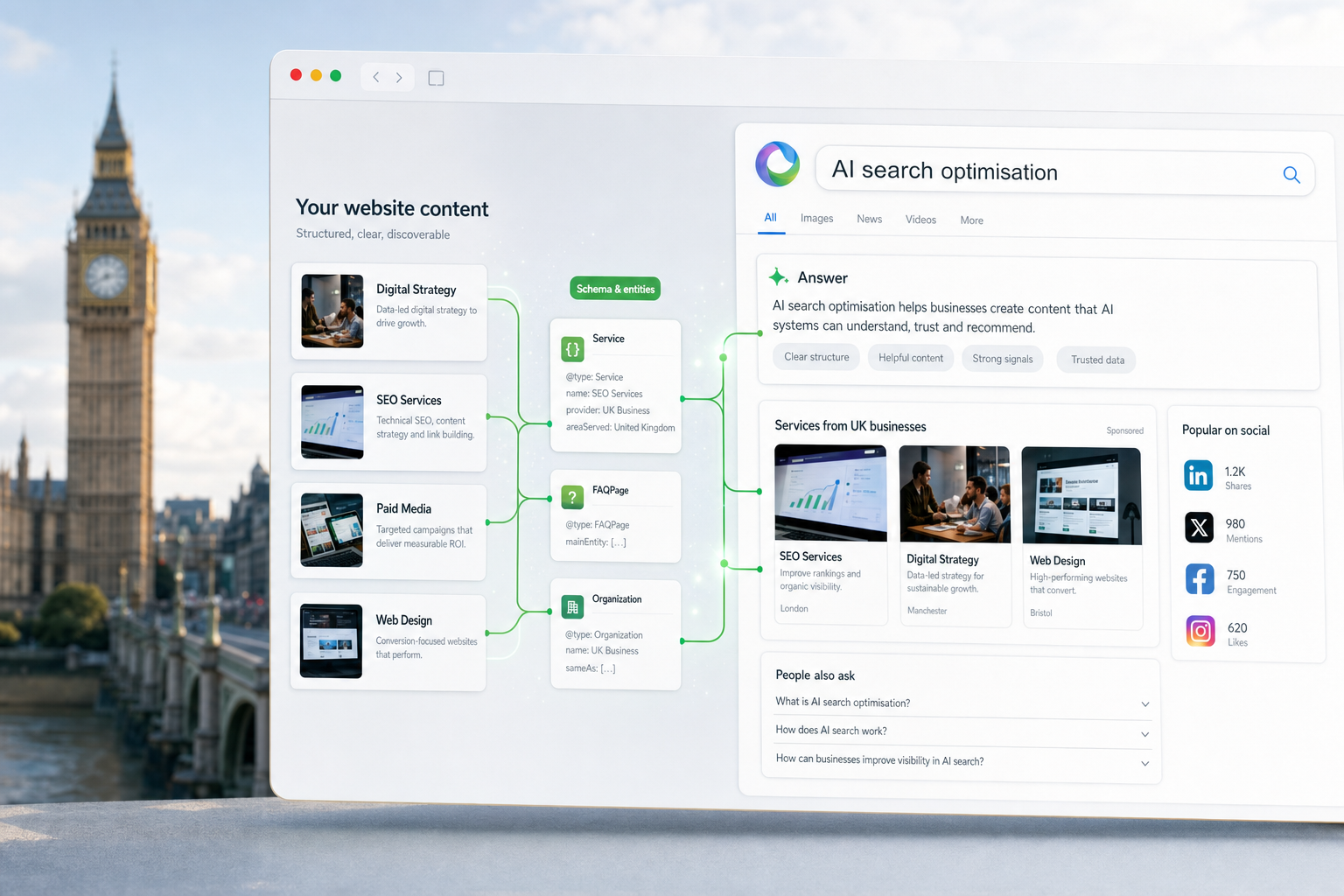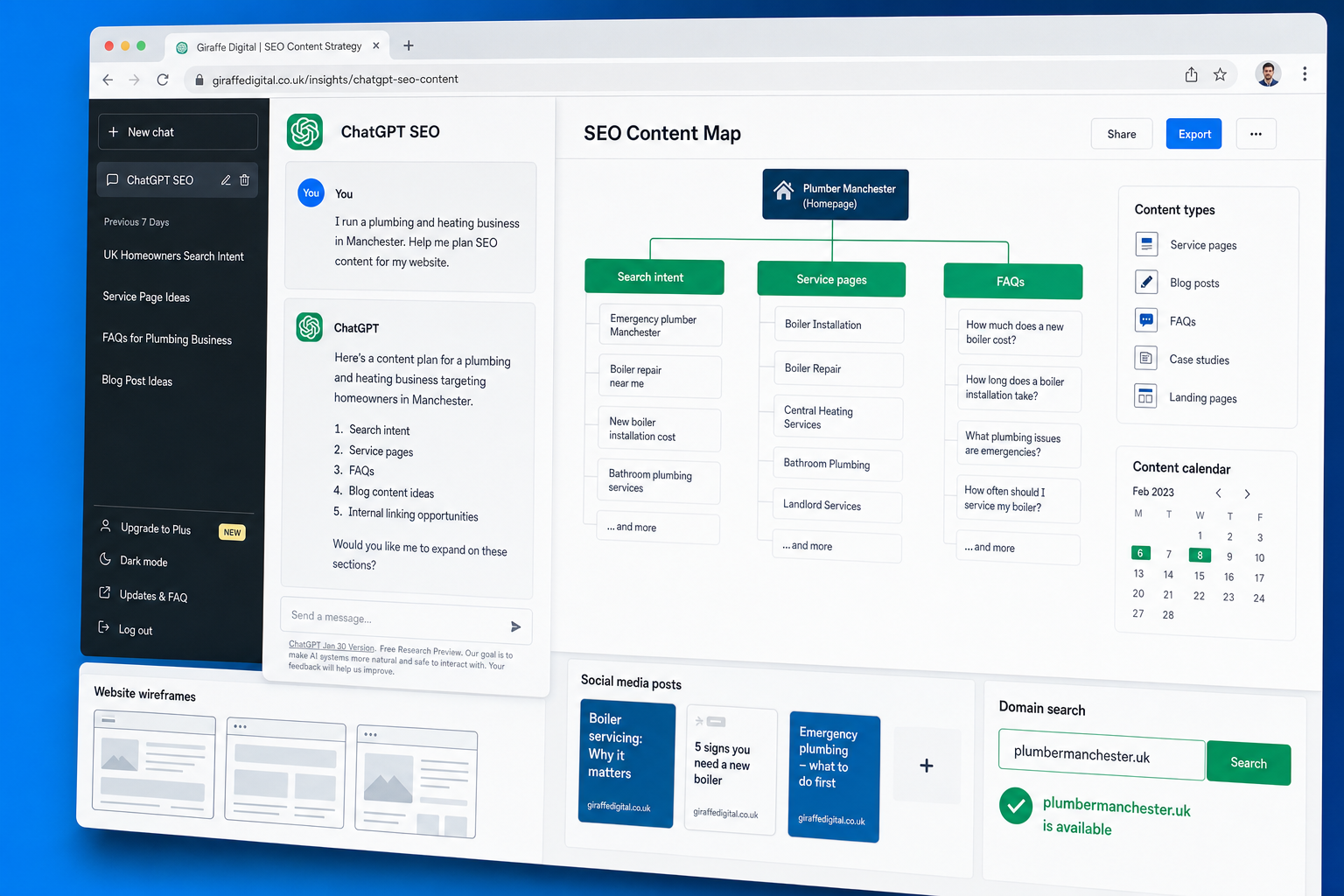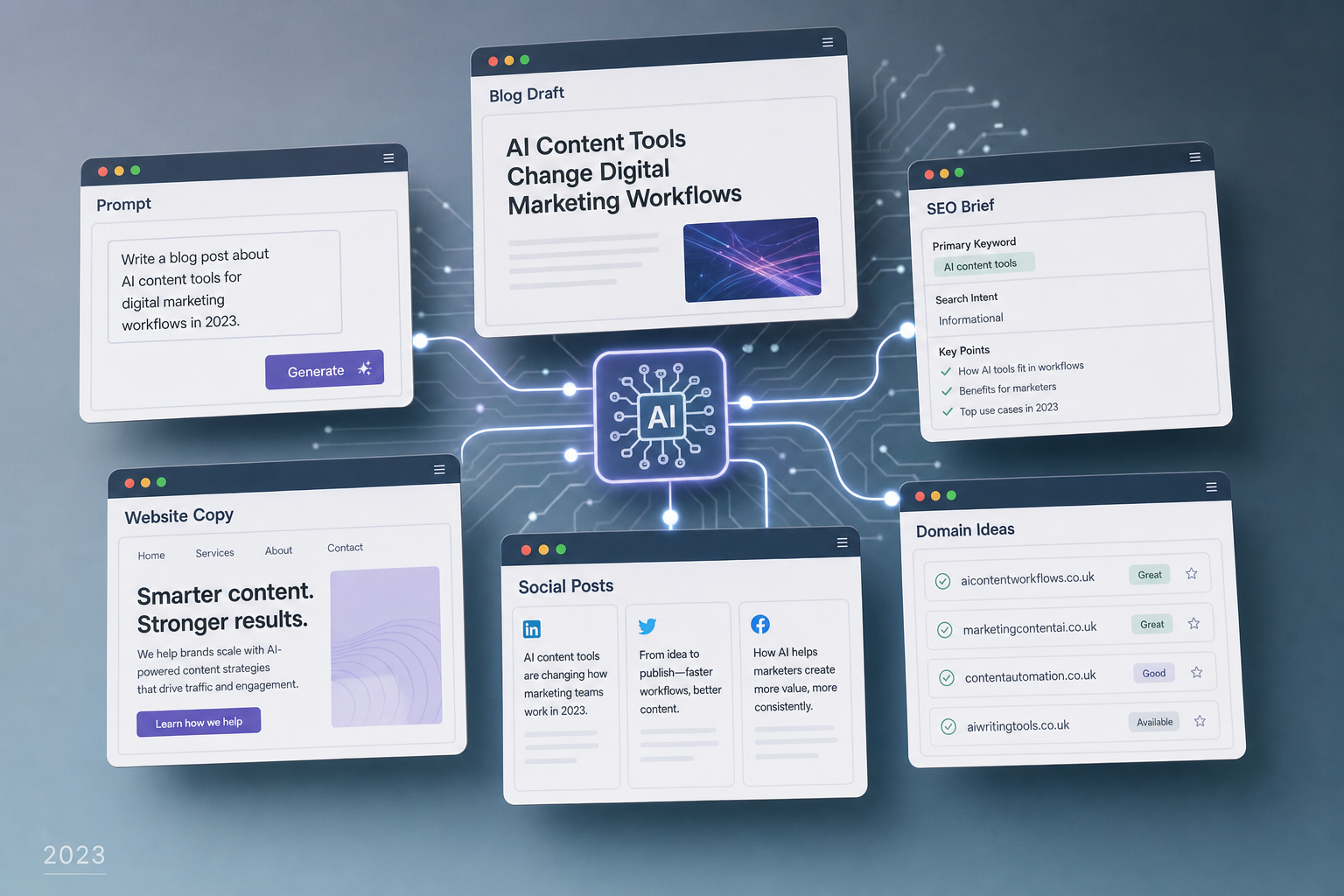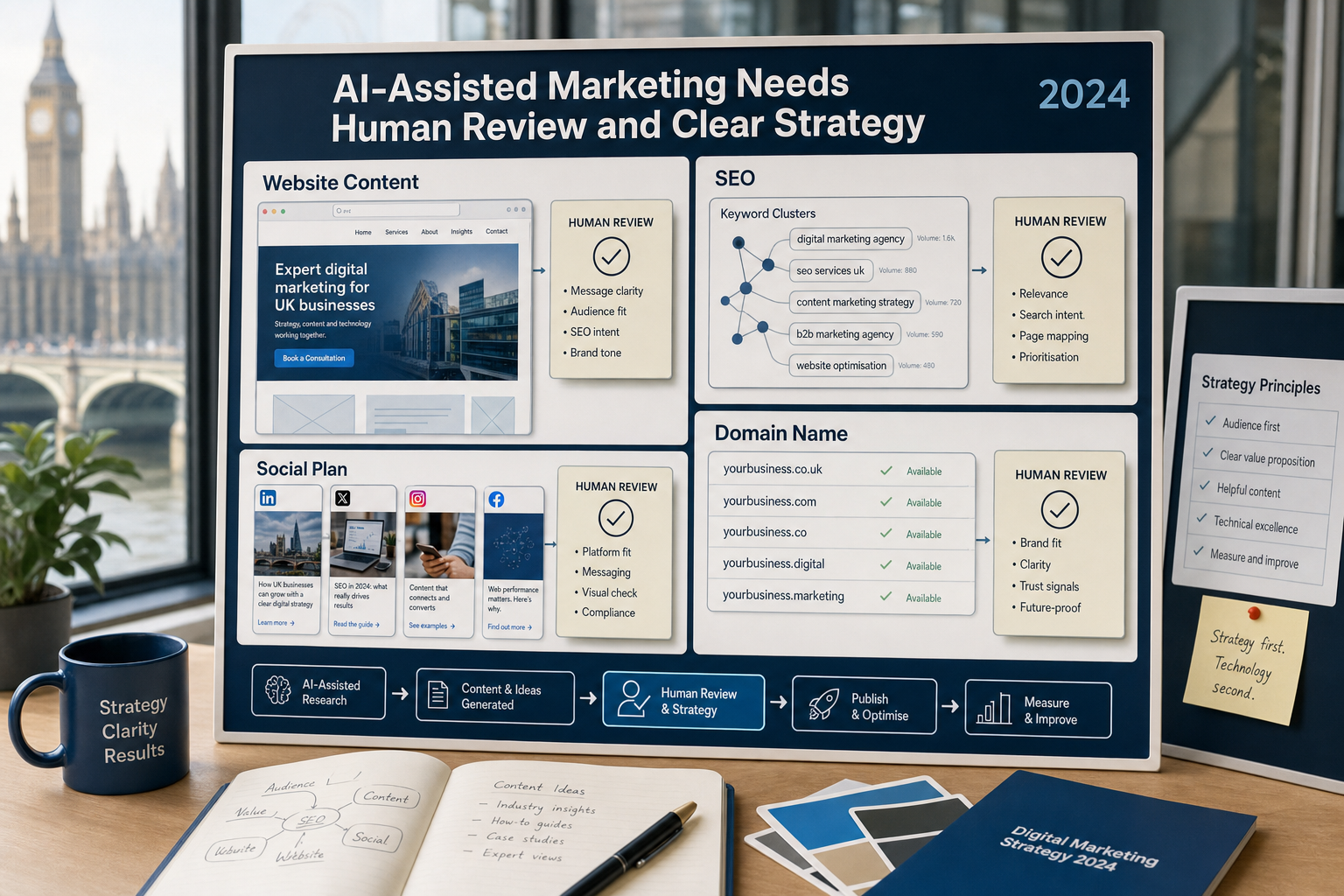
AI can now help businesses draft content, plan campaigns, summarise research, organise ideas and speed up routine marketing tasks. Used well, it can support better decision-making and free up time for work that needs judgement, creativity and customer understanding. Used without care, it can produce bland copy, incorrect claims, inconsistent branding and content that does not match what customers actually need. For UK business owners, the opportunity is not simply to use AI more often. The real advantage comes from building an AI marketing strategy that combines useful automation with clear goals, human review and a well-planned digital presence.
AI is a useful assistant, not a marketing strategy on its own
AI tools are particularly good at accelerating early-stage work. They can help create content outlines, suggest blog topics, rework social captions, compare audience segments, draft email structures and turn notes into clearer paragraphs. This can be valuable for small and medium-sized businesses where marketing time is often limited.
However, the tool does not know your customers, your sales process, your tone of voice or your commercial priorities unless these are clearly supplied and checked. It may produce content that sounds confident but lacks accuracy. It may also make assumptions about services, locations, credentials or availability. That is why AI should sit inside a wider marketing process, rather than replacing one.
A strong AI marketing strategy starts with the same fundamentals as any good digital strategy: who you want to reach, what problems they are trying to solve, why your business is a credible choice and what action you want visitors to take next. Once these points are clear, AI can help you work faster while your team keeps control of quality, accuracy and brand reputation.
Start with business goals before choosing tools
It is easy to begin with a tool and then look for a reason to use it. A better approach is to decide what business outcome you need first. A local professional services firm may want more qualified enquiries from its website. An e-commerce brand may want clearer product content and more consistent email campaigns. A hospitality business may need to improve visibility for local searches and keep social channels active during seasonal periods.
Before using AI in marketing, define a small number of measurable priorities. These might include increasing relevant organic search traffic, improving enquiry quality, reducing the time spent drafting first versions of content, creating more consistent brand messaging, or supporting internal teams with clearer campaign planning.
Once the goal is clear, AI can be used with more purpose. For example, if your website does not explain your services clearly, AI might help turn sales notes into page outlines. If your social media activity is inconsistent, AI could support a monthly content plan. If your blog has no structure, AI might help group topics into useful themes. The important point is that the tool supports a defined marketing need rather than creating content for its own sake.
Human review protects quality, accuracy and trust
Human review is essential because marketing content has to do more than fill space. It must represent your business accurately, answer real customer questions and support trust. AI-generated material can be fluent while still being wrong, vague or unsuitable for your market.
Every AI-assisted asset should be checked by someone who understands the business. That review should cover factual accuracy, compliance with any sector expectations, brand tone, customer relevance, originality and whether the content makes a useful next step clear. If a page, advert or social post mentions a service, guarantee, qualification, location or timescale, those details should be verified before publication.
For regulated, technical or advisory sectors, human review becomes even more important. Businesses offering financial, legal, medical, property, recruitment, training or specialist consultancy services should be especially careful with claims. AI can help structure information, but it should not be treated as an authority. The final responsibility sits with the business publishing the content.
AI can produce a first draft quickly, but a first draft is not a finished marketing asset. The review stage is where accuracy, usefulness and brand value are added.
Build better prompts from real business knowledge
The quality of AI output depends heavily on the information given to it. A vague request, such as asking for a blog post about a service, usually produces generic content. Better prompts include the audience, location, tone, customer concerns, service details, desired outcome and any points to avoid.
For example, a better prompt might explain that the business serves UK homeowners, wants a reassuring but practical tone, needs to avoid exaggerated claims and wants the content to encourage visitors to book a consultation. The AI can then create a more relevant structure, which can be edited by a person who knows the business.
Useful source material for prompts might include existing website copy, customer questions, sales call notes, brochures, service descriptions, reviews, internal guidance, brand guidelines and frequently asked questions. This helps AI reflect real business knowledge rather than inventing a generic version of your company.
It is also worth keeping a simple prompt library. This might include separate prompts for blog outlines, service page drafts, social media captions, email newsletters, advert variations and content audits. Over time, your team can improve these prompts based on what produces useful results.
Use AI to support website design and content planning
Website design is not only about how a site looks. It also involves structure, messaging, usability, navigation, content quality and how easily visitors can take action. AI can support this planning stage by helping organise information and identify gaps.
For a new website or redesign, AI can help create a first version of a sitemap based on your services, audiences and locations. It can also help draft page outlines that show what each page should cover, such as key benefits, process, FAQs, trust signals and calls to action. This can be useful before designers and developers begin visual work because it gives the project a clearer content foundation.
AI can also help compare different user journeys. For example, a business might ask how a first-time visitor, returning customer and procurement manager would each navigate the site. These outputs should not replace proper user research, analytics or professional judgement, but they can help teams think more clearly about visitor needs.
When AI is used for website copy, the editing stage should focus on clarity. Many AI drafts contain too many broad statements about being reliable, innovative or customer-focused. Stronger website content explains what you do, who it is for, what makes the service suitable and what the visitor should do next. A helpful service page should reduce uncertainty, not simply sound polished.
Keep SEO focused on usefulness, not volume
AI makes it easier to create large amounts of content, but publishing more pages does not automatically improve search performance. Search marketing still depends on relevance, quality, technical accessibility and whether the content genuinely helps the person searching.
For SEO in January 2024, businesses should be cautious about using AI to mass-produce near-identical articles or location pages. Content that is thin, repetitive or written mainly to target keywords is unlikely to build lasting value. A better approach is to use AI for research support, outline development, content clustering and improving drafts, then rely on human expertise to add practical detail.
An effective AI marketing strategy for SEO might include identifying common customer questions, grouping them into topic areas, mapping those topics to service pages and articles, and improving existing pages before creating new ones. AI can help spot missing sections, suggest internal linking opportunities and turn technical explanations into clearer language.
Human input should add examples, experience and commercial context. For instance, an AI draft about choosing a website platform may list general considerations, but your team can add what UK business owners should think about, such as ease of updating content, support requirements, accessibility, hosting reliability, enquiry tracking and future growth. This is the difference between generic content and content that helps a real buyer make a better decision.
Apply AI carefully to social media marketing
Social media is often where businesses first notice the time-saving potential of AI. It can suggest post ideas, turn a blog article into several shorter updates, adapt messages for different channels and create campaign calendars. This is useful, especially when teams struggle to post consistently.
However, social media content needs a clear point of view. If every caption sounds like a generic motivational post, it will not help your brand stand out. AI can create structure, but people should add opinion, relevance and timing. A business owner, marketing manager or agency partner should decide whether a post is genuinely useful for the audience.
For LinkedIn, AI can help turn expertise into clearer commentary, but posts should still sound like the people behind the business. For Facebook and Instagram, it can help plan seasonal themes, event reminders, product explanations and customer education. For short-form video, AI can help draft scripts and shot lists, but the best ideas still come from understanding the audience and the platform.
A simple review checklist helps maintain quality. Ask whether the post says something specific, whether the call to action is appropriate, whether the tone matches the brand, whether any claims are accurate and whether the content fits the platform. If the answer is no, edit before publishing.
Brand consistency matters more when content is easier to create
When content creation becomes faster, brand discipline becomes more important. Without guidance, AI-assisted marketing can quickly drift into mixed tones, inconsistent terminology and messages that do not reflect the business.
A practical brand guide does not need to be complicated. It should include your positioning, target audiences, preferred tone of voice, words you use, words you avoid, key service descriptions, proof points and visual principles. This can then be used to brief people and AI tools more effectively.
For example, a premium consultancy may want calm, precise language and avoid overexcited claims. A family-run retail business may prefer warm, straightforward language. A technology provider may need to balance technical accuracy with accessible explanations. If these choices are written down, AI can be directed more reliably and human reviewers have clearer standards to check against.
Domain names, registrations and online identity
AI can help brainstorm domain name ideas, but domain selection should still be handled with care. Your domain is part of your brand identity and often appears in search results, email addresses, printed materials and word-of-mouth recommendations.
When considering a domain, choose something clear, memorable and appropriate for your market. Avoid spellings that are difficult to explain over the phone, unnecessary hyphens and names that could be confused with another organisation. For UK-facing businesses, it may be sensible to consider a domain extension that customers recognise and trust, alongside any broader plans for trading outside the UK.
Before registering a domain, check whether the name aligns with your company name, branding, trade marks and social media handles. It is also wise to think about future services or locations. A very narrow domain can be limiting if the business expands, while a very broad one may be less memorable.
AI can create lists of possibilities, but it cannot make the final judgement about brand risk, customer perception or long-term suitability. Treat its suggestions as a starting point and review them through a business, legal and marketing lens before making a decision.
Data privacy and responsible use
Businesses should be careful about what information they put into AI tools. Customer records, private commercial details, employee information, unpublished financial data and confidential documents should not be used casually. If your team uses AI, create internal guidance on what can and cannot be entered into tools.
Responsible use also includes being clear about review and approval. Decide who can create AI-assisted content, who checks it and who signs it off. This is particularly important when content is published on the website, sent to customers or used in advertising.
It is also worth considering copyright and originality. AI can help generate ideas and drafts, but businesses should avoid copying distinctive wording from competitors or relying on outputs that may be too close to existing material. Human editing, original examples and business-specific insight make content more valuable and reduce risk.
A practical workflow for AI-assisted marketing
For many businesses, the best starting point is a simple workflow rather than a complex transformation programme. The following process can help keep AI useful and controlled:
- Set the objective: decide whether the task supports SEO, enquiries, brand awareness, customer education, retention or campaign planning.
- Provide a clear brief: include audience, tone, service details, location, desired action and any restrictions.
- Generate a first draft: use AI to create an outline, ideas or draft content rather than expecting a finished result.
- Review for accuracy: check facts, claims, service details, terminology and compliance considerations.
- Edit for brand and usefulness: add examples, remove generic wording and make the content more helpful.
- Optimise for the channel: adapt the content for website pages, SEO, email, social media or adverts.
- Measure performance: review engagement, enquiries, rankings, conversions or feedback, then improve the process.
This approach keeps people in control while still benefiting from the speed and structure AI can provide. It also helps teams avoid publishing content simply because it is easy to produce.
Where professional digital strategy still adds value
AI can support marketing delivery, but it does not replace strategic judgement. A professional digital strategy considers your brand, website, search visibility, user experience, content, analytics, technical performance and commercial goals together. This joined-up view is where many businesses find the most value.
For example, AI might suggest more blog content, but an audit may show that the service pages need clearer calls to action first. It might generate social media ideas, but the website may not be ready to convert visitors. It might produce keyword suggestions, but technical SEO issues may be limiting performance. A strategic review helps decide what to prioritise.
Good marketing is not about using every available tool. It is about choosing the right actions in the right order. For some businesses, that may mean improving website structure and page content. For others, it may mean refining brand messaging, setting up clearer reporting, improving local SEO, or creating a more manageable social media plan.
AI works best when people lead the process
AI-assisted marketing is most valuable when it is guided by clear strategy and reviewed by people who understand the business. It can save time, improve planning and help teams move from a blank page to a workable draft more quickly. It can also support website design, SEO, social media and content production when used responsibly.
The businesses that benefit most will not be those that publish the most AI-generated content. They will be the ones that use AI to strengthen their thinking, improve consistency and support better customer communication. With a clear AI marketing strategy, human review and a focus on practical business value, AI becomes a useful part of a stronger digital marketing system rather than a shortcut that creates more noise.