LinkedIn is no longer just an online address book for recruiters and job seekers. For many UK businesses, it is becoming a practical way to strengthen professional credibility, build referral relationships, support search visibility and give potential customers another reason to trust the people behind a company. Used properly, LinkedIn marketing can sit comfortably alongside a well-designed website, sensible search engine optimisation and a broader social media strategy.
The important point is that LinkedIn should not be treated as a place to collect contacts. A large network is of little value if your profile is unfinished, your company presence is weak, and your activity gives no clear indication of what you do. The businesses that gain the most from LinkedIn are those that approach it as a professional communications channel: clear positioning, useful content, relevant conversations and consistent follow-up.
Start with a clear purpose
Before adjusting profiles or joining groups, decide what LinkedIn should achieve for your organisation. Different businesses will use it in different ways. A professional services firm may want to build trust with managing directors and finance directors. A web design company may use it to share examples of digital thinking and connect with marketing managers. A manufacturer may use it to maintain relationships with distributors, suppliers and trade contacts.
Common objectives include generating introductions, improving personal credibility, supporting recruitment, keeping in touch with existing customers, promoting events, and helping prospects understand the business's expertise. It is usually unhelpful to set a vague goal such as "get more followers" or "be more social". Instead, think in terms of valuable relationships and commercial outcomes.
For example, a local accountancy practice might use LinkedIn to connect with business owners met at networking events, answer questions in relevant groups and link back to helpful guidance on its own website. A business-to-business supplier might use it to keep key contacts informed when a new brochure, case study or technical article is published. In both cases, the platform supports the broader marketing activity rather than replacing it.
Improve personal profiles before promoting the business
LinkedIn is built around individuals, so the personal profiles of directors, sales staff, consultants and senior team members are often more visible than the company page itself. If those profiles are incomplete or unclear, the business loses an opportunity to make a strong first impression.
A good profile should explain who the person helps, what they specialise in and how their experience relates to the needs of potential customers. Avoid filling the summary with internal jargon or vague claims. A visitor should be able to understand quickly whether the person is relevant to them.
Pay particular attention to the headline, summary and experience sections. The headline does not have to be limited to a job title. A more descriptive line, such as "Helping UK retailers improve ecommerce website performance" or "Commercial solicitor advising owner-managed businesses", is often more useful than simply "Director". Use natural language and include relevant keywords, but do not keyword-stuff the profile. People read these pages, and search engines may also index them, so clarity matters.
Recommendations are also valuable, provided they are genuine and specific. A short recommendation from a client, supplier or colleague can help demonstrate trust. It is better to have a small number of credible recommendations than a collection of generic comments that say very little.
Create and maintain a useful company presence
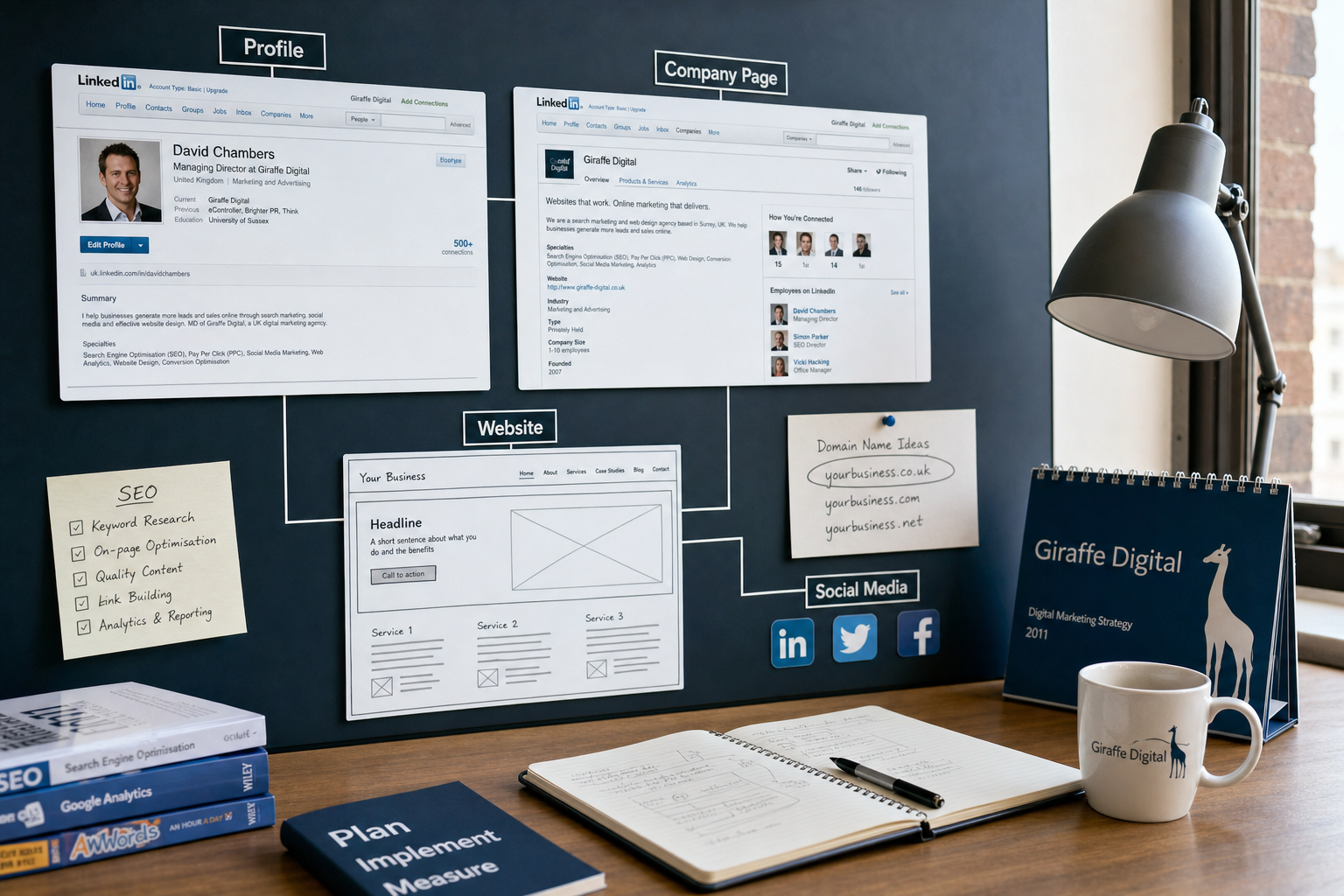
LinkedIn Company Pages give businesses a place to present an overview of their organisation. They should not be left as a bare listing. At minimum, make sure the company description, sector, location and website address are correct. The wording should be consistent with the language used on your website and other marketing material.
The company description should explain what the business does, who it serves and why it is different. Try to avoid broad statements that could apply to any competitor. A visitor should leave with a clear understanding of your service area, your audience and your tone of voice.
Where suitable, use the Products and Services area to describe key offerings. For a digital agency, this might include website design, search engine optimisation, pay-per-click advertising, domain registration support, email marketing, or social media marketing. For a consultancy, it may include advisory services, training programmes or retained support. Keep the descriptions concise and useful, and link them to appropriate pages on your own website where visitors can find more detail.
This connection between LinkedIn and your website is important. LinkedIn can introduce your business, but your website should remain the main hub for enquiries, detailed information, contact forms, resources and conversion. If your website looks dated, is difficult to navigate or does not clearly explain your services, the traffic you earn from LinkedIn may not turn into worthwhile enquiries.
Use LinkedIn Groups with care
Groups are one ofLinkedIn'ss most useful features for business marketing, particularly in specialist or regional markets. They allow professionals with shared interests to discuss problems, ask questions and share resources. However, they are not places for repeated sales messages.
Choose groups that are relevant to your market rather than joining as many as possible. A business owner in Bristol may benefit from regional business groups, sector-specific groups and groups connected to trade bodies or professional interests. Once inside, spend some time observing the tone of discussion before posting.
The best contributions are usually practical and informed. Answer questions, share a considered opinion, point people towards genuinely useful resources and ask intelligent questions of your own. If you have written a helpful article on your website, it may be appropriate to share it in a group, but introduce it by explaining why it is useful. Simply dropping links into discussions is unlikely to build trust.
LinkedIn Answers can also be useful for demonstrating knowledge. By responding to questions in your field, you can show expertise without immediately asking for business. The same principle applies: be helpful first. A clear, thoughtful answer may encourage someone to view your profile, visit your website or connect with you directly.
Build connections strategically rather than randomly
There is a temptation to measure success by the number of connections. While a larger network can increase visibility, relevance is more important. A carefully built network of customers, prospects, suppliers, referrers and industry contacts is more valuable than a long list of people who have no genuine connection to your business.
After meeting someone at an event, receiving an enquiry or speaking to a potential partner, send a personalised invitation. Mention where you met or why you would like to connect. This is more professional than sending the standard invitation without context, particularly when the person may not immediately recognise your name.
It is also worth reviewing your existing address book and customer list, provided this is done sensibly and in line with your communication preferences. Connecting with existing customers can help keep your business visible between projects or purchases. However, do not treat a connection as permission to send constant promotional messages. LinkedIn messages should be used thoughtfully and personally.
Connect LinkedIn activity with your website and SEO
LinkedIn marketing works best when it supports your wider digital presence. Your website should contain useful pages that clearly explain your service, answer common questions, and give visitors a reason to contact you. LinkedIn can then be used to highlight this material and direct the right people towards it.
For search engine optimisation, the priority remains a technically sound website with well-written content, clear page titles, sensible navigation and relevant inbound links. LinkedIn should not be seen as a shortcut around that work. It can, however, help distribute your content, increase brand exposure and encourage conversations that lead to mentions, links and enquiries.
If you publish articles, guides, or news updates on your website, add a LinkedIn share button where appropriate so readers can share them with their professional network. This is especially useful for business-to-business content, such as buying guides, legislation updates, opinion pieces, event announcements and technical explanations. Make sure each article has a clear title and description, as these elements influence how appealing the shared link appears.
It is also sensible to link from your website to the LinkedIn profiles of key people and to your company page where this supports credibility. For example, a consultancy might include links to LinkedIn profiles on team pages. A recruitment business might use LinkedIn to demonstrate consultant expertise. A design agency might use it to show the professional background of its senior staff.
Keep branding consistent across channels
Potential customers may encounter your business through a Google search, a LinkedIn profile, a recommendation, an email signature, a printed brochure or a networking event. If each touchpoint presents the company differently, it can create confusion. Consistency in name, tone, description and identity helps people recognise and remember you.
Check that your business name is written consistently across LinkedIn, your website and other social media profiles. Make sure your logo is clear and not distorted. Use the same core description of your services, adapted to suit each channel. This is particularly important for businesses that have recently changed direction, launched a new website or refreshed their brand.
Domain registration also warrants consideration when planning digital branding. Choose a domain name that is easy to say, easy to spell and suitable for your market. For many UK businesses, a UK-focused domain can help reinforce location and trust. In contrast, an additional broader domain may be useful if you trade internationally or want to protect your brand. Avoid over-complicated names, excessive hyphens or wording that restricts the business if your services may expand. Once the right domain is secured, use it consistently for your website and professional email addresses.
Use advertising and promotion carefully
LinkedIn offers advertising options that may be suitable for some business-to-business campaigns. The attraction is the ability to target professional audiences by factors such as sector, role or location. This can be useful for promoting events, white papers, recruitment opportunities or specialist services.
As with any paid advertising, the message and landing page matter. Sending visitors to a generic home page is rarely the best option. If you are promoting a seminar, send them to a page about that seminar. If you are promoting a guide, send them to a page where the guide is clearly introduced and easy to request. Good website design has a direct impact on whether paid traffic becomes an enquiry.
Paid promotion should also be measured. Track the number of enquiries, sign-ups or meaningful actions generated, not just clicks. If a campaign attracts visitors but yields no useful responses, adjust the audience, message, or landing page before spending more effort on it.
Measure the right things
LinkedIn activity can be difficult to judge if you only look at connection numbers. A better approach is to review a mixture of practical indicators. Are more relevant people viewing your profile? Are you receiving enquiries from professional contacts? Are group discussions leading to conversations? Is LinkedIn sending visitors to your website? Are those visitors reading useful pages or contacting you?
Website analytics can help show whether LinkedIn is referring traffic and what that traffic does once it arrives. It is also worth asking new enquiries how they found you, as the route may involve several steps. A person might first see your comment in a LinkedIn group, then search for your company name, and finally complete the contact form on your website. Without asking, that influence may be missed.
Set a simple monthly routine. Review profiles, update company information, check group activity, review website referral traffic, and note any enquiries that began on LinkedIn. This keeps the activity focused and prevents it from becoming either neglected or time-consuming.
A practical weekly approach
For most small and medium-sized businesses, LinkedIn does not need to take hours each day. A regular, disciplined approach is usually more effective than occasional bursts of activity. Consider the following weekly routine:
- Accept or decline connection requests thoughtfully, and send personalised invitations to relevant new contacts.
- Spend a short period contributing to one or two important groups.
- Share one useful item, such as a website article, event notice, guide or industry observation.
- Review profile views and follow up where there is a genuine reason to do so.
- Check that any new website content is easy to share and clearly linked to your services.
This kind of routine keeps the business visible without turning LinkedIn into a distraction. Consistency. A consistently updated profile is unlikely to deliver much value, whereas a steady presence can gradually build recognition and trust.
LinkedIn works best as part of a wider digital strategy
LinkedIn marketing can be highly useful for professional visibility, relationship building and business-to-business communication. Its greatest value comes when it is connected to a clear website, credible branding, strong content and sensible search marketing. The platform can open doors, but your wider digital presence must give people confidence once they walk through them.
For UK business owners, the practical starting point is simple: make sure your personal profiles are professional, your company page is accurate, your website is ready to receive visitors and your activity is genuinely helpful. From there, LinkedIn can become a valuable part of your online marketing rather than just another profile to maintain.