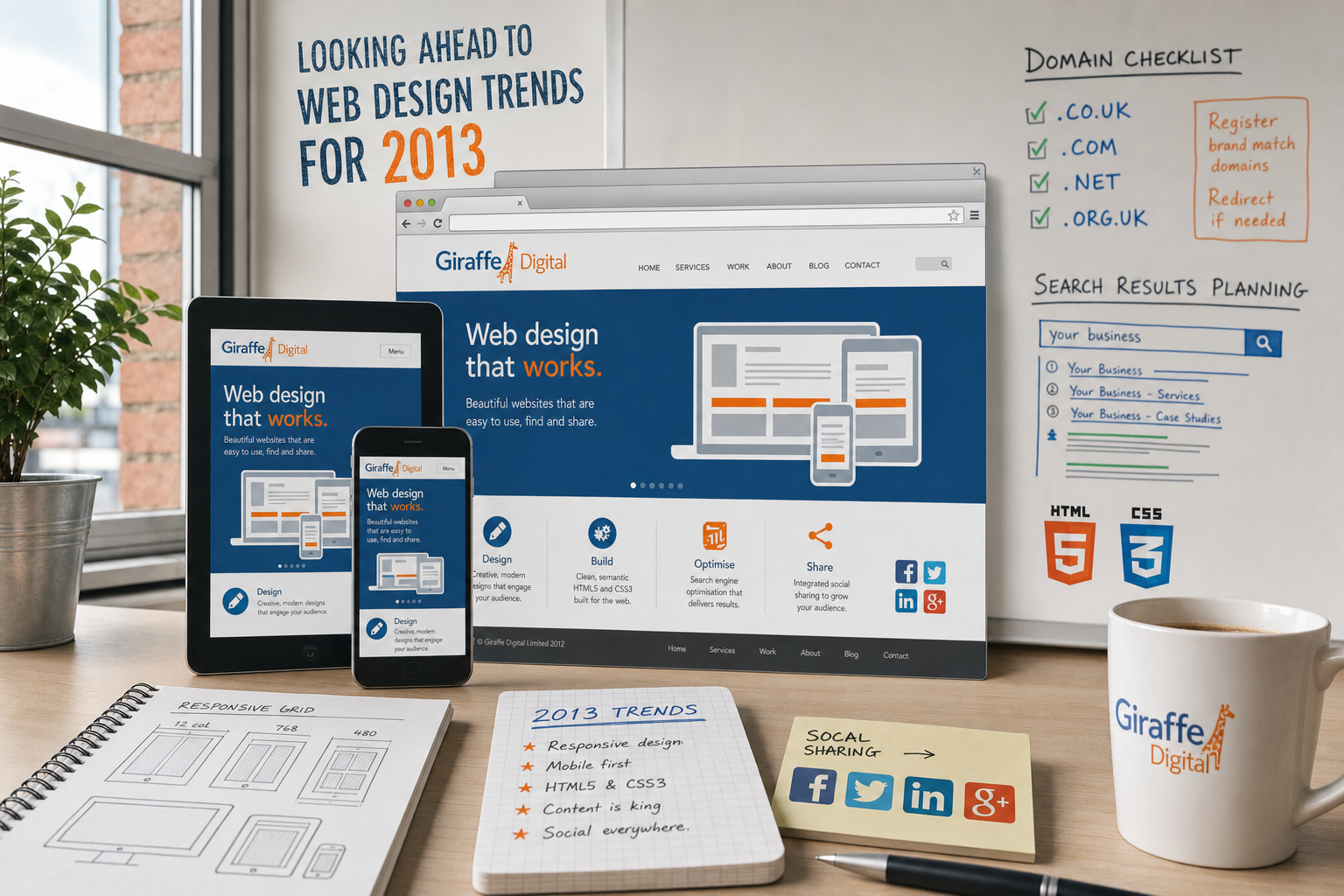
As 2013 approaches, many UK businesses are reviewing whether their websites still reflect the way customers search, browse, compare and enquire online. Looking Ahead to Web Design Trends for 2013 is not simply about making a site look more fashionable. It is about improving usability, helping people find information quickly, supporting search visibility and making every online interaction feel consistent with the organisation behind it.
For business owners, the question is not whether a website should be redesigned just because a new year is beginning. The better question is whether the current site is still doing its job. Does it work well on smartphones and tablets? Is the message clear within a few seconds? Can visitors contact you easily? Does the design support search engine optimisation, social media marketing and lead generation? A good website in 2013 should be a practical business asset, not just an online brochure.
Responsive design will move from desirable to expected
One of the clearest web design trends for 2013 will be the continued rise of responsive website design. More people are using smartphones and tablets to look up services, compare local suppliers, read reviews and make enquiries. A site that only works properly on a desktop monitor can feel awkward on a smaller screen, particularly when text is too small, buttons are difficult to tap or navigation menus are crowded.
Responsive design allows a website layout to adapt to different screen sizes. Rather than building entirely separate desktop and mobile sites, a responsive approach uses flexible grids, scalable images and CSS media queries to present content more appropriately across devices. For many businesses, this can provide a more consistent experience and make ongoing website management more efficient.
The business value is straightforward. If a potential customer finds your site on a phone while travelling, on a tablet at home or on a desktop computer at work, the experience should still feel professional. Contact details should be visible, calls to action should be easy to use and the most important content should not be hidden beneath unnecessary clutter.
Cleaner layouts and clearer content hierarchy
Overly busy websites are becoming less effective. Visitors rarely arrive with unlimited patience. They want to understand who you are, what you offer and why they should choose you. In 2013, expect to see more emphasis on cleaner layouts, stronger spacing, simpler navigation and clearer page structures.
This does not mean every website should look plain. It means design decisions should support the visitor journey. A professional services firm may need a calm, credible layout with a strong case for trust. A retailer may need clear product categories, strong photography and simple purchase routes. A local trades business may need location information, telephone numbers and enquiry options to be immediately visible.
Good visual hierarchy helps users make decisions. Important headings, introductory copy, images, buttons and supporting information should be arranged in a way that naturally guides the eye. Businesses should avoid filling every available space with banners, badges and competing messages. A focused page is usually more persuasive than a crowded one.
Content strategy will become central to website design
Search engines and customers both reward useful content. The days of treating copy as an afterthought are fading. A new website should be planned around the information people need at each stage of the buying process. This includes service descriptions, frequently asked questions, advice articles, product information, location pages and clear contact details.
For search marketing, content needs to be relevant, well written and organised logically. Following the impact of recent search quality updates, businesses should be cautious about thin pages, duplicated wording and unnatural keyword repetition. The primary aim should be to answer genuine customer questions in a clear and trustworthy way.
A useful content plan for 2013 might include a well-structured services section, a regularly updated blog or news area, customer guidance pages and concise landing pages for important locations or sectors. This can help search engines understand the site while also giving visitors more reasons to stay, share and enquire.
Designing for trust and credibility
Trust has always mattered, but it is becoming increasingly important as customers compare several businesses before making contact. A modern website should make it easy for visitors to judge whether an organisation is reliable, established and suitable for their needs.
Trust signals can include clear company information, named team members where appropriate, professional photography, accreditations, trade memberships, testimonials, portfolio examples, press mentions and transparent contact details. These should be presented honestly and naturally, not forced into every page.
Design also affects credibility. Poor alignment, inconsistent typography, broken links, low-quality images and outdated layouts can make a business appear less professional than it really is. In 2013, many visitors will form an opinion before they have spoken to you. Your website needs to support that first impression.
HTML5, CSS3 and richer visual experiences
HTML5 and CSS3 are giving designers and developers more ways to create attractive, flexible websites without relying so heavily on older techniques. Rounded corners, subtle shadows, gradients, transitions and embedded media can all help create a more polished experience when used sensibly.
The key is restraint. New visual effects should improve the site rather than distract from it. A gentle transition on a menu or button can make an interface feel more refined. Overuse of animation can slow a site down or irritate visitors. Businesses should ask whether each design feature helps communication, usability or brand perception.
Browser support also needs to be considered carefully. Not every visitor will be using the latest version of a browser, so websites should be built with sensible fallbacks. A site does not have to look identical in every browser, but it should remain usable, readable and professional.
Photography, illustration and brand personality
Stock imagery has its place, but generic photographs can make a business feel interchangeable. One of the more valuable website design trends for 2013 will be a stronger focus on authentic visual identity. This may include better staff photography, images of premises, product photography, original illustrations, icons and visual elements that reflect the brand.
For service-led businesses, well-planned photography can help humanise the organisation. For product businesses, strong imagery can reduce uncertainty and support buying decisions. For local businesses, location-based photography can help visitors feel that the company is real, accessible and relevant to their area.
Visual consistency matters across the whole digital presence. Website graphics, social media profiles, email newsletters and printed materials should feel connected. A recognisable visual style makes it easier for customers to remember and trust the brand.
Social media integration without unnecessary clutter
Social media marketing will continue to influence website planning in 2013. Platforms such as Facebook, Twitter, LinkedIn, Google+ and Pinterest are giving businesses more ways to share updates, start conversations and attract visitors back to their websites. However, social media should support the website rather than overwhelm it.
Social sharing buttons can be useful on blog posts, advice articles and product pages, but they should not dominate the design. Social profile links should be easy to find, particularly for businesses that actively maintain those channels. Embedding feeds can work in some cases, but stale or irrelevant updates can make a site look neglected.
The best approach is to connect social media to a broader content plan. If a business publishes helpful articles, advice pieces, offers, event updates or company news, social channels can help distribute that content. The website should remain the central hub where visitors can find out more, enquire and convert.
Search engine optimisation built into the design process
SEO should not be bolted on after a website has been launched. In 2013, successful website projects should consider search visibility from the earliest planning stage. This includes keyword research, site structure, page naming, headings, internal linking, content quality, page speed and technical accessibility.
For UK businesses, local search is particularly important. If customers search by town, county or region, the website should make location relevance clear. This might include a well-written contact page, individual location pages where justified, consistent business details and properly maintained local listings such as Google+ Local.
Search engines are becoming better at recognising quality and relevance. Businesses should be wary of shortcuts that promise instant rankings through poor-quality links or copied content. A sustainable approach combines good technical foundations, useful content, genuine authority and ongoing improvement.
Faster websites and better performance
Speed is a design issue as well as a technical one. Large images, excessive scripts and unnecessary features can slow a website down. This is especially noticeable for mobile visitors or users on slower connections. A slow site can reduce enquiries, increase abandonment and create a poor impression.
In 2013, more businesses should pay attention to image optimisation, leaner code, sensible use of JavaScript and reliable hosting. Designers and developers should work together to create pages that look good without becoming unnecessarily heavy.
Performance also supports search marketing. While quality content and relevance remain essential, a faster and easier-to-use site gives visitors a better experience. That can encourage more page views, more enquiries and more repeat visits.
Domain registration and naming considerations
A good domain name remains a valuable business asset. When choosing a domain, businesses should aim for something memorable, easy to spell and closely connected to the organisation or service. For UK businesses, a .co.uk domain is often a natural choice, while a .com may also be worth securing if it is available and appropriate.
Avoid domain names that are too long, awkward to pronounce or dependent on hyphens. Exact-match keyword domains can still attract attention, but they should not be chosen at the expense of brand strength or credibility. A domain should work on business cards, email addresses, telephone conversations and search results.
It is also sensible to keep registration details organised, note renewal dates and ensure the domain is controlled by the business rather than being left entirely with a third party. Losing access to a domain can cause serious disruption to email, website traffic and brand reputation.
Planning a website that can grow
A website built for 2013 should not be treated as a finished object that remains untouched for years. Businesses need flexible platforms, sensible content management and a structure that can support new pages, campaigns and services over time.
This is especially important for organisations planning to invest in SEO, social media marketing or regular content publishing. A blog, news section, resource area or project portfolio can give the website room to develop. The design should allow new content to be added without damaging the overall look and feel.
Measurement should also be part of the plan. Website analytics can show which pages attract visitors, where enquiries come from and which content performs best. This evidence can guide future improvements and help businesses make better digital marketing decisions.
What UK businesses should prioritise in 2013
Not every trend will matter equally to every organisation. The right priorities depend on the business model, audience, competition and current website performance. However, most UK businesses should review the following areas carefully:
- Mobile usability: Check whether key pages are easy to read and use on smartphones and tablets.
- Clear messaging: Make sure visitors can quickly understand what the business offers and who it serves.
- Search-friendly structure: Plan pages around services, locations and customer needs.
- Trust signals: Present credentials, examples and contact details clearly.
- Content quality: Replace thin or outdated pages with useful, original information.
- Performance: Reduce unnecessary weight and improve loading times.
- Brand consistency: Align the website with social media, email and offline materials.
The most effective websites in 2013 will combine attractive design with sound commercial thinking. They will be easy to use, simple to update, visible in search and connected to wider digital marketing activity. For business owners, the opportunity is to create a website that does more than look current. It should support enquiries, reinforce trust and give customers a better reason to choose you.
Web design trends for 2013 point towards a more thoughtful, user-focused approach. Responsive layouts, stronger content, cleaner design and better integration with search and social media are all part of the same movement: building websites around real customer behaviour. Businesses that invest in those fundamentals will be better placed to compete online throughout the year ahead.