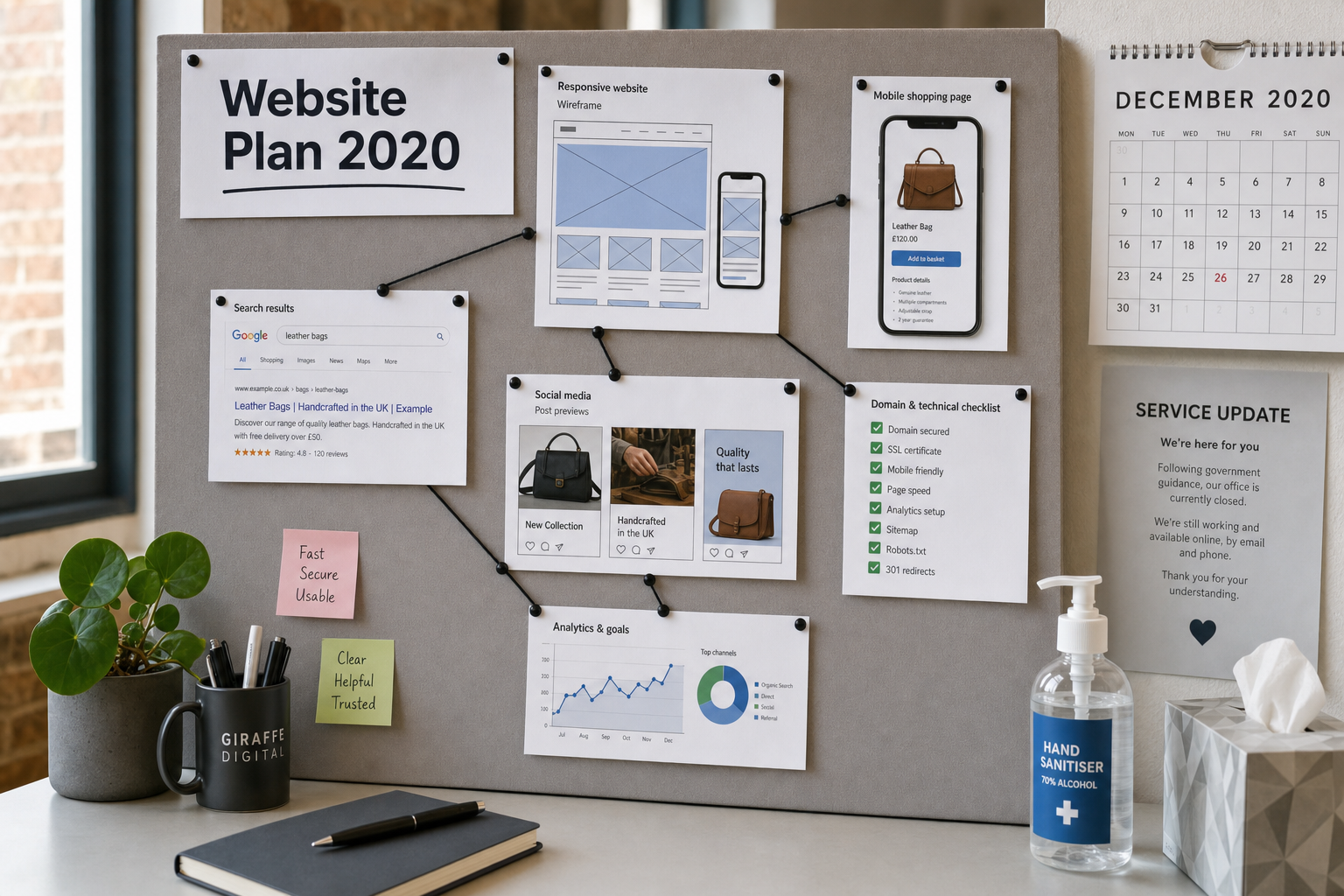
For many UK businesses, 2020 has made the value of a well-planned website impossible to ignore. Customer behaviour has changed quickly, trading conditions have been unpredictable, and organisations that once treated their website as a digital brochure have had to ask much more of it. A website now needs to support enquiries, sales, service updates, bookings, recruitment, customer reassurance and marketing activity across several channels. Good website planning in 2020 is not about rushing to add every possible feature; it is about making clear decisions that help the business remain useful, visible and commercially resilient.
Whether you are commissioning a new website, improving an existing one or preparing a digital strategy for the year ahead, the lessons from this year are practical. Businesses need websites that can be updated quickly, found easily, understood by customers and measured properly. The following guidance is written for business owners who want a stronger online presence without unnecessary complexity.
Start with the business purpose, not the homepage
One of the clearest website planning lessons from 2020 is that a website should be planned around business outcomes rather than design preferences alone. A visually polished homepage is important, but it will not deliver value if the website does not answer the right questions or guide visitors towards useful actions.
Before thinking about colours, layouts or imagery, define what the website must do for the business. For example, a professional services firm may need more qualified enquiries, stronger trust signals and clearer service pages. A retailer may need improved product filtering, delivery information and a simpler checkout process. A hospitality business may need booking guidance, updates on opening times and prominent safety information. A charity may need donation journeys, volunteer information and campaign landing pages.
Useful planning questions include:
- Who are the main audiences and what are they trying to achieve?
- What questions do customers ask before they are ready to enquire or buy?
- Which services, products or locations are most commercially important?
- What actions should visitors take on each key page?
- What information must the team be able to update quickly?
- How will the website support wider marketing activity, such as search, email and social media?
This type of planning helps prevent a common problem: building a website that looks finished but does not work hard enough. A strong website should make the next step obvious, whether that is calling, completing a form, making a booking, buying a product or downloading helpful information.
Make flexibility part of the design brief
Businesses have had to communicate frequent changes this year, from opening hours and service availability to delivery options and online appointments. Websites planned too rigidly can make these updates slow and expensive. A more flexible design gives the business room to respond without needing a full redesign every time circumstances change.
When planning website design, think in terms of reusable sections and page types. A good content management system should allow your team to publish news, update service pages, amend calls to action, add landing pages and manage core information without relying on developers for every small edit. This does not mean giving up design control. It means creating a structured system in which approved components can be used consistently.
Examples of useful flexible elements include:
- Announcement bars for urgent updates.
- Reusable call-to-action blocks for enquiries, bookings or downloads.
- Frequently asked questions sections on service and product pages.
- Landing page templates for campaigns.
- Staff, location or department profiles where relevant.
- Blog or insight templates for search-led content.
Flexibility should also apply to content hierarchy. Important information should not be hidden in a PDF or buried in a news post if customers need it before making a decision. If delivery times, consultation options or appointment procedures matter, they should be placed where users naturally look for them.
Design for clarity, speed and mobile behaviour
Mobile browsing is now central to customer behaviour, and many users will first encounter your business through a search result, a social post or a shared link on a phone. A website that is difficult to read, slow to load or awkward to navigate on a smaller screen will lose opportunities before visitors have properly considered the offer.
Good website design in 2020 should prioritise clarity. That means concise headings, readable text, strong contrast, accessible navigation and pages that are not overloaded with unnecessary effects. Design should support trust and understanding, not distract from them.
Speed also deserves attention during planning. Large images, excessive scripts and poorly chosen plugins can slow a website and damage user experience. Search engines have also continued to emphasise page experience, and Google has announced that Core Web Vitals will become ranking signals in 2021. For businesses planning now, it is sensible to treat loading performance, interactivity and visual stability as part of quality website design, not as technical afterthoughts.
Practical design considerations include:
- Compressing and correctly sizing images before upload.
- Using clear menus that work well on mobile devices.
- Keeping forms as short as possible while collecting essential information.
- Making phone numbers, addresses and calls to action easy to find.
- Avoiding intrusive pop-ups that block important content.
- Testing key journeys on real devices, not only on a desktop screen.
Website design should also reflect the brand appropriately. A local accountancy practice, an e-commerce brand and a creative agency will not need the same visual tone. However, all businesses benefit from a design system that feels credible, consistent and easy to use.
Plan content around customer intent and search demand
Search visibility remains one of the most valuable long-term benefits of a well-planned website. However, effective SEO is not achieved by adding keywords to pages at the end of a project. It should influence the site structure, page topics, headings, internal links and content priorities from the start.
For website planning in 2020, the most useful approach is to map content to customer intent. Some visitors are ready to act; others are still researching. Your website should support both. A service page might target a specific commercial search, while a blog article or guide might answer an earlier-stage question. Together, these pages can build authority and help users progress towards an enquiry or purchase.
For example, a business offering office refurbishment might need core pages for each main service, location-focused pages where appropriate, case-study-style project pages and helpful articles about planning regulations, workplace layouts or reopening considerations. An e-commerce business might need optimised category pages, detailed product descriptions, delivery and returns information, comparison guides and seasonal buying advice.
Key SEO planning tasks include:
- Researching the words and phrases customers actually use.
- Grouping keywords by topic rather than creating thin pages for every variation.
- Writing unique title tags and meta descriptions for important pages.
- Planning internal links so related pages support each other.
- Creating genuinely useful content that answers common questions.
- Ensuring search engines can crawl and index the website correctly.
Local businesses should also pay close attention to location signals. Accurate contact information, clear service areas, location pages where justified and a well-maintained Google My Business listing can all support local visibility. Consistency matters, particularly when opening hours or service arrangements change.
Treat social media and the website as connected channels
Social media has played an important role this year in keeping customers informed quickly. Facebook, Instagram, LinkedIn, Twitter and YouTube can all support awareness and engagement, depending on the audience. However, social activity is strongest when it leads back to a website that provides depth, reassurance and a clear route to action.
Website planning should therefore consider how social campaigns will connect with on-site content. If you are promoting a service, event, product range or downloadable guide, the linked landing page should match the promise of the post. Sending every visitor to the homepage often creates unnecessary friction. A focused page with relevant information, strong imagery, proof points and a clear call to action will usually perform better.
It is also worth planning how website content can supply social media. Blog posts, frequently asked questions, product guides, team updates and customer advice can all be repurposed into shorter posts. This keeps social channels useful without relying only on last-minute announcements.
For practical measurement, ensure that campaign links and website analytics are considered before activity goes live. Google Analytics and Search Console can help businesses understand where visitors come from and what they do on the site. The aim is not to track every possible number, but to measure the actions that matter: enquiries, sales, bookings, downloads, calls and other meaningful conversions.
Choose domain names with long-term clarity in mind
Domain registration is a small decision with long-term implications. A domain name should be easy to say, spell and remember. It should also support the brand without limiting future growth. For UK businesses, a relevant UK domain can help users recognise that the organisation serves the UK market, while a broader domain may be appropriate for businesses with international ambitions.
When choosing a domain, avoid names that are too long, confusing or reliant on unusual spelling. Hyphens and numbers can create problems when a domain is shared verbally. If a domain is likely to be used on signage, social profiles, email addresses and printed materials, simplicity becomes even more important.
Before registering, carry out sensible checks. Make sure the name does not create confusion with another established organisation, and consider whether matching or closely related social media handles are available. It is also wise to register important variations where appropriate, particularly to protect the brand from common misspellings or confusion.
Domain planning should also include practical administration. Keep ownership details clear, store renewal information securely and ensure the business, not an individual employee or supplier, has appropriate control. Losing access to a domain can cause serious disruption to email, website visibility and customer trust.
Select technology that suits the business, not the trend
The technology behind a website should be chosen according to what the business needs to manage, integrate and scale. A small brochure website, a content-heavy publishing site, a membership platform and an e-commerce store all have different requirements. Choosing the wrong platform can create unnecessary limitations or ongoing maintenance issues.
Popular content management systems and e-commerce platforms can be excellent choices when they are configured well, maintained properly and supported by the right hosting environment. The key is to avoid assuming that a platform alone will solve strategic problems. A good website still needs clear structure, strong content, considered design, security, backups and performance management.
Important technology considerations include:
- How easily the team can update content.
- Whether the platform supports required e-commerce, booking or enquiry features.
- How secure and maintainable the system is.
- Whether plugins or extensions are reputable and genuinely necessary.
- How the website will handle backups, updates and recovery.
- Whether hosting is suitable for expected traffic and performance needs.
- How forms, email marketing, CRM systems or payment tools will integrate.
Security should not be overlooked. HTTPS is now expected by users and browsers, especially where forms, logins or payments are involved. Software updates, strong passwords, restricted user permissions and regular backups are basic requirements for a professional business website.
Build trust into every key page
Trust has become even more important as customers make decisions remotely. If people cannot visit your premises, meet a team or inspect a product in person, the website has to work harder to reduce uncertainty. This applies to both consumer and business-to-business organisations.
Trust-building content might include clear contact details, team information, professional accreditations, delivery and returns guidance, service processes, testimonials, case studies, guarantees where appropriate and transparent answers to common concerns. The exact mix will depend on the business, but the principle is consistent: do not make visitors work hard to decide whether you are credible.
Photography can also support trust. Authentic images of premises, products, team members or completed work often communicate more than generic stock images. Where original photography is not possible, choose imagery carefully so it still feels aligned with the brand and audience.
Calls to action should be reassuring rather than aggressive. Instead of relying only on phrases such as Submit, use wording that makes the next step clear, such as Request a consultation, Ask for advice or Check availability. Small details like this can improve confidence and conversion.
Create a realistic website planning process
A successful website project needs more than a design concept and a launch date. It needs decisions, content, approvals, technical checks and measurement. Many delays happen because businesses underestimate the time needed to write content, gather imagery, confirm service details or review pages properly.
A practical planning process might include:
- Discovery: clarify business goals, audiences, competitors, technical needs and marketing priorities.
- Site structure: plan pages, navigation, user journeys and SEO opportunities.
- Content planning: decide what must be written, updated, removed or consolidated.
- Design: create layouts that support brand, usability and conversion.
- Development: build the website, content management features and integrations.
- Testing: check mobile behaviour, forms, links, speed, accessibility basics and browser compatibility.
- Launch: manage redirects, analytics, search indexing and any DNS changes carefully.
- Improvement: review performance data and refine pages after launch.
This final stage is often missed. A website should not be treated as finished the day it goes live. Search behaviour changes, customer questions evolve and business priorities shift. Regular review helps keep the website useful and commercially relevant.
Use 2020 as a prompt to plan properly
The strongest website planning lesson from 2020 is that digital presence is no longer separate from day-to-day business resilience. A website is often the first place customers go for reassurance, information and action. If it is slow, unclear, outdated or difficult to update, it can hold the business back at precisely the moment it is needed most.
Good planning creates confidence. It helps a business decide what to build, what to say, which technology to use and how to measure success. It also reduces wasted effort by aligning website design, SEO, social media, domain choices and content around a shared commercial purpose.
For UK business owners preparing for the months ahead, the priority is not to chase every digital trend. It is to build a website that is clear, flexible, trustworthy and connected to the way customers now research and buy. With thoughtful planning, your website can become a stronger foundation for marketing, sales and customer service throughout 2021 and beyond.