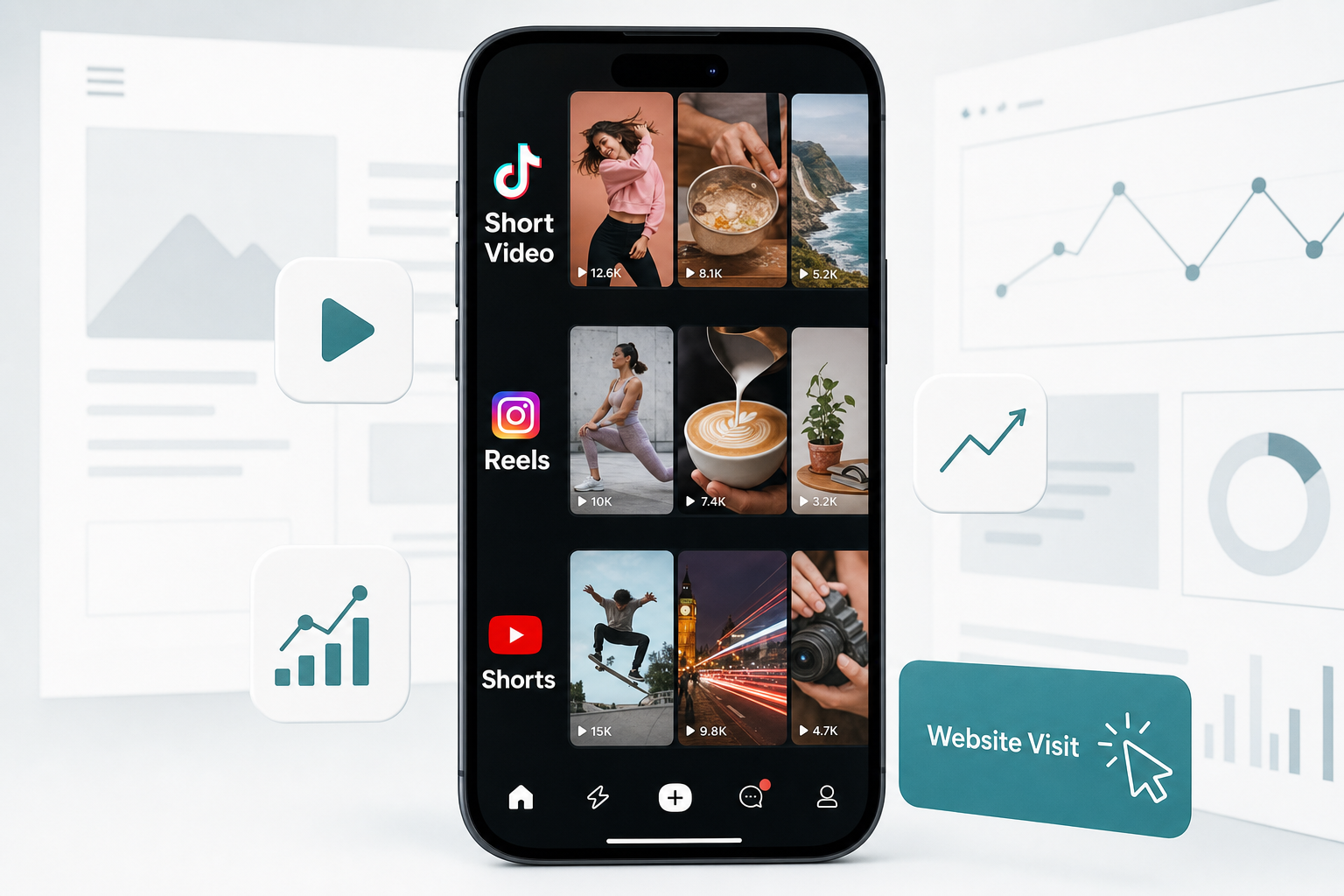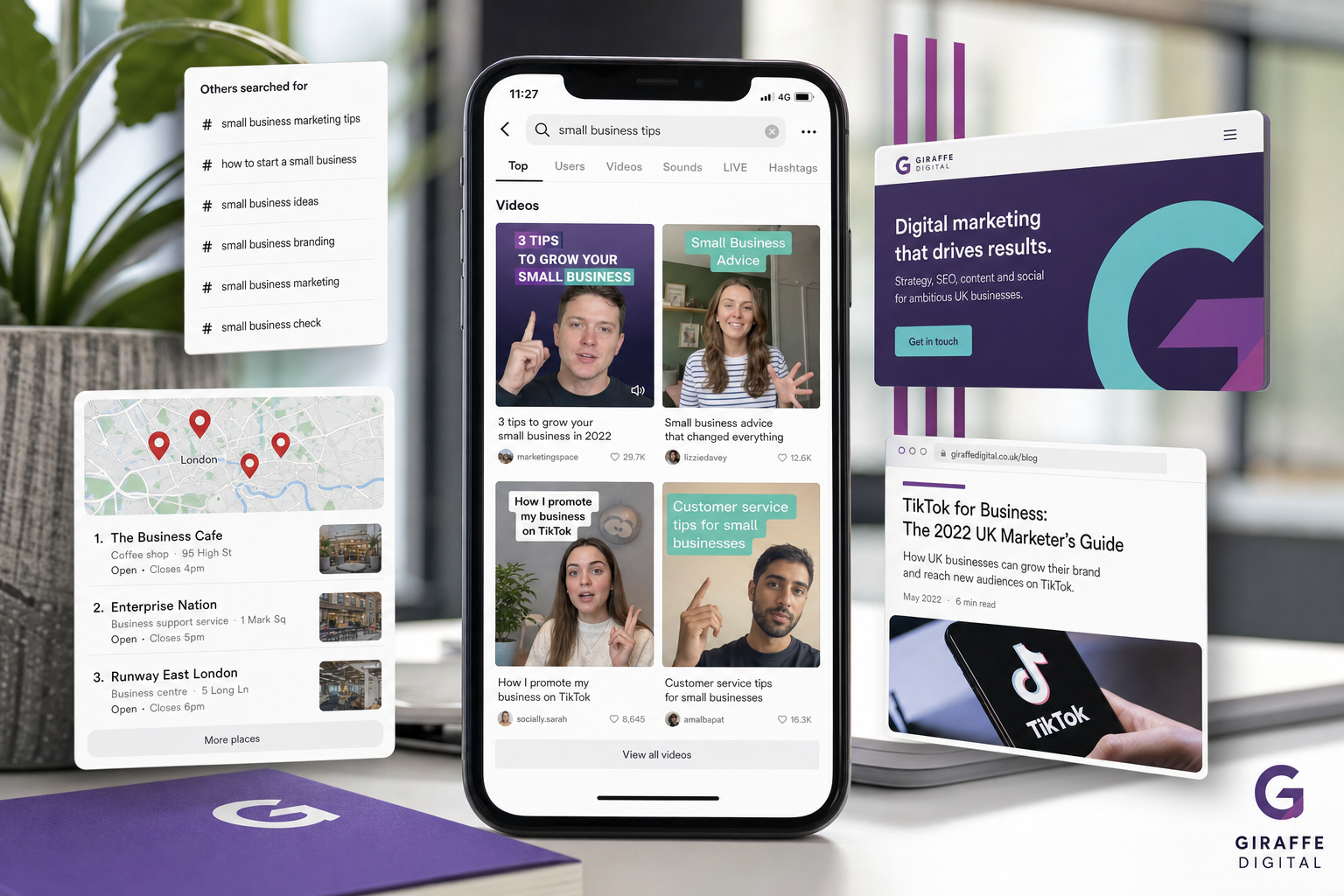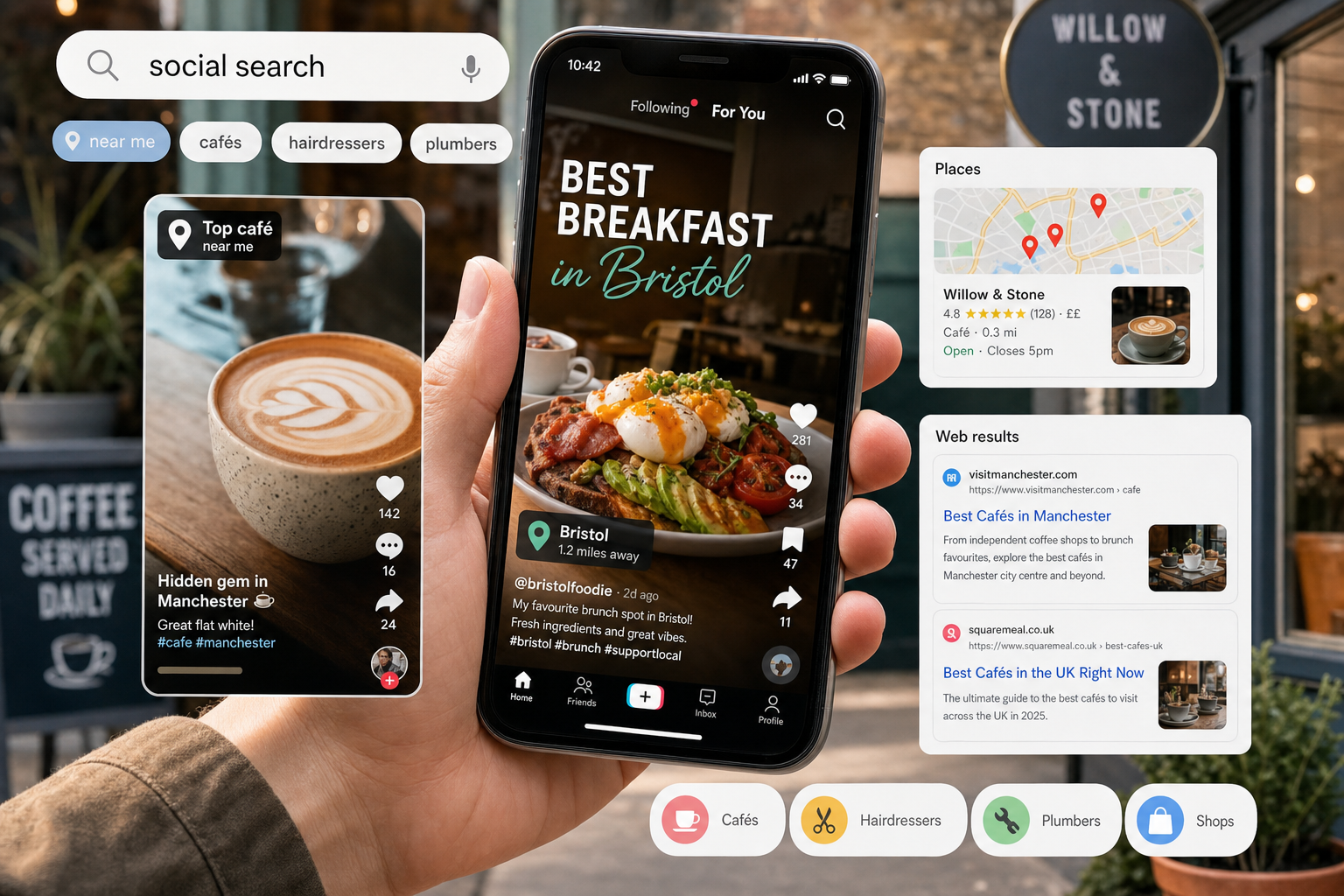
Short-form video has become more than a visibility tool. For many customers, it is now part of how they search, compare and decide who to trust. People still use traditional search engines, but they are also typing questions into social platforms, watching quick demonstrations, checking comments, saving posts and looking for signs that a business feels credible before they visit its website or get in touch.
For UK business owners, this shift matters because social search brings together several areas of digital marketing that are often treated separately: website design, SEO, branding, social media marketing, content planning and even domain registration. A business that appears consistently across search results, social profiles, short-form videos and its own website is easier to find, easier to understand and easier to choose.
Short-Form Video and Social Search Keep Growing because customers want quick answers, real-world proof and a clearer sense of whether a business is right for them. The opportunity is not simply to post more often, but to connect useful social content with a website and brand presence that can turn attention into enquiries.
What social search means in 2026
Social search is the behaviour of using social platforms to look for information, recommendations, products, services, local businesses and answers. Instead of only searching in a traditional search engine, a customer might search on TikTok for hair colour ideas, use Instagram to compare local cafés, search YYouTube Shortsfor DIY advice, browse Pinterest for home inspiration or use LinkedIn to assess a professional service provider.
This does not mean traditional SEO is being replaced. It means the search journey is broader. A potential customer might first see a short video, then search for your business name, visit your website and return to a social profile to check recent activity. Each step either builds confidence or creates friction.
Social platforms have also improved the way they organise and surface content. Captions, on-screen text, hashtags, comments, location tags, profile names and video descriptions all help content become discoverable. For business owners, this means social posts should not be treated as throwaway updates. They are searchable assets that can keep working long after they are published.
Why short-form video is still growing
Short-form video continues to grow because it matches how people prefer to assess information quickly. It can show a product in use, explain a service in plain English, introduce a team, demonstrate a result or answer a common question in less than a minute. For customers who are weighing up several options, video can make a business feel more human and easier to understand.
The strongest short-form videos are not necessarily the most polished. In many sectors, clarity and usefulness matter more than high production values. A local trade business can show a quick before-and-after, a clinic can answer a frequent booking question, a retailer can demonstrate product sizing, and a professional services firm can explain a common misconception. These videos support search because they match real customer questions.
For example, a kitchen showroom might create short videos around searches such as ‘small kitchen storage ideas’, ‘matt or gloss kitchen cabinets’ and ‘what to ask before a kitchen design appointment’. A dental practice might answer ‘how long does teeth whitening take?’ or ‘what happens at a first consultation?’. A solicitor might explain ‘what documents do I need for a house purchase?’ in accessible language. Each video should help a viewer make a better decision, not simply push for a sale.
How social search changes SEO strategy
SEO in 2026 should not be limited to optimising web pages for traditional search results. Your website remains the centre of your online presence, but customers may discover you elsewhere first. That means your SEO strategy should include the phrases people use on social platforms, the questions they ask in comments and the visual proof they expect to see before clicking through.
A useful approach is to map your main customer questions across both your website and social channels. If a question is important enough to answer in a blog post or service page, it may also be worth answering in a short video. Likewise, if a short video receives useful comments, those comments can inspire website FAQs, product copy, service explanations or future articles.
Search language on social platforms is often more conversational than formal. People may search for ‘best facial for dull skin’, ‘how to choose a wedding photographer’, ‘easy bookkeeping tips for small business’ or ‘family-friendly restaurants in Bristol’. Your website still needs well-structured pages, but your social content can capture these more natural phrases through spoken words, captions and descriptions.
Use your website as the trusted destination
Social platforms are powerful for discovery, but your website should remain the place where visitors find the clearest, most complete and most reliable information about your business. A good website gives you control over your message, your service details, your enquiries and your conversion journey.
If a viewer finds you through a short video, they should be able to move easily to a relevant page on your website. That page should match the topic they were interested in, rather than forcing them to search from your homepage. For instance, a video about garden office planning considerations should link to a garden office service page, guide or enquiry page that continues the same conversation.
This is where website design and social search meet. Clear navigation, fast-loading pages, mobile-friendly layouts, well-written service content, visible calls to action and trust signals all help turn social discovery into business value. If your website feels outdated, confusing or slow, the interest created by social content can be lost quickly.
Building content that can be found
Short-form video should be planned with search intent in mind. Instead of only asking what to post, ask what your customer is trying to find out before they choose you. The answer will lead to more useful content ideas and stronger search visibility.
Start with a list of common customer questions. These may come from sales calls, emails, reviews, live chat, social comments or search query data. Group them by topic, such as pricing concerns, service process, product comparisons, local availability, maintenance, guarantees, delivery, preparation or aftercare. Then create short videos that answer one question at a time.
Each video should have a clear hook, a concise answer and a next step. The hook can repeat the question in natural language. The answer should be specific enough to be helpful. The next step might invite the viewer to read a fuller guide, visit a service page, book a consultation or save the post for later.
Optimise captions, descriptions and on-screen text
Searchable social content relies on signals. Spoken words can often be understood by platform systems, but captions, descriptions and on-screen text still matter. Use plain language that reflects what customers search for. Avoid stuffing keywords into every line. Instead, use the main phrase naturally and make the content genuinely useful.
For example, a fitness studio might use on-screen text such as ‘Beginner reformer Pilates: what to expect in your first class’. The caption could explain who the class is suitable for, what to wear and how to book. The description might include the location and a related phrase such as ‘Pilates studio in York’. This gives both people and platforms clearer context.
Accessibility also supports discoverability. Captions help people watch without sound and make your message easier to understand. Clear audio, readable text, good contrast and simple editing all improve the experience. These details are part of good content design, not optional extras.
Where branding fits into social search
Branding is especially important when customers move between platforms. A person might see a video on one platform, search for the business name in a search engine, visit the website and then check another profile. Consistent branding reassures them that they have found the right business.
Your profile name, handle, logo, colours, tone of voice and key messages should feel connected to your website. This does not mean every post must look identical, but it should be recognisably yours. A fragmented brand presence can make a legitimate business feel less established than it really is.
For service businesses, trust is often built through detail. Show who is behind the business, explain your process, answer questions clearly and avoid vague claims. For product businesses, show the product in real situations, include care information, clarify sizing or specifications and make it easy to find the same product on your website.
Good social search content does not just attract attention. It reduces uncertainty, answers practical questions and gives customers a reason to take the next step.
Practical examples for UK businesses
A local restaurant could use short-form video to answer searches such as ‘best Sunday roast near me’, ‘gluten-free lunch in town’ or ‘private dining for small groups’. The videos can show the setting, food, accessibility details and booking process. The website should then provide menus, opening times, dietary information, location details and an easy booking route.
An accountancy firm could create videos around ‘limited company or sole trader’, ‘when to register for VAT’, ‘what records should I keep?’ and ‘Self Assessment deadlines’. The website should contain more detailed guides, service pages and contact options for different business types. This approach makes the firm more visible while also demonstrating expertise.
An interiors retailer could use social search content for ‘how to style a small hallway’, ‘best lighting for a cosy living room’ or ‘how to measure curtains’. The website should support this with product categories, measurement guides, inspiration pages and clear delivery information.
A trades business could answer location-based questions such as ‘emergency plumber in Leeds’, ‘how to spot a roof leak’ or ‘do I need an electrician for a new oven?’. The short video provides immediate reassurance, while the website confirms services, coverage areas, qualifications and enquiry options.
Domain registration and naming considerations
Your domain name still plays an important role in how customers recognise, remember and trust your business. Social search may create the first point of discovery, but your domain is often where a serious visitor goes next.
Choose a domain that is easy to spell, easy to say and closely connected to your business name. For UK organisations, a UK-focused domain extension can help signal relevance, while a broader extension may suit businesses with wider ambitions. The best choice depends on your audience, brand and long-term plans.
Before committing to a business name or domain, check whether matching or closely aligned social handles are available. Exact matches are not always possible, but avoid a situation where your website address, business name and social usernames all look unrelated. Consistency helps customers find you and reduces confusion.
It is also sensible to register important variations where appropriate, protect renewal access, keep ownership details organised and make sure any older domains redirect correctly. Avoid building a brand around a domain that is too narrow if you expect your services to expand. A name that only reflects one product, one town or one trend may become restrictive later.
How to connect short-form video with your website
The most effective digital strategies create a clear journey between social content and owned content. A viewer should understand what you do, why it matters and where to go next. This requires planning beyond the post itself.
Use dedicated landing pages where it makes sense. If you run a campaign around a specific service, product range or seasonal offer, send people to a page that reflects the same message. The page should answer the next set of questions a visitor is likely to have after watching the video.
Use your website analytics to understand whether social visitors engage with key pages. Look at landing pages, enquiry routes, time on page and conversion actions. Use platform insights to see which videos are being searched for, saved, shared or watched for longer. The aim is not to chase every trend, but to find patterns that support business goals.
It is also worth embedding selected videos on relevant web pages if they improve the visitor experience. A service page can become more persuasive when it includes a concise explanation, demonstration or customer question answered by your team. Keep performance in mind, as heavy media can slow a page if it is not implemented carefully.
What to prioritise in 2026
Businesses do not need to be active everywhere. A focused presence on the right platforms is usually more effective than a thin presence across every channel. Choose platforms based on where your customers search, what type of content suits your offer and what your team can maintain consistently.
For visually led sectors, platforms built around video and imagery may be especially valuable. For professional services, educational short-form content and LinkedIn visibility may support credibility. For local businesses, location signals, reviews, current opening information and regular visual updates can all influence trust.
A useful starting plan is to create one short-form video theme per week, supported by one website improvement per month. For example, answer a customer question in video, then improve the related website section with clearer copy, FAQs or a stronger call to action. This keeps your social search activity connected to your wider digital presence.
Common mistakes to avoid
- Posting without search intent: Entertaining content can be useful, but business content should also answer real customer needs.
- Using vague captions: Captions such as ‘new post’ or ‘watch this’ give platforms and people very little context.
- Ignoring the website journey: If interested viewers cannot find a relevant page, they may choose a competitor.
- Chasing every trend: Trends can create reach, but they should still make sense for your brand and audience.
- Letting profiles go stale: Outdated opening hours, old branding or inconsistent contact details can damage trust.
- Forgetting measurement: Review what leads to enquiries, not just what gets views.
A balanced approach to search visibility
Social search is growing because people want quick, visual and trustworthy answers. Short-form video supports that behaviour by making information easy to consume and easy to share. However, the strongest results come when social content is connected to a well-designed website, a clear brand, thoughtful SEO and a domain strategy that supports long-term recognition.
For UK business owners, the opportunity is not simply to make more videos. It is to become easier to find and easier to choose. By answering real questions, using searchable language, keeping branding consistent and improving the website journey, businesses can turn social discovery into meaningful enquiries and stronger customer relationships.