Social media advertising has moved well beyond simply placing a message in front of as many people as possible. For UK businesses, the real value now lies in reaching the right audience with a clear offer, a well-designed landing page and a sensible plan for measurement. Whether you are promoting a local service, an e-commerce product range, an event or a professional organisation, paid social activity can support search marketing, brand awareness and lead generation when it is planned carefully.
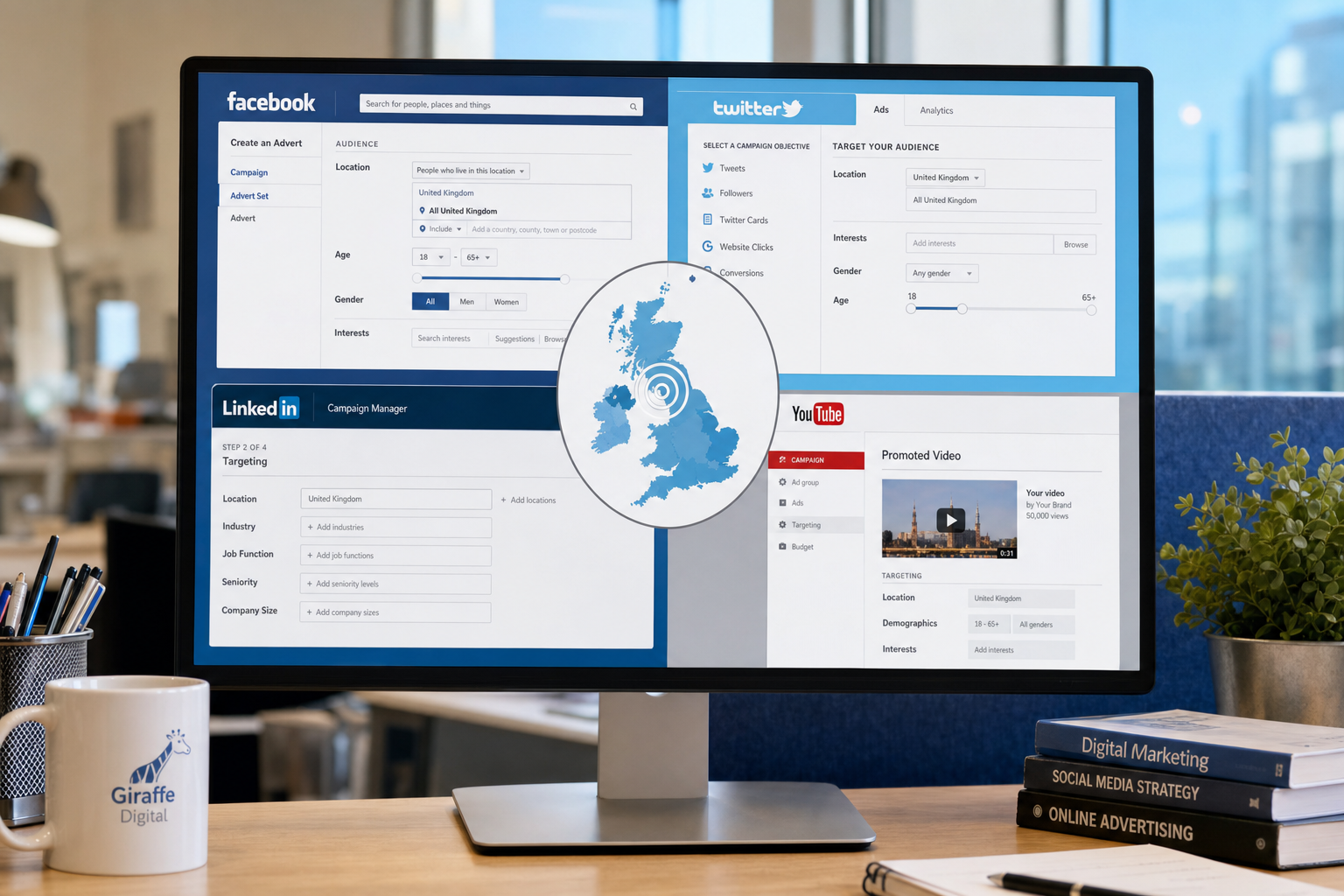
The appeal is easy to understand. Many customers already spend time on Facebook, Twitter, LinkedIn and YouTube, and those platforms allow advertisers to select audiences by interest, location, job role, age range, device and other useful signals. This does not remove the need for strong website design, search engine optimisation or good customer service, but it does give businesses another way to attract attention and guide potential customers towards an enquiry, booking or purchase.
Why targeting matters for UK businesses
Traditional advertising often relies on broad exposure. A newspaper advert, radio slot or printed leaflet may reach plenty of people, but only a proportion will be in the right location, have the right need or be ready to respond. Social media advertising gives businesses more control over who sees their message. A company can focus on people within a particular region, those with relevant interests, or decision-makers in a specific profession.
For example, a wedding venue in Yorkshire may wish to reach engaged couples within travelling distance rather than spend budget on a national audience. A software provider may prefer to reach operations managers, finance directors or small business owners. A retailer may promote a seasonal range to existing followers and to people who have shown an interest in similar products. The point is not merely to narrow an audience, but to make the advert more relevant to the people who see it.
Relevance improves both efficiency and brand perception. If the advert feels useful, timely and appropriate, the user is more likely to click, like, share, enquire or remember the business. If it feels intrusive or poorly targeted, it can quickly be ignored. Careful targeting also encourages better creative work, because the message can be written for a particular customer group rather than for everyone at once.
The main social advertising options in July 2013
Each social platform has its own strengths, audience and advertising style. The best choice depends on the customer, the product and the objective. Most businesses should avoid trying every available option at once. A small, well-measured campaign on one or two suitable platforms is often more useful than a scattered approach.
Facebook advertising
Facebook remains one of the most accessible paid social channels for many consumer-facing businesses. Advertisers can target users by location, age, gender, interests, relationship status and connections to a page, app or event. Sponsored posts can help a business reach more of its page followers, while other advert formats can encourage page likes, website visits or engagement with a specific post.
For local businesses, location targeting is particularly valuable. A restaurant, gym, estate agent or training provider can focus activity around its catchment area and test different messages for different customer groups. Businesses with an established customer list may also explore audience options that help them reach existing contacts or people with similar characteristics, provided data is handled responsibly and in line with applicable privacy expectations.
Facebook Exchange has also drawn attention from advertisers looking at remarketing. This can allow businesses to reconnect with users who have visited their website, although it is best suited to organisations with enough traffic and a clear understanding of how to use remarketing sensibly. Frequency should be watched carefully; an advert that follows a user too often can damage confidence rather than build it.
Twitter promoted activity
Twitter advertising can be useful when a business has a strong message, a timely campaign or a subject people are already discussing. Promoted Tweets, Promoted Accounts and Promoted Trends give advertisers different ways to increase visibility. The platform is particularly suited to events, media activity, public conversations and brands with a distinct voice.
Targeting can include interests, geography and users who are similar to followers of selected accounts. For example, a business exhibition may promote updates to people interested in entrepreneurship, technology or marketing within a defined region. A professional services firm may promote a guide or seminar to people who follow relevant industry publications. As with all social advertising, the creative message must feel natural to the platform. A stiff press release headline rarely performs as well as a concise, useful statement with a clear reason to act.
LinkedIn advertising
LinkedIn is often a strong choice for business-to-business campaigns. Its targeting by job title, seniority, company size, industry and geography can be valuable for professional services, recruitment, training, software and consultancy. The audience may be smaller than on Facebook, but it can be more directly relevant for certain objectives.
A useful LinkedIn campaign might promote a white paper, event registration, consultation request or specialist service page. The advert should be specific. Rather than saying a business offers “solutions for companies”, it is better to identify the audience and the problem: for example, “HR guidance for growing manufacturers” or “IT support for accountancy firms”. Clear positioning helps the right people recognise the value quickly.
YouTube and video promotion
YouTube advertising can help businesses explain products, demonstrate expertise and build familiarity. TrueView video adverts allow users to choose whether to watch, which places more importance on the opening seconds. A good video advert should not begin with a long animated logo or vague introduction. It should quickly show the problem, benefit or idea that matters to the viewer.
Video can work particularly well for products that need demonstration, services that benefit from trust, or organisations with useful educational content. A home improvement company could show a short transformation, a training provider could introduce a course, and a manufacturer could explain how a product is used. The video does not need to be extravagant, but it should be clear, credible and consistent with the wider brand.
Good targeting still needs a good website
Paid social campaigns often fail because the advert receives attention but the destination page does not support the next step. If someone clicks from a carefully targeted advert and lands on a slow, confusing or unrelated page, the opportunity is wasted. Website design is therefore central to social media advertising.
The landing page should match the promise made in the advert. If the advert promotes a free consultation, the page should explain the consultation and make it easy to enquire. If the advert promotes a product range, the page should show that range rather than sending users to the homepage and expecting them to search. Consistency of headline, imagery and call to action helps reassure the visitor that they are in the right place.
Mobile use must also be considered. Many social media users browse on smartphones and tablets, so a page that is difficult to read or navigate on a smaller screen will lose enquiries. Responsive website design is increasingly important, but even where a full redesign is not yet practical, businesses should review key landing pages for readable text, clear buttons, quick loading and simple forms.
Trust signals matter as well. Contact details, company information, testimonials, case studies, delivery information, privacy statements and professional design all help visitors feel more confident. Social advertising can bring people to the door; the website must then do the work of earning the enquiry.
Planning a campaign with a clear objective
Before setting up any adverts, a business should decide what success looks like. Common objectives include increasing awareness, growing a social following, driving website visits, generating enquiries, promoting an event, encouraging downloads or supporting e-commerce sales. Each objective requires a slightly different advert, audience and landing page.
An awareness campaign may use broader targeting and stronger visual branding. A lead generation campaign needs a focused page, persuasive copy and an enquiry form that is not unnecessarily long. An event campaign needs date, location and registration information to be immediately visible. An e-commerce campaign should take users as close as possible to the relevant product or category.
Businesses should also consider how paid social supports other marketing. A social advert may introduce a new audience to the brand, while search engine optimisation helps capture people actively searching for services. Email marketing can then keep in touch with those who have requested updates. Offline activity, such as exhibitions or print campaigns, can be reinforced with targeted social promotion before and after the event.
Measuring performance without getting distracted
Social platforms provide a wide range of figures, but not every number is equally meaningful. Likes, shares and comments can be useful indicators of interest, yet they do not automatically prove commercial value. Clicks, enquiries, sign-ups, sales and quality of traffic often give a more practical view of performance.
At a minimum, businesses should track which adverts are running, which audiences are being targeted, what landing pages are being used and what actions result. Web analytics can help show whether visitors from social adverts stay on the site, view key pages or complete enquiry forms. Where possible, campaign tracking should be added to links so that traffic can be separated clearly from unpaid social activity.
Testing is important. Rather than relying on one advert, create two or three variations with different headlines, images or calls to action. Compare performance after enough data has been gathered, then refine the campaign. A small change in the offer or landing page can make a notable difference. The goal is not to chase every metric, but to learn which message, audience and website experience produces the best response.
Branding, content and search considerations
Social media advertising should not sit apart from the rest of a business’s digital presence. The tone of the adverts, the look of the landing page, the social profile and the main website should all feel like part of the same organisation. Inconsistent branding can reduce trust, particularly when a user is encountering the business for the first time.
Content is also valuable. A business does not always need to advertise a direct sales message. Guides, checklists, videos, blog posts and event invitations can work well when they are genuinely helpful. For example, an accountancy firm may promote a plain-English tax guide for small businesses, while a web design company may promote a checklist for planning a new website. Useful content gives people a reason to engage before they are ready to buy.
Search marketing should remain part of the wider plan. Social advertising can bring targeted visitors quickly, while SEO builds visibility for relevant searches over time. A strong content programme can serve both channels: it gives social campaigns something valuable to promote and gives search engines useful pages to index. Businesses should avoid thin, duplicated or keyword-stuffed pages. Clear, original and well-structured content is a safer long-term approach.
Domain names and campaign addresses
A suitable domain name helps customers remember and trust a business. When choosing a domain, aim for something clear, easy to spell and closely aligned with the brand. For UK businesses, a .co.uk domain is often expected, although some organisations may also choose to secure the matching .com if it is available and relevant. Avoid excessive hyphens, confusing abbreviations and spellings that are difficult to say over the telephone.
For social advertising campaigns, it is usually better to send users to a well-designed page on the main website than to create unnecessary separate domains for every promotion. Keeping activity on the primary domain can support brand consistency, analytics and search visibility. If a campaign-specific address is used, it should be simple and professional, and redirected correctly when the campaign ends.
Domain ownership should also be managed carefully. Ensure the business has access to registration details, renewal reminders and administrative contacts. Losing control of a domain can disrupt websites, email and advertising activity. Good digital marketing depends on dependable technical foundations.
Practical steps before launching
- Define the audience: Decide who you want to reach, where they are based and what matters to them.
- Set one main objective: Choose whether the campaign is for awareness, traffic, enquiries, sales, event registrations or another specific action.
- Prepare the landing page: Make sure the page matches the advert, loads promptly and works well on mobile devices.
- Write platform-appropriate adverts: Keep copy clear and direct, and use imagery that suits both the audience and the social network.
- Track results: Use analytics and campaign tracking to understand what happens after the click.
- Review and refine: Pause weak adverts, improve strong ones and use what you learn in future campaigns.
A more focused way to reach customers
Social media advertising is becoming a more precise and practical option for businesses that want to reach specific audiences online. It is not a replacement for a strong website, good search visibility or a clear brand, but it can complement them very effectively. The businesses most likely to benefit are those that plan carefully, respect the user’s attention and connect each advert to a useful next step.
For UK business owners, the opportunity is to use targeting sensibly rather than simply spend more. Know who you want to reach, offer something relevant, support the campaign with a professional website and measure the actions that matter. Done well, social media advertising can help turn online attention into meaningful business enquiries.