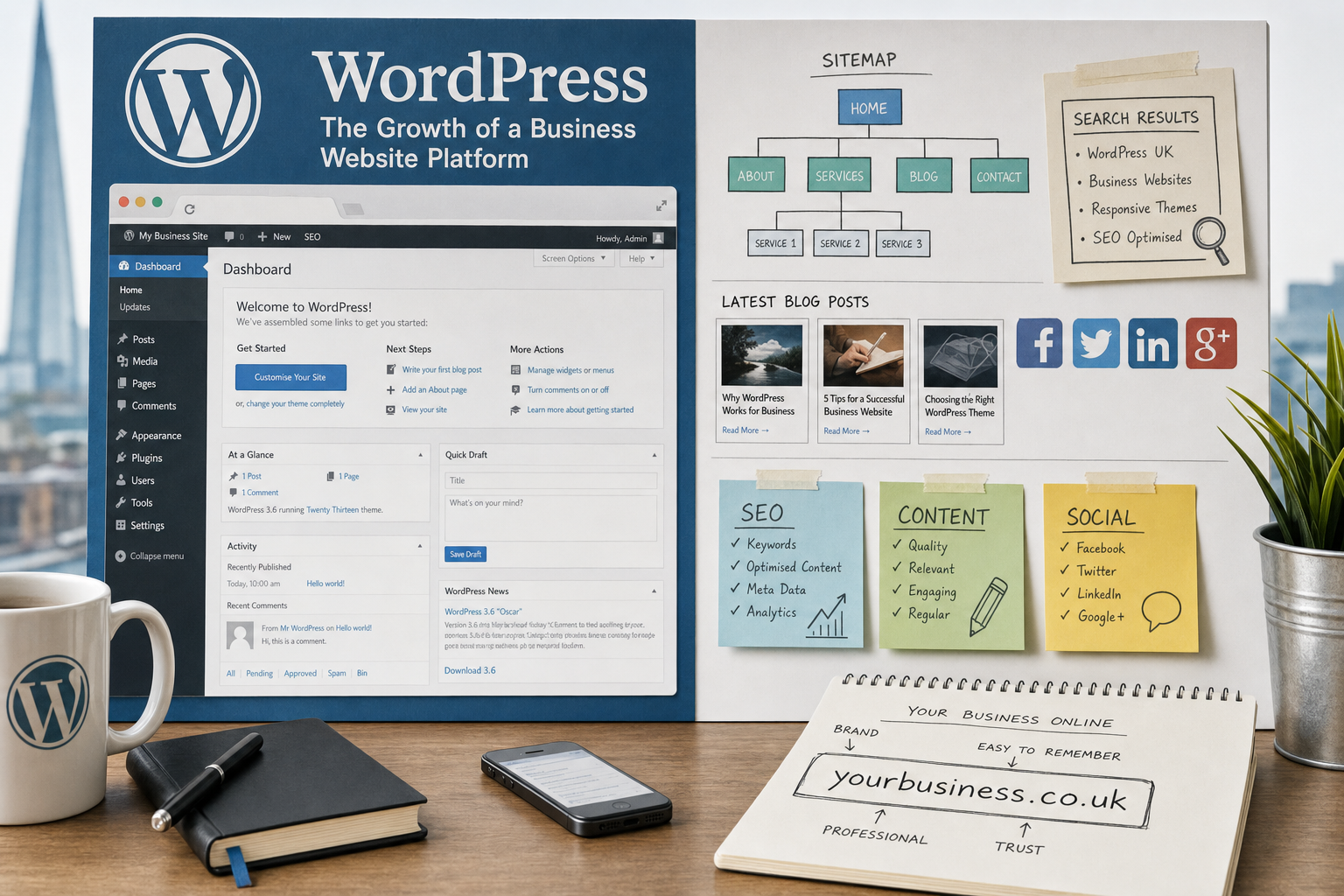
WordPress has moved a long way from being seen simply as a blogging tool. For many UK businesses, it is now a serious website platform capable of supporting professional design, regular content publishing, search engine optimisation and day-to-day marketing activity. Whether you are planning a new company website or considering a redesign of an existing one, WordPress websites offer a practical balance of flexibility, control and value.
The appeal is not difficult to understand. Business owners want websites that look credible, can be updated without unnecessary difficulty and are built with marketing in mind. A static brochure site may still have its place, but more organisations now need news sections, service pages, image galleries, landing pages, contact forms, social sharing and ongoing search visibility. WordPress provides a strong foundation for these requirements when it is planned and developed properly.
Why WordPress has become a serious option for business websites
One of the main reasons WordPress has grown so quickly is that it gives businesses a manageable content management system without forcing them into a rigid structure. A good WordPress build allows pages, posts, images and menus to be edited by authorised users, which means a company is less dependent on a developer for every small change.
This matters for marketing. If your opening hours change, a new service is launched or you want to publish a timely article, you should not have to wait weeks for your website to be updated. WordPress makes regular publishing more realistic, and regular publishing is increasingly important for search, social media and customer confidence.
It is also a platform with a large community behind it. Themes, plugins, documentation and developer knowledge are widely available. This does not mean every plugin or theme is suitable for a business website, but it does mean there is a broad ecosystem supporting the platform. For a business owner, that can reduce the risk of being locked into an obscure system that only one supplier understands.
Another strength is scalability, within reason. A small business might begin with a simple website of five or six pages and a news section, then later add case studies, team profiles, downloadable guides, improved enquiry forms or e-commerce functionality. WordPress is not the correct answer for every possible project, but it is suitable for a wide range of professional websites when the brief is carefully considered.
WordPress websites and professional design
A common mistake is to assume that a WordPress website must look like a standard template. In reality, WordPress is the underlying system; the quality of the finished website depends on planning, design and development. A professionally designed WordPress website should reflect your brand, support your sales process and make it easy for visitors to understand what you do.
Good design starts with structure. Before choosing colours, fonts or images, it is important to consider the journey a visitor should take. A firm of solicitors, for example, may need clear service categories, strong trust signals and simple enquiry options. A manufacturer may need product information, technical downloads and clear routes for trade enquiries. A local trades business may need location pages, testimonials and a prominent telephone number.
WordPress can support these different requirements, but the website should not be designed around the platform alone. It should be designed around the customer. The homepage needs to explain the business quickly, the navigation should be logical, and key calls to action should be visible without feeling aggressive.
Responsive design is also an important consideration. More people are browsing on smartphones and tablets, and a website that is difficult to use on a smaller screen can lose enquiries. In 2013, a separate mobile website is still sometimes used, but responsive web design is becoming a sensible approach for many businesses because it allows one website to adapt to different screen sizes. A WordPress theme or custom design should be tested carefully across common devices and browsers, rather than assumed to work everywhere.
Content control and the value of regular publishing
For many businesses, the biggest advantage of WordPress is the ability to publish useful content regularly. A news or blog section can help demonstrate expertise, answer customer questions and give search engines more relevant material to index. This does not mean writing for the sake of it. Thin, repetitive articles are unlikely to impress either visitors or search engines.
A better approach is to create content that reflects genuine customer needs. A heating company might publish seasonal maintenance advice. An accountancy firm might explain common tax deadlines in plain English. A design company might show how branding, photography and layout affect trust. These articles can then be shared through social media, linked from email campaigns and used by sales staff when answering common enquiries.
WordPress makes this style of publishing relatively straightforward. Posts can be categorised, scheduled, drafted and edited. Images can be added to support the message, and older articles can be updated when information changes. It is still important to have an editorial plan, but the platform removes many of the practical barriers that once made website updates feel complicated.
Search engine optimisation considerations in 2013
Search engine optimisation has changed considerably over recent years. It is no longer sensible to think in terms of simply adding a few keywords to a page and expecting results. Search engines are paying more attention to quality, relevance, natural language, links, user behaviour and the overall trustworthiness of a website. Updates such as Panda and Penguin have encouraged businesses to move away from poor content and questionable link building.
WordPress websites can be very search-friendly, but only when they are set up correctly. The platform provides a good starting point for clear page structures, readable URLs, title tags, meta descriptions and internal linking, but these still require thought. Each important page should have a clear subject, a useful heading structure and copy written for real customers rather than stuffed with repeated phrases.
The primary phrase for a page should appear naturally where it helps the reader. For example, a page about WordPress websites should explain what the service includes, who it is for, how the process works and what business benefits it offers. Repeating the same keyword unnaturally is not a substitute for useful information.
Technical details also matter. A WordPress website should be configured with clean permalinks, an XML sitemap where appropriate, sensible redirects when replacing an old site, and no accidental blocking of important pages from search engines. Google Webmaster Tools and analytics reporting can help identify crawl issues, search queries and visitor behaviour. These tools should be part of the launch and ongoing improvement process, not an afterthought.
Local search is particularly important for many UK businesses. Clear contact details, consistent business information, relevant location pages and a well-maintained presence on mapping and local listing services can help potential customers find you. WordPress can support local landing pages and structured content, but these pages must be genuinely useful and not created as near-duplicate doorway pages.
Choosing a domain name for a business website
A good domain name supports your brand and makes your website easier to remember. For most UK businesses, it is sensible to secure a domain that closely matches the trading name where possible. A short, clear domain is often better than one filled with hyphens or unnecessary words.
When choosing between domain extensions, consider where your customers are based and how the business is positioned. A UK-focused company may benefit from a UK domain, while a business with wider ambitions may also wish to secure a broader extension. It can be sensible to register common variations to protect the brand, but the main website should normally have one primary domain to avoid confusion.
Before registering a domain, check the spelling carefully, consider how it sounds when read aloud, and make sure it will work on printed materials, email addresses and business cards. Avoid names that are too close to another established brand, as this can create confusion and potential legal difficulty. Also ensure that the domain is registered in the correct name and that renewal reminders are managed responsibly. Losing control of a business domain can cause serious disruption.
Social media and WordPress working together
Social media is now part of the online marketing mix for many businesses, although it should not be treated as a replacement for a proper website. Your website is the central place where you control your content, present your services and capture enquiries. Social platforms are useful for distribution, conversation and relationship building.
WordPress makes it easier to connect website content with social activity. New articles can be shared on Twitter, Facebook, LinkedIn, Google+ or other relevant platforms. Social sharing buttons can be added, though they should be implemented carefully so they do not slow the website or distract from the main enquiry path. A blog post that answers a useful question can provide far better social content than a sales message repeated every week.
Different platforms suit different organisations. LinkedIn may be valuable for professional services and business-to-business firms. Facebook may suit community-focused brands, hospitality, retail and events. Twitter can be useful for networking, customer service and sharing timely updates. The key is to choose platforms based on where your audience spends time, rather than feeling obliged to be everywhere.
Plugins, performance and security
Plugins are one of the reasons WordPress is so flexible, but they should be used with care. It can be tempting to install a plugin for every idea, from sliders and galleries to forms and search features. Too many plugins, or poorly built plugins, can slow a site, create conflicts or introduce security risks.
A business website should use reputable plugins only where they serve a clear purpose. Contact forms, SEO management, caching, spam protection and backup tools may all be useful, but each addition should be assessed. If a feature is central to the website, it may be better developed properly rather than patched together with multiple add-ons.
Security also needs attention. WordPress is popular, which means poorly maintained installations can become a target. Sensible precautions include using strong passwords, avoiding obvious administrator usernames, keeping WordPress core files, themes and plugins up to date, removing unused plugins, and maintaining reliable backups. Hosting quality also matters. A cheap or poorly managed hosting environment can undermine a well-designed website through slow loading, downtime or weak support.
Performance should be tested before launch. Large images, unnecessary scripts and bloated themes can make pages slow to load. Visitors are impatient, and search engines also consider site quality. Optimising images, using clean code and choosing suitable hosting can make a noticeable difference to the user experience.
When WordPress may not be the right choice
Although WordPress websites are suitable for many businesses, it is important to be honest about fit. Very complex web applications, highly bespoke booking systems or large-scale enterprise requirements may need a different technical approach. The right decision depends on the business objectives, the required functionality, the internal team and the long-term maintenance plan.
However, for a large number of small and medium-sized UK businesses, WordPress offers an effective route to a professional, manageable and search-friendly website. The key is not simply to install WordPress, choose a theme and hope for results. The key is to combine the platform with proper strategy, design, content planning, technical implementation and ongoing marketing.
Planning a WordPress website that supports growth
A successful WordPress project should begin with clear questions. What does the website need to achieve? Who are the primary audiences? Which services or products are most important? What actions should visitors take? How will enquiries be measured? Who will update the website after launch?
Answering these questions helps shape the sitemap, page content, design approach and marketing plan. It also prevents the website from becoming a collection of attractive pages with no commercial purpose. A good business website should support trust, explain value and make the next step easy.
It is also wise to think beyond launch day. Search visibility, content marketing and social media all take ongoing attention. WordPress gives businesses the tools to keep improving, but those tools need to be used. A monthly plan for new content, a review of analytics data and small website improvements can turn a launch project into a long-term marketing asset.
WordPress has earned its place as a leading business website platform because it combines usability, flexibility and marketing potential. For UK business owners who want more control over their online presence, it can be an excellent choice. With the right planning and professional implementation, WordPress websites can do far more than sit online as digital brochures; they can become active, useful and measurable parts of a wider digital strategy.