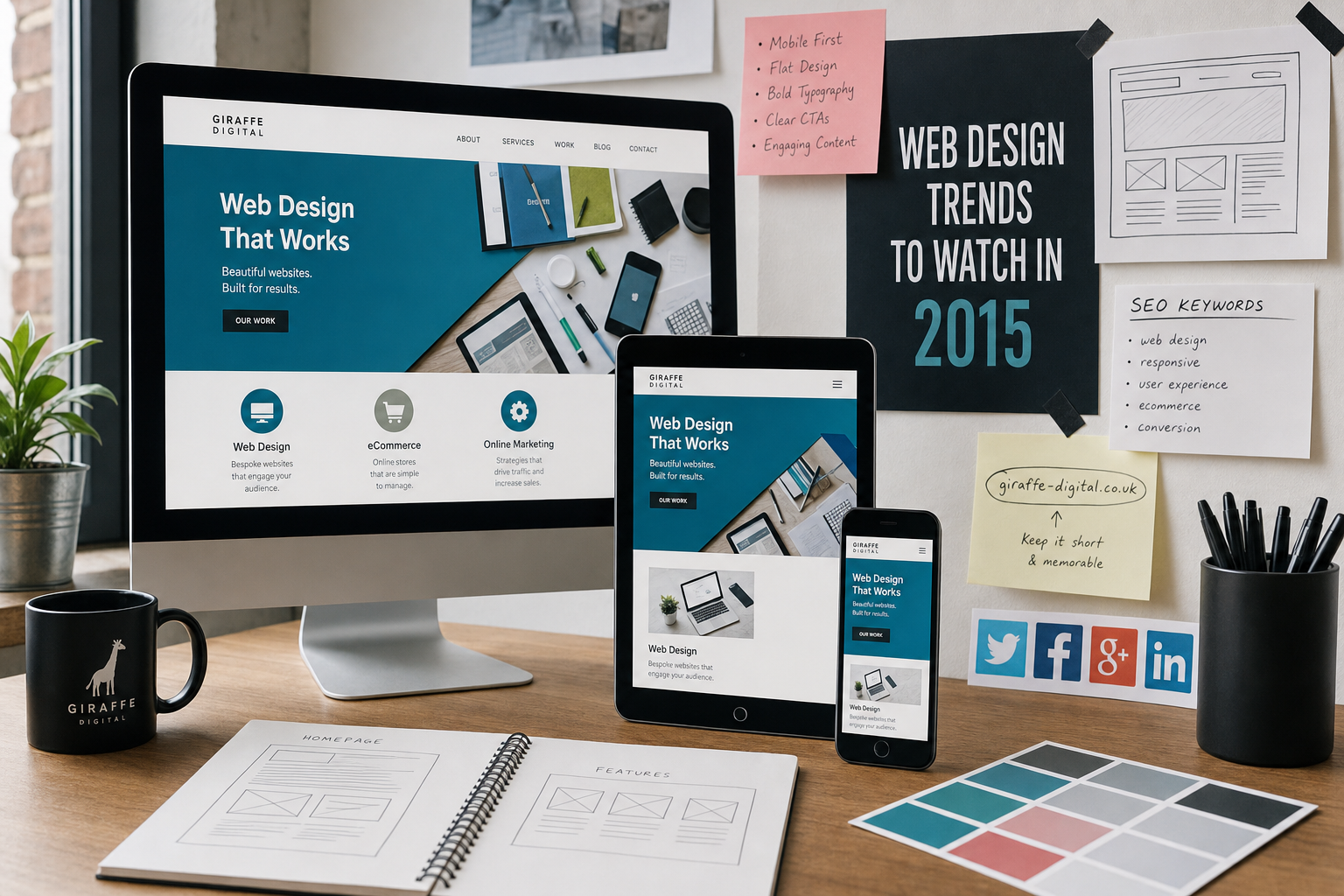
As more customers research, compare and buy online, a business website can no longer be treated as a static brochure. In 2015, the most effective sites will be clear, fast, mobile-friendly and closely connected to wider digital marketing activity. The strongest web design trends to watch in 2015 are not simply about making a site look modern; they are about helping visitors understand what you offer, trust your organisation and take the next step with confidence.
For UK business owners planning a new website or considering a redesign, the key is to focus on practical value. A polished visual style matters, but it should support usability, search visibility, brand recognition and lead generation. The following trends are worth watching because they can improve how people experience your business online and how well your website supports commercial goals.
Responsive design becomes the expected standard
Responsive web design has been discussed for several years, but in 2015 it is set to become a basic expectation rather than an optional extra. Customers now move between desktop computers, tablets and smartphones throughout the day. A website that only works comfortably on a large screen risks frustrating a significant share of its audience before visitors have even read the first paragraph.
A responsive website adapts its layout to the size of the screen. Menus become easier to tap, columns stack neatly, images resize and contact details remain accessible. For a local service business, this can make a considerable difference. A potential customer searching on a mobile phone may want to check opening hours, request a quote or tap a telephone number. If the page is hard to read or the form is awkward to complete, they may simply choose another supplier.
Search behaviour also supports the move towards responsive design. Google has introduced mobile-friendly labels in mobile search results, making it clearer when a page is likely to work well on a phone. While a website should always be designed for people first, mobile usability is becoming increasingly important for search marketing as well.
Simpler layouts and clearer messaging
Many older websites try to say everything at once. The result is often a cluttered homepage filled with competing boxes, small text, stock imagery and unclear calls to action. A noticeable design shift for 2015 is towards simpler layouts that place the most important message at the centre of the experience.
This does not mean every site should look minimal or empty. It means each page should have a clear purpose. A homepage might introduce the business, direct visitors to core services and provide obvious routes to make contact. A service page should explain the problem being solved, outline the benefits, answer common questions and invite an enquiry. A product page should make the product easy to understand and easy to buy.
Strong typography, generous spacing and well-structured sections can help visitors scan a page quickly. Business owners should consider whether a first-time visitor can understand what the organisation does within a few seconds. If not, the design may be making the sales process harder than it needs to be.
Large imagery, video and visual storytelling
Large photographs, full-width banners and carefully produced video are likely to remain prominent in 2015. Faster broadband and sharper screens have made visual storytelling more practical, provided it is handled sensibly. A well-chosen image can communicate atmosphere, quality and personality far more quickly than a long block of text.
For example, a hotel might use strong photography to show its rooms, restaurant and local surroundings. A manufacturer could use detailed images to demonstrate precision and process. A professional services firm might combine staff photography with concise messages that make the organisation feel approachable and credible.
However, visual design must not come at the expense of speed. Oversized image files can slow a site down, particularly on mobile connections. Images should be compressed, cropped appropriately and used with a clear purpose. Video should support the message rather than distract from it. A short introductory film, product demonstration or customer guidance video can be useful, but only if it is relevant and easy to access.
Flat design, cards and cleaner interfaces
Flat design has influenced many websites and applications, and it will continue to shape website design in 2015. Instead of heavy gradients, glossy buttons and decorative textures, flat design uses cleaner shapes, simple icons, strong colour and straightforward interface elements. When done well, it can make a site feel contemporary and easier to use.
Card-based layouts are also becoming more familiar. Inspired by social platforms and image-led browsing, cards allow content to be divided into manageable blocks. This can work well for blogs, case study previews, product categories, news items or resources. Each card can include a title, image, short description and link, making it easy for visitors to browse and choose what interests them.
The important point is consistency. Buttons should look like buttons, links should be recognisable and navigation should be predictable. A fashionable interface is only valuable if visitors can use it without confusion. Business websites should avoid design choices that look clever but make simple tasks harder.
Better content structure for SEO and users
Search engine optimisation in 2015 is less about tricks and more about relevance, quality and technical clarity. A well-designed website should support SEO from the start, not treat it as an afterthought. Page titles, headings, internal links, useful copy and sensible site architecture all help search engines understand what each page is about.
For business owners, this means planning the website around real services, locations and customer needs. A company offering several distinct services should usually have a dedicated page for each one rather than relying on a single general overview. If the business serves specific regions, location-focused content can be useful when written naturally and supported by genuine information.
Keyword research still matters, but content should not be stuffed with repeated phrases. The primary aim is to answer the visitor’s question better than a competitor’s page does. Helpful explanations, frequently asked questions, testimonials where appropriate, clear contact information and fresh blog content can all support search performance while improving trust.
Technical foundations also matter. Clean code, logical navigation, XML sitemaps, fast loading times and properly redirected old URLs can help preserve visibility during a redesign. If your current website has been online for several years, make sure any redesign includes a migration plan so that valuable pages and search rankings are not accidentally lost.
Performance and speed become part of design quality
A beautiful website that loads slowly will underperform. Visitors are impatient, especially when browsing on phones or tablets. Search engines also want to provide users with good results, and speed is one of the factors that can influence the overall experience of a site.
In 2015, good web design should include practical performance considerations. Images should be prepared correctly, scripts should be kept under control and unnecessary visual effects should be avoided. Hosting quality, caching and efficient content management also play a role.
Speed is particularly important for e-commerce, enquiry-led websites and campaigns that use paid search or social advertising. If you are paying to bring visitors to a landing page, every delay can reduce the number of people who complete the form, make a call or place an order. Performance should therefore be seen as a commercial issue, not only a technical one.
Social media integration becomes more considered
Social media marketing continues to be valuable, but simply adding a row of icons to the header is not a strategy. In 2015, businesses should think more carefully about how their website and social channels support each other. The website should remain the main owned platform, while social networks help with reach, conversation and distribution.
For many UK businesses, Facebook, Twitter, LinkedIn and Google+ may all have a role, depending on the audience. Image-led sectors may also find value in Pinterest or Instagram. The right choice depends on where customers spend time and what type of content the organisation can maintain consistently.
A practical website should make it easy for visitors to share useful articles, follow active channels and find recent updates where relevant. Blog content can provide material for social posts, while social questions can inspire future articles or guidance pages. This creates a healthier digital marketing cycle: useful content attracts attention, social media distributes it, and the website converts interested visitors into enquiries or customers.
Trust signals and brand consistency matter more
As competition online increases, trust becomes a major design consideration. A visitor may compare several suppliers before making contact, so the website must quickly communicate credibility. Professional design, clear wording, accurate contact details and consistent branding all contribute to that judgement.
Trust signals can include trade memberships, accreditations, guarantees, customer reviews, case studies, secure checkout indicators for e-commerce and clear privacy information. These should be presented honestly and without clutter. If a business serves a particular area, a physical address and local telephone number can also reassure visitors that the organisation is genuine and accessible.
Brand consistency is equally important. Colours, typography, tone of voice and imagery should feel connected across the website, social media profiles, email newsletters and printed materials. A consistent identity helps customers remember the business and makes marketing activity feel more professional.
Domain names and the importance of a stable online identity
A good domain name remains a valuable business asset. For UK organisations, a clear and memorable domain can support brand recognition, word of mouth and search visibility. The best choice is usually short, easy to spell and closely linked to the business name or core activity.
When registering a domain, avoid unnecessary hyphens, confusing spellings and names that are too similar to another organisation. Consider how the domain will sound when spoken aloud over the telephone and how it will look on vehicles, stationery, email addresses and adverts. A domain that is difficult to explain can create small but repeated barriers for customers.
The launch of shorter .uk domains gives some businesses another option alongside established UK domain formats. It may be sensible to secure relevant variations to protect the brand, particularly if the business already has a strong name. Once selected, the domain should be managed carefully, renewed on time and connected to reliable email and hosting arrangements.
Content management systems and maintainable websites
Many businesses want more control over their websites, and content management systems will continue to be popular in 2015. A well-built system can allow staff to update pages, publish blog posts, add images and manage basic content without needing a developer for every small change.
However, flexibility should not mean a lack of structure. Too many options can lead to inconsistent pages and design problems over time. A good website build should provide enough control for routine updates while protecting the overall layout, brand and usability. Training is also important so that staff understand how to add content correctly, optimise images and write effective page titles and descriptions.
Security and maintenance should be part of the conversation from the beginning. Content management systems, plugins and themes need to be kept up to date. Forms, backups and user permissions should be reviewed regularly. A website is not a one-off project; it is an ongoing business platform.
Personalisation and conversion-focused design
One of the most useful design trends for 2015 is a stronger focus on conversion. Rather than judging a website only by how it looks, businesses should ask what they want visitors to do. This might be submitting an enquiry, booking an appointment, downloading a guide, signing up to a mailing list, calling the office or completing a purchase.
Conversion-focused design uses clear calls to action, helpful page layouts and reduced friction. Contact forms should ask for only the information needed at that stage. Telephone numbers should be visible, particularly on mobile. Landing pages for campaigns should match the advert or social post that brought the visitor there. Important pages should guide people towards the next step without feeling pushy.
Basic analytics can reveal how visitors use the site, which pages attract attention and where people leave. This information can then guide improvements. Small changes to wording, layout, form length or button placement may have a meaningful effect over time.
How to approach a website redesign in 2015
Before committing to a redesign, business owners should take time to define goals. A redesign should not be based only on the feeling that the current site looks old. Useful questions include: who are the most valuable customers, what information do they need, which pages currently perform well, what search terms matter, which devices do visitors use, and what actions should the website encourage?
A strong redesign process should include planning, content review, design, development, testing and launch support. Mobile layouts should be tested on real devices where possible. Forms should be checked carefully. Old URLs should be redirected if page addresses change. Search engines should be able to crawl the new site, and analytics should be in place from the start.
The businesses that benefit most from the web design trends to watch in 2015 will be those that apply them with purpose. Responsive layouts, cleaner design, stronger content, social integration and better performance are not separate ideas; together, they create a more useful and commercially effective website. By focusing on customers first and technology second, UK businesses can build online platforms that support enquiries, sales and long-term growth.