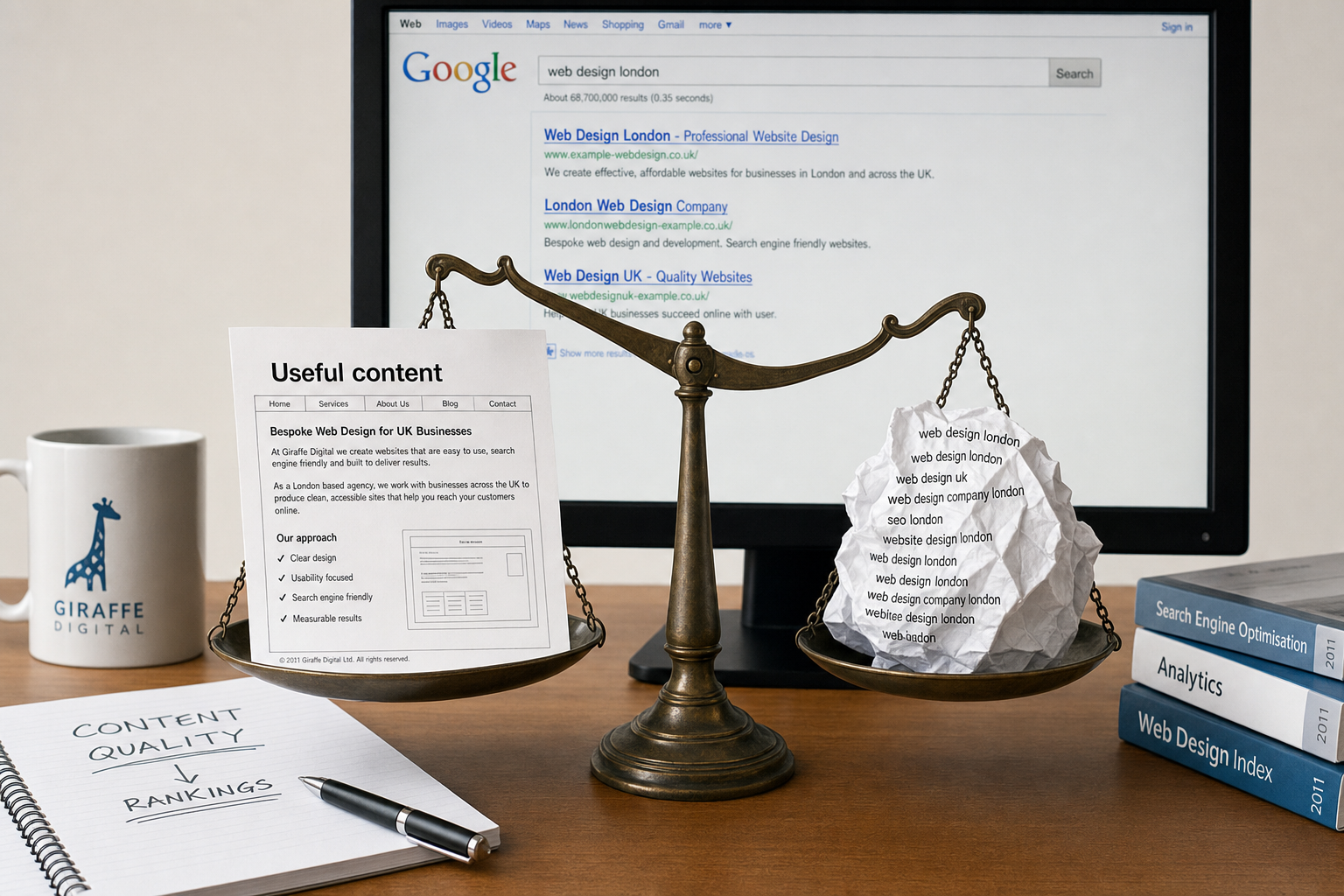
For many UK businesses, search engine optimisation still seems to revolve around one question: how many times should we use a keyword on a page? It is an understandable concern. Search engines need to understand what a page is about, and well-chosen phrases still matter. Yet repeating the same term until the page sounds unnatural is not a sound strategy. Strong content quality is more valuable because it helps people understand your offer, trust your organisation and take the next sensible step.
A website is rarely judged by search engines alone. It is judged by potential customers, existing clients, suppliers, journalists and prospective staff. If a page is awkward, repetitive or thin, visitors notice. They may not use the phrase "keyword stuffing," but they will recognise a page written for a machine rather than a person. Quality content brings together relevance, clarity, usefulness and credibility. That combination is far more likely to support search performance and commercial results than squeezing a phrase into every sentence.
What content quality means for a business website
Content quality is not simply about elegant writing. It is about publishing information that serves a clear business purpose and meets the reader's needs. A good page should explain what you do, who it is for, why it matters and what the visitor should do next. It should also do so in language that suits your audience.
For example, a local accountancy firm does not need to fill a page with the phrase small business accountant in every paragraph. It needs to explain the problems it helps solve: annual accounts, tax returns, payroll, VAT, business planning and practical advice for company directors. Those topics naturally include relevant words and phrases, but they also make the page useful. A visitor can quickly decide whether the firm understands their situation.
Good content quality usually includes several practical elements:
- Relevance: the page focuses on a subject your customers genuinely care about.
- Clarity: the copy is easy to read, with plain explanations and a logical order.
- Specificity: the page avoids vague claims and gives meaningful detail about services, processes or expertise.
- Trust: the content supports confidence through accuracy, professional presentation and realistic promises.
- Action: the visitor knows whether to call, enquire, download, visit, book or continue reading.
Search engines are increasingly focused on showing results that satisfy users. A page full of repeated phrases may initially appear relevant, but if visitors leave quickly because the content is poor, that is not a good long-term foundation. A useful, well-structured page has a better chance of attracting links, being shared on social networks and supporting enquiries.
Why keyword stuffing damages trust
Keyword stuffing is the practice of forcing a target phrase into copy far more often than a reader would expect. It can appear in paragraphs, headings, image descriptions, footers, hidden text or lists of locations. In some cases, it is obvious, such as a page that says a business offers web design London, affordable web design London, and professional web design London on almost every line. In other cases it is more subtle, but the result is the same: the page feels mechanical.
This approach creates several problems. First, it weakens the message. Repetition replaces explanation, so the visitor learns less about the business. Secondly, it harms credibility. A professional organisation should sound confident and clear, not desperate to be noticed by a search engine. Thirdly, it can make the page harder to read, especially on smaller screens or on pages with dense blocks of text.
There is also a branding issue. Your website copy forms part of your voice. If your brochures, proposals and conversations are helpful and professional, but your website reads like a list of search terms, the experience is inconsistent. That inconsistency can affect the quality of enquiries you receive. Better content tends to attract visitors who understand your offer before they make contact, which often leads to more productive conversations.
A sensible use of keywords is still important. The target phrase should appear where it helps the page make sense, such as in the page title, a heading, the opening paragraph and naturally within the body copy. Related phrases and common customer questions can also be included. The difference is that the writing remains useful. A good test is to read the page aloud. If it sounds unnatural, it probably needs editing.
Writing for people and search engines
The best search content is written for people first, then refined for search. That does not mean ignoring optimisation. It means starting with the visitor's problem and creating a page that genuinely helps. Search engines rely on signals such as on-page content, links, page structure, and user behaviour. Quality content supports many of those signals without resorting to tricks.
Before writing a page, consider the visitor's intent. Someone searching for a service may want reassurance, examples of what is included, an outline of the process and an easy way to enquire. Someone searching for advice may want an explanation, a checklist or a comparison. A single page should not try to answer everything, but it should answer the main question well.
For a service page, a useful structure might include:
- A clear opening that states the service and its benefit.
- A short explanation of who the service is suitable for.
- Details of what is included and how the process works.
- Common questions or concerns addressed in plain English.
- Evidence of credibility, such as qualifications, experience or sector knowledge where relevant.
- A clear call to action.
This structure provides search engines with enough context to understand the page while giving visitors the confidence to continue. It also naturally creates opportunities to use relevant phrases without cramming them into every sentence.
Meta descriptions should also be considered carefully. While they are not a magic ranking device, they often appear in search results and can influence whether someone clicks. A clear description that summarises the page is usually more effective than a string of keywords. Page titles should be concise, relevant and readable. Headings should help people scan the page, not merely repeat the same phrase.
The commercial value of better content
Content quality matters because it affects business outcomes. A website can attract many visitors and still fail if its pages do not clearly explain the offer. Conversely, a more focused site with well-written content may produce stronger enquiries because visitors arrive with a better understanding of the business.
Quality content can support several commercial goals. It can reduce time spent answering basic questions, because common concerns are already covered online. It can help sales conversations, because prospects have read a clear explanation of services before making contact. It can improve customer confidence, because the website feels considered and professional. It can also support repeat visits, particularly when a business publishes useful guidance, news or resources.
For example, a manufacturer could publish practical pages explaining materials, maintenance, lead times and ordering requirements. A solicitor could write clear guidance around common legal processes, while being careful not to replace tailored advice. A retailer could explain product differences, delivery information and aftercare. In each case, the content helps the visitor make a decision. The keywords are present because the subject demands them, not because they have been forced into the page.
It is also worth thinking beyond the first visit. Useful content can be referenced in emails, proposals, social media updates and conversations. A well-written guide can become a valuable business asset. Keyword-stuffed copy rarely has that broader value.
Content, website design and usability should work together
Even excellent copy can underperform if the website design makes it difficult to read. Content quality is closely linked to presentation. Clear typography, sensible spacing, meaningful headings and an uncluttered layout all help visitors absorb information. A page should not bury its most important message below confusing navigation or distracting graphics.
Many business websites now need to consider a growing range of screen sizes and devices. While desktop browsing remains important, more people are using smartphones and tablets to research businesses, check details and follow links from email or social networks. Pages should load efficiently, display essential information clearly and make contact details easy to find. Heavy pages, awkward menus and tiny text can reduce the value of even well-planned content.
Design should reinforce the message. A professional services firm may need calm, confident pages with clear explanations and strong calls to action. A creative business may need more visual emphasis, but the words still need to describe services and encourage enquiries. An ecommerce site needs product information, delivery details, returns guidance and reassurance at key stages of the buying process.
Good navigation also supports search and usability. If important pages are easy to find, visitors and search engines can understand the site's structure. A clear hierarchy, descriptive link text and a sensible internal linking structure help important content receive attention. Linking from a general services page to more detailed pages can be useful, provided each page has a distinct purpose.
Social media rewards useful content
Social media marketing is another reason to focus on content quality. Platforms such as Twitter, Facebook, LinkedIn and YouTube give businesses more ways to share knowledge, start conversations and point people back to useful pages. However, social media does not fix weak content. If a shared link leads to a poor page, the opportunity is wasted.
Useful content gives you something worthwhile to talk about. A business can share a practical article, a short guide, a video demonstration, a frequently asked question or a piece of industry commentary. The aim should not be to broadcast promotional messages all day, but to be helpful and relevant to the people you want to reach.
There is also an important connection between content and reputation. When people share a page, they are effectively recommending that it is worth a look. Pages that offer clear advice, original perspective or practical value are more likely to earn that recommendation. Keyword-stuffed pages are less likely to be shared because they do not make the sharer look helpful.
For smaller businesses, a manageable approach is best. Publish fewer pieces of content, but make them stronger. A thoughtful monthly article is usually more valuable than frequent thin posts written only to target search phrases. Social activity should then support that content by introducing it to relevant audiences and encouraging discussion.
Domain names, brands and content expectations
Domain registration decisions can also influence how visitors perceive content. A domain should be memorable, credible and suitable for the long term. Some businesses are tempted to register domains made entirely from keywords, especially when they believe an exact phrase may help in search. A descriptive domain can have value if it genuinely fits the brand, but it should not be chosen at the expense of trust.
For UK businesses, it is sensible to consider domain endings that match the market, such as a UK-focused domain for a company primarily serving customers here. It may also be prudent to secure closely related versions of a brand name where appropriate, to reduce confusion. Keep spelling simple, avoid unnecessary hyphens if they make the address harder to say, and think carefully before choosing a name that limits future growth.
Most importantly, a domain name cannot compensate for weak content. A keyword-rich address may attract attention, but visitors still need clear information, a professional design and reasons to make contact. A strong brand domain supported by high-quality content can be more persuasive than a search phrase turned into a web address with little substance behind it.
Practical steps to improve content quality
Improving content quality does not always require a complete website rewrite. Many businesses can make progress by reviewing key pages and making them more useful. Start with the pages that matter most: home page, main services, contact page, product categories, about page and any pages already receiving search traffic.
Ask practical questions of each page:
- Does the opening paragraph explain the page clearly?
- Would a potential customer understand what we offer and who it is for?
- Are we answering the questions people commonly ask before buying?
- Have we used the main keyword naturally rather than repetitively?
- Are headings helpful and specific?
- Is there a clear next step?
- Does the page sound like our organisation?
- Is any information out of date, vague or unnecessary?
It is also worth comparing your content with real enquiries. The language customers use on the telephone or in emails can reveal better phrases than internal jargon. If people ask for website redesign rather than digital presence refresh, use the language they understand. Search optimisation should reflect the market's vocabulary, not just the organisation's preferred terminology.
Where possible, add substance. Replace broad claims, such as "high-quality service," with explanations of how the service is delivered. Instead of saying experienced team, describe the kind of experience that matters. Rather than claiming bespoke solutions, explain what is tailored and why. Specific writing is more useful, more credible and often more naturally optimised.
A long-term approach to search visibility
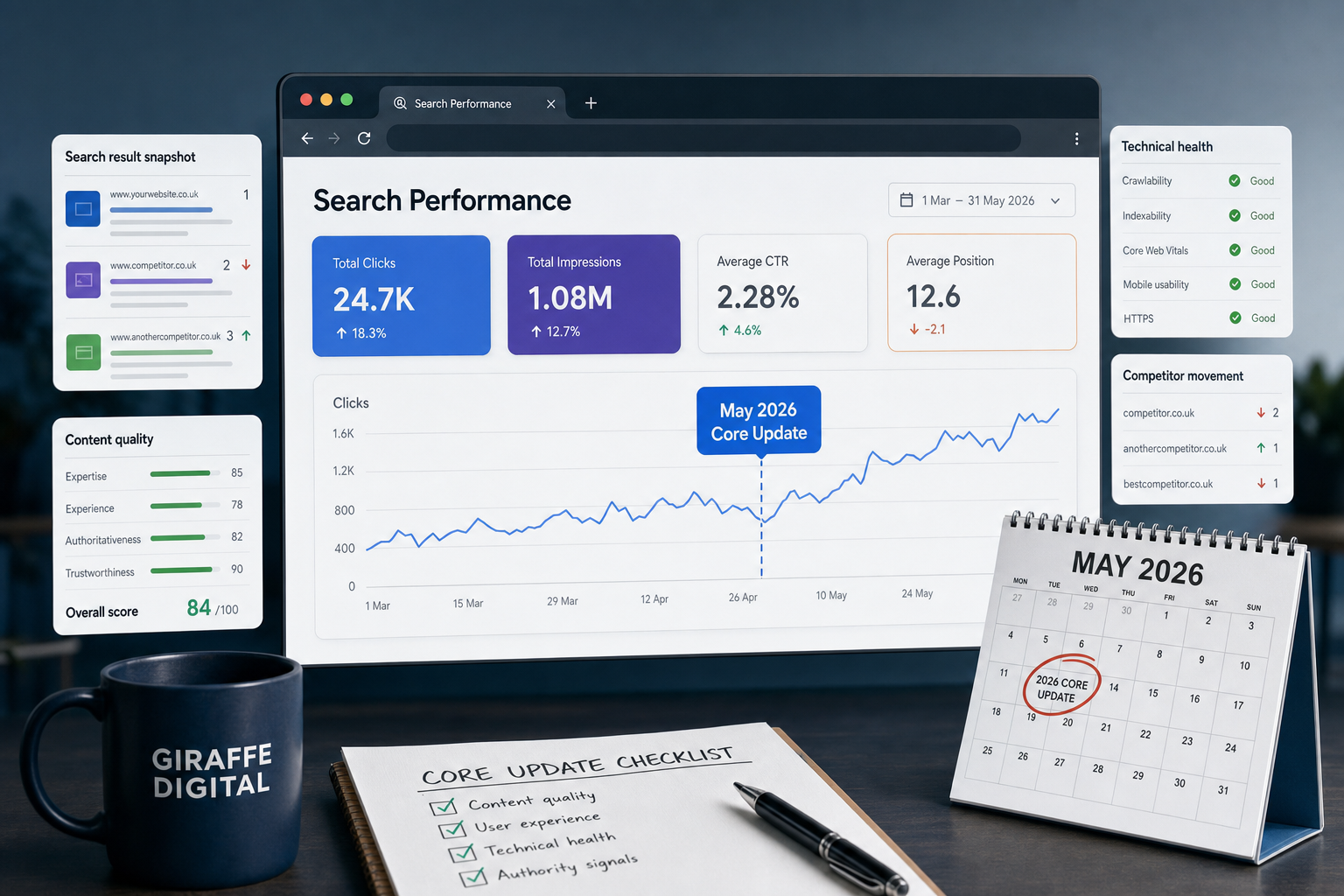
Search marketing is not a one-off exercise. Algorithms change, competitors improve their sites, and customer expectations rise. Chasing shortcuts can create short bursts of activity but often leaves a business with weak assets. Investing in content quality builds something more durable.
A practical long-term approach includes regular content reviews, sensible keyword research, technical checks, improved page structure and ongoing measurement. Website analytics can show which pages attract visitors, where people leave and which sources bring enquiries. Search engine webmaster tools can also help identify crawling issues and search queries. These insights should inform better content, not encourage mechanical repetition.
Quality content also works well alongside other digital marketing activity. Email newsletters need useful links. Social media needs material worth sharing. Pay-per-click campaigns need landing pages that convert visitors into enquiries. Offline marketing often drives people to the website for more information. In every case, the content has to do the work of explaining, reassuring and guiding.
The strongest websites are not built around keywords alone. They are built around customers, services, trust and clear communication. Keywords help connect the right people to the right pages, but content quality is what keeps them there and encourages them to act.
Quality first, optimisation second
Keyword stuffing belongs to a narrow view of search marketing. It treats the visitor as secondary and assumes that repetition is enough. A better approach is to create pages that answer real questions, present the business professionally and use search phrases with care.
For UK business owners considering a new website, a redesign or an SEO campaign, the message is straightforward: do not separate content from strategy. Plan what your customers need to know, design pages that make that information easy to use, and optimise the copy so search engines can understand it. That is the balance that creates better visibility, stronger trust and more valuable enquiries.
Content quality is not a fashionable extra. It is one of the foundations of effective digital marketing. When your website is clear, useful and credible, every other activity has a better chance of succeeding.