Facebook advertising is becoming an increasingly useful option for small businesses that want to reach local customers, build awareness and support the work already being done on their website, search visibility and wider marketing. For many UK business owners, Facebook has moved beyond being simply a place to post updates to friends and family. It is now a platform where people follow brands, recommend services, respond to events and notice offers from organisations they already know, or may be interested in.
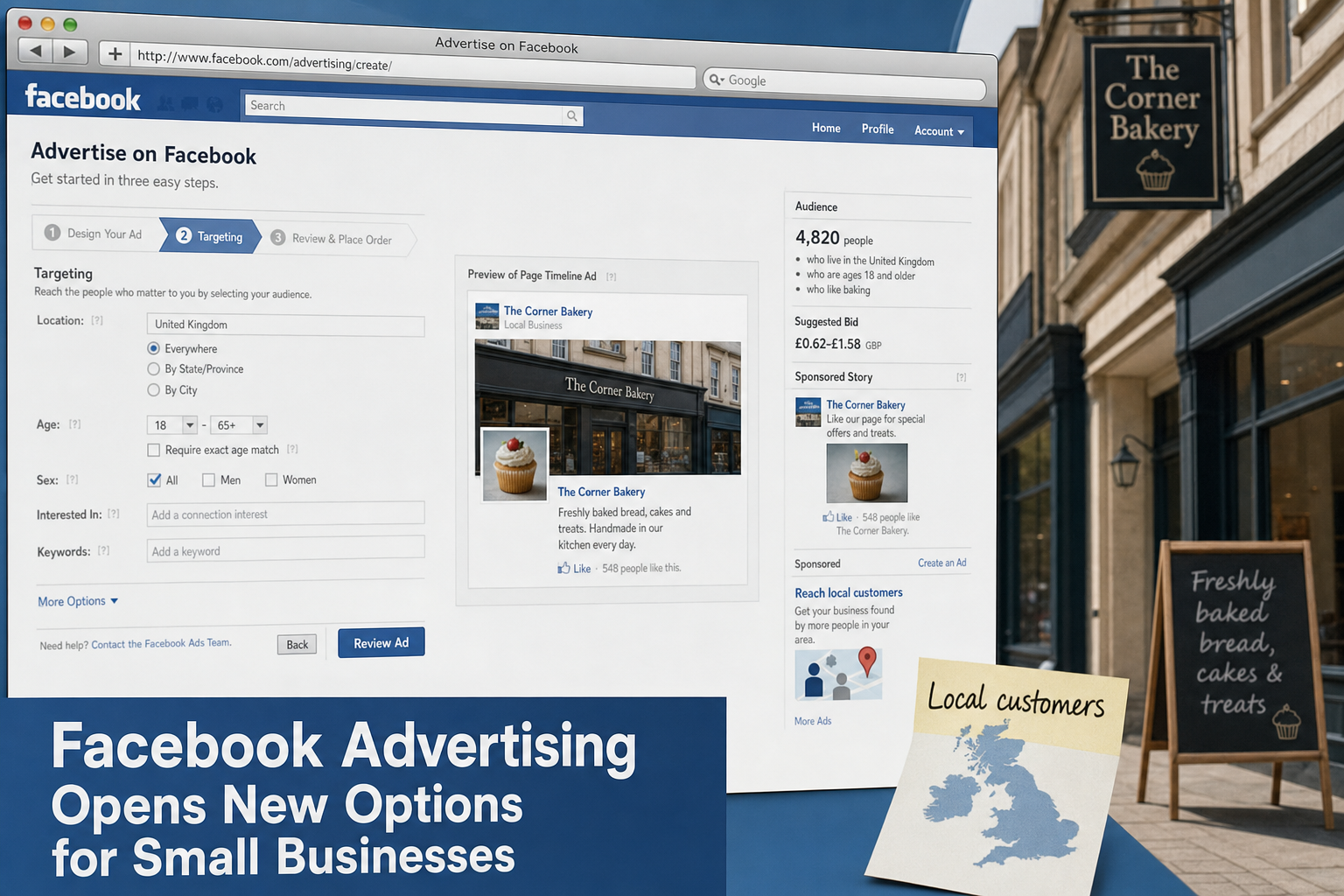
For a small business, the appeal is straightforward: Facebook allows advertising to be targeted by location, age, gender, interests and connections. That means a local retailer, professional service, restaurant, salon, trades business or community organisation can place a message in front of a more relevant audience than would be possible with many traditional forms of advertising. Used properly, Facebook advertising can complement website design, search engine optimisation and email marketing rather than replacing them.
Why Facebook advertising matters for small businesses
Small businesses often have to be selective about where they spend their time and marketing budget. A smart campaign is not about reaching everyone; it is about reaching the people most likely to care. Facebook advertising is useful because it provides a degree of audience control that can be particularly helpful for smaller organisations.
For example, a wedding photographer in Hampshire may want to reach engaged people within a manageable travelling distance. A fitness instructor may want to promote a new beginners’ programme to adults in a particular town. A café may wish to make more local residents aware of a new lunchtime menu. In each case, Facebook’s targeting options can help narrow the audience so that the advert is more relevant.
There is also a social element that is difficult to achieve with ordinary display advertising. When people like a Page, comment on a post or interact with a Sponsored Story, their connection may make the message feel more familiar to friends. This does not guarantee results, but it does make Facebook a distinctive channel for businesses that rely on recommendation, trust and local reputation.
Understanding the main advertising options
Small businesses using Facebook advertising in 2014 are likely to consider adverts that appear around Facebook’s content, promoted posts and activity that highlights interactions people have already made with a Page or post. The best option depends on what the business is trying to achieve.
Advertising a Facebook Page
Many campaigns are designed to encourage people to like a business Page. This can be useful where the business has a clear plan for regular updates, photographs, advice, events or product news. A Page with an engaged following can become a useful communication channel, especially for businesses that have repeat customers or an active local community.
However, a Page should not be treated as a replacement for a proper website. Facebook controls the platform, the layout and the rules. Your website remains the place where you can present your brand properly, explain services in full, publish useful content and capture enquiries in a controlled environment. A sensible approach is to use Facebook to start conversations and use the website to convert interest into action.
Promoting specific posts or stories
Promoted posts and social advertising can help extend the reach of activity that is already happening around your Page. If someone likes your Page or interacts with one of your updates, Facebook can use that social context to make the message more relevant. This can work well when the underlying post is genuinely useful or interesting, rather than simply promotional.
For instance, a garden centre might post a seasonal planting guide, a restaurant might share photographs of a new menu, or a solicitor might publish a brief note explaining a common legal question in plain English. If the content has value, advertising can help more people see it. If the content is weak, advertising usually only exposes that weakness to a larger audience.
Sending people to your website
Facebook advertising can also be used to send visitors to a specific page on your website. This is particularly useful when you have a dedicated landing page for a service, event, brochure request or enquiry form. Sending visitors to the home page is sometimes appropriate, but it is often better to take people directly to the most relevant information.
A good landing page should match the advert closely. If the advert promotes a free consultation, the page should explain the consultation clearly. If the advert mentions a local service, the page should reassure visitors that you work in their area. Consistency between advert and landing page helps avoid confusion and gives potential customers a clearer next step.
Planning a campaign before you spend
The best Facebook advertising campaigns begin with a clear objective. Before setting up an advert, decide what you want people to do. Do you want more Page likes, more website visits, more enquiries, more event responses or more awareness in a local area? Each objective needs a slightly different approach.
It is also important to think carefully about the audience. A common mistake is to target too broadly. For many small businesses, a well-defined local audience is more valuable than a large but vague one. Consider geography first, then refine by age, interests and other relevant details. The aim is to be specific without becoming so narrow that the advert has too little room to perform.
The message should be simple. People browsing Facebook are not usually looking for a detailed sales pitch. They are scanning updates, photographs and conversations. Your advert needs to be clear enough to understand quickly. A strong image, a short benefit-led headline and a direct call to action will usually perform better than a complicated message.
The importance of strong design and branding
Facebook advertising can bring more people into contact with your business, but that first impression must be supported by good design. If your Facebook Page looks neglected, your website is difficult to use, or your branding appears inconsistent, potential customers may lose confidence.
With Timeline for Pages, businesses have more visual space to express their identity. The cover image, profile image and Page content should work together. A strong cover image can show products, premises, staff, location or brand personality, but it should remain professional and appropriate. The profile image should usually be a clear logo or recognisable brand mark.
Your website should also reflect the same identity. Colours, typefaces, tone of voice and key messages should feel connected across Facebook, your website and other marketing material. This consistency makes a small business look more established and helps people recognise you when they see you again in search results, email or offline materials.
Website design also affects results after the click. A visitor who arrives from Facebook should be able to understand what you do, where you operate and how to contact you without unnecessary effort. Contact details, enquiry forms, maps and service information should be easy to find. If the site is slow, confusing or out of date, advertising may generate visits without producing meaningful enquiries.
How Facebook advertising fits with SEO and search marketing
Facebook advertising should be seen as part of a broader digital marketing plan. Search engine optimisation remains essential because many customers still begin with a search. Someone looking for an accountant, florist, builder or training provider may use a search engine when they are ready to compare options. Your website needs well-written pages, useful content and a sensible structure so that search engines can understand it.
Social media can support this wider visibility by helping content reach more people. If a business publishes a useful guide, case study, event announcement or seasonal article, Facebook can help distribute it. This may lead to more visits, more enquiries and more people becoming aware of the brand. It should not be treated as a shortcut for poor SEO, but it can help good content work harder.
Recent changes in search have also made quality more important. Thin, duplicated or low-value content is increasingly risky, while useful, original material gives businesses a stronger foundation. For small business owners, that means writing for real customers first: answer common questions, explain services properly, show expertise and keep information accurate.
Domain names, trust and the customer journey
A professional domain name remains an important part of building trust online. Even if much of your conversation with customers happens on Facebook, your website address should be easy to remember, easy to type and closely connected to your business name or main service.
When choosing a domain, keep it short where possible, avoid confusing spellings and think carefully before using hyphens or unusual wording. UK businesses will often benefit from a domain that feels appropriate for a UK audience, especially if most customers are local or national rather than international. It is also wise to register a domain in the business’s own name and keep renewal details organised, so that the company retains control of an important digital asset.
Facebook adverts that send people to a clear, professional domain can feel more trustworthy than adverts leading to a long or unfamiliar web address. This is another reason to consider the whole journey, from advert to landing page to enquiry.
Measuring results sensibly
One of the advantages of online advertising is the ability to review performance. Facebook provides information about impressions, clicks and interactions, while website analytics can show what visitors do after arriving on your site. These figures should be used to improve campaigns over time.
Clicks alone are not enough. A campaign that attracts many visitors but no enquiries may need a better landing page, clearer offer or more relevant audience. Similarly, a campaign with fewer clicks but strong enquiries may be more valuable than one that produces lots of casual traffic. Small businesses should look at the quality of the response, not only the volume.
Testing can be useful. Try different images, headlines or audiences, but change one element at a time where possible. This makes it easier to understand what has improved performance. Keep records of what has been tested, what worked and what should be avoided in future campaigns.
Practical examples for UK businesses
A local restaurant could use Facebook advertising to promote a new early evening menu to people within a short distance of the premises. The advert might lead to a website page showing the menu, opening hours, location and booking details. The Facebook Page could then be used to share photographs, respond to comments and remind followers about seasonal specials.
A professional services firm could promote a helpful guide, such as advice for small businesses preparing accounts or understanding employment responsibilities. Rather than pushing for an immediate sale, the advert could introduce expertise and direct visitors to a useful article on the website. Clear contact details and related service pages would then help turn interest into enquiries.
A retailer could advertise a new product range to people with relevant interests in nearby towns. The campaign might direct users to a product category page or encourage them to follow the Facebook Page for updates. Strong photography, accurate stock information and a clear returns or delivery message would help reassure potential customers.
A balanced approach works best
Facebook advertising gives small businesses more options, but it works best when supported by good planning. A rushed advert pointing to a weak website is unlikely to deliver lasting value. A clear campaign, targeted audience, professional design and useful landing page have a much better chance of success.
For UK business owners considering digital marketing, the key is to connect the pieces. Your Facebook Page should reflect your brand. Your adverts should speak to a defined audience. Your website should provide the detail and reassurance customers need. Your search marketing should help people find you when they are actively looking. When these elements work together, Facebook advertising can become a valuable part of a practical and measurable marketing programme.