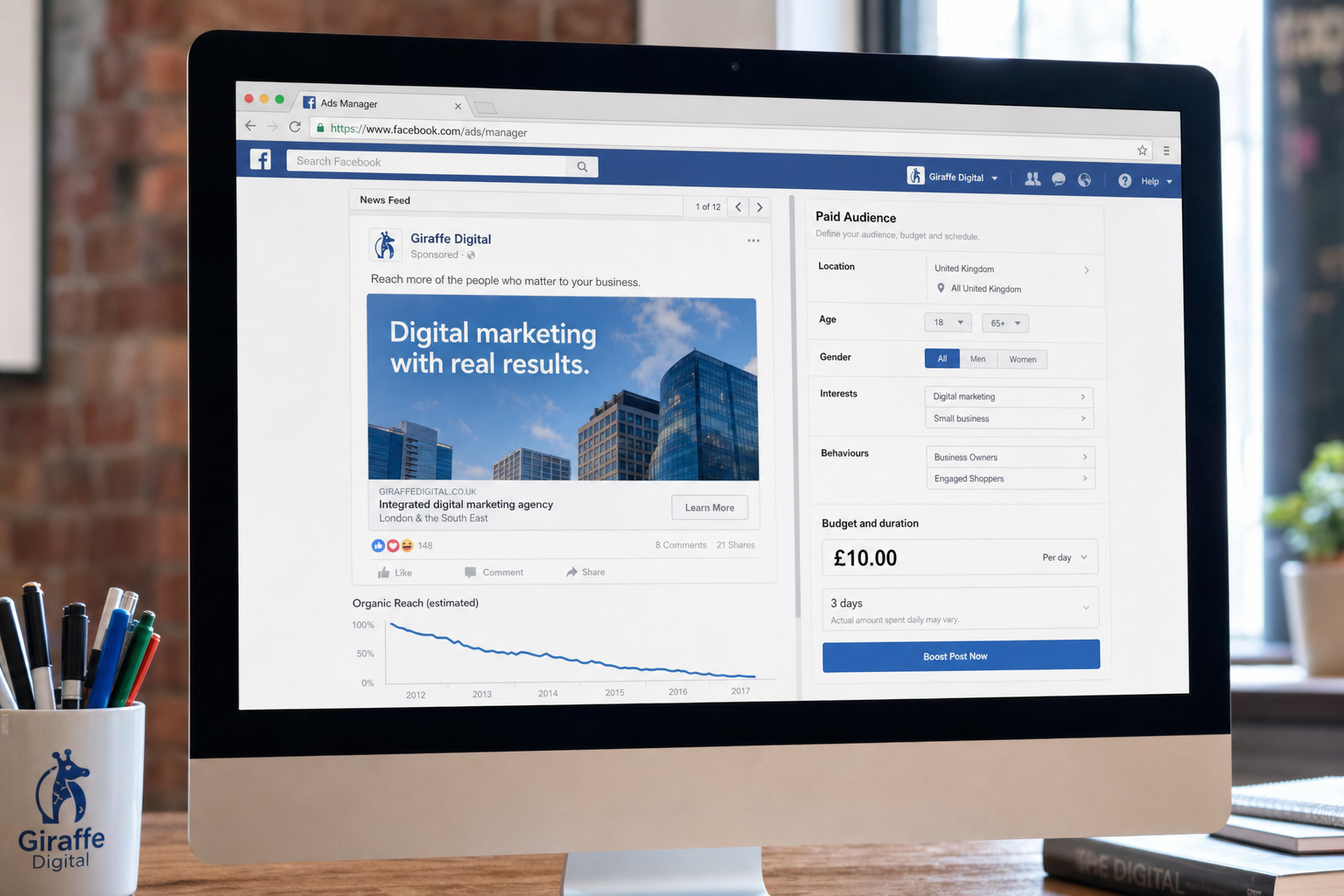
For many UK businesses, Facebook has become a familiar part of day-to-day marketing. It is where customers ask questions, recommend local services, share updates and discover brands. However, relying on a Facebook Page to reach followers for free is becoming less dependable. Organic reach has been reducing for some time, and changes to the News Feed mean business posts must work harder to appear in front of the people who matter.
This does not mean Facebook is no longer useful. Quite the opposite. It means businesses need a more considered approach to social media marketing, with paid social media playing a larger role alongside website design, search engine optimisation, email marketing, content and branding. A well-planned campaign can put the right message in front of a carefully selected audience at the right stage of their decision-making process.
Why organic Facebook reach is no longer enough
When businesses first began using Facebook Pages, many treated them as a free broadcast channel. If a company posted an update, a healthy proportion of its followers would see it. That expectation is now outdated. Facebook has a huge volume of content competing for attention, including posts from friends, family, groups, publishers, events and businesses. The News Feed cannot show everything to everyone.
Facebook’s ranking system aims to prioritise content that people are likely to find relevant and engaging. Posts that generate meaningful interaction may travel further, but many standard business updates reach only a small percentage of Page followers. For a business owner, this can be frustrating. You may have spent years building an audience, only to find that an important announcement, seasonal offer or new service update receives limited visibility.
The practical lesson is simple: an audience is still valuable, but access to that audience is not guaranteed. A Facebook Page should be treated as part of a wider digital presence rather than the main platform your business depends on. Your website, domain name, email list and search visibility remain assets you control more directly. Social platforms are powerful, but their rules and algorithms can change.
What paid social media can do for a business
Paid social media allows businesses to move from hoping a post will be seen to actively placing content in front of selected audiences. Instead of boosting every update without a plan, a company can use paid campaigns to support specific objectives such as increasing enquiries, promoting a new website, growing awareness in a local area, attracting event registrations or encouraging people to download a guide.
On Facebook, advertisers can target by location, age, interests, behaviours and connections. For many UK businesses, location targeting is particularly useful. A restaurant, tradesperson, gym, solicitor, estate agent or independent retailer may not need to reach the whole country. They may need to reach people within a sensible travelling distance who are likely to be interested in their services.
Paid campaigns can also support different stages of the customer journey. A person who has never heard of your business may need an introductory message that builds trust. Someone who has visited your website may respond better to a more specific offer or reminder. A past customer may be interested in a related service, seasonal promotion or loyalty message. This is where paid social becomes more strategic than simply paying for likes.
Boosted posts and structured campaigns are not the same thing
Many business owners first try paid social media by clicking the boost button beneath a Facebook post. This can be useful for simple visibility, especially if the post is already performing well organically. However, boosting should not be confused with a properly planned campaign.
A structured campaign begins with a clear objective. Are you trying to increase traffic to a landing page, generate enquiries, encourage phone calls, build awareness or promote a piece of content? The objective should influence the advert format, audience, creative, copy, landing page and measurement. Without that clarity, it is easy to spend money on engagement that looks encouraging but does not contribute to business goals.
For example, a local home improvement company might boost a photograph of a completed project and receive several likes. That may help visibility, but a more focused campaign could target homeowners in selected postcodes, use a carousel of project images, link to a service page and encourage visitors to request a consultation. The second approach is more likely to create measurable commercial value.
Building a stronger website before increasing traffic
Paid social media works best when the destination is ready to convert interest into action. Sending people to a slow, confusing or dated website can waste valuable attention. Before increasing traffic, businesses should review whether their website gives visitors enough confidence to enquire, buy, book or call.
A good business website in 2017 should be responsive, clear and easy to use on mobile devices. Many people will click from Facebook on a phone, so pages should load quickly and present key information without forcing visitors to pinch, zoom or search. Contact details should be easy to find, forms should be straightforward and calls to action should match the advert that brought the visitor there.
Consistency also matters. If an advert promises a free consultation, a guide, a product range or a specific service, the landing page should continue that message. Sending every click to the homepage is not always the best option. A dedicated landing page can explain the offer, answer common objections and guide the visitor towards one clear next step.
Using the Facebook pixel and conversion tracking
One of the most useful tools for advertisers is the Facebook pixel. Added to a website, it helps track what people do after clicking or viewing an advert. This can include visiting a page, completing a form, viewing a product or reaching a thank-you page after an enquiry.
Conversion tracking is important because social media results should not be judged only by likes, shares and comments. Those metrics can show interest, but they do not always show business impact. If your aim is to generate enquiries, the more important question is whether the campaign helped people take that action.
The pixel can also help create remarketing audiences. For instance, a business could show follow-up adverts to people who visited a service page but did not enquire. These audiences are often warmer than completely cold prospects because they have already shown some interest. As always, businesses should be transparent and responsible with data, respecting privacy expectations and relevant UK marketing regulations.
Choosing the right platforms for paid social media
Facebook is often the starting point because of its large audience and detailed targeting options, but it is not the only platform worth considering. Instagram advertising, managed through Facebook’s advertising system, can work well for visually led sectors such as food, fitness, fashion, interiors, travel, events and lifestyle brands. Strong imagery is essential, and adverts should feel natural within the feed.
LinkedIn may be more appropriate for business-to-business campaigns, recruitment, professional services and higher-value commercial decisions. Its targeting by job role, industry and company type can be useful, although the message usually needs to be more business-focused and less casual.
Twitter can support timely conversations, events, content promotion and brand awareness, especially where audiences are active around news, media, sport, politics or specialist interests. Pinterest may be relevant for businesses connected to design, weddings, craft, interiors, food and retail inspiration. The right choice depends on where your audience spends time and what kind of decision you are asking them to make.
How paid social supports SEO and search marketing
Paid social media and search engine optimisation are different disciplines, but they can support each other. SEO is concerned with improving visibility in search results, often by creating useful content, strengthening technical foundations and building authority over time. Paid social can help bring the right audience to that content more quickly.
For example, a business might publish a helpful guide answering common customer questions. Search visibility may build gradually, but a paid social campaign can introduce the guide to a relevant audience immediately. If the content is genuinely useful, it may earn shares, links, enquiries and brand searches. These signals can strengthen the wider digital presence, even though paid social itself is not a direct substitute for SEO.
Paid social can also reveal which messages resonate. If several advert variations are tested, the best-performing headlines, offers and benefits can inform website copy, blog topics, email subject lines and search advertising. This makes social advertising a useful research tool as well as a promotional channel.
Branding, creative and message quality still matter
Targeting is powerful, but it cannot rescue weak creative. People scroll quickly, particularly on mobile. An advert must earn attention in a crowded feed while still feeling credible and relevant. Clear photography, concise copy and a strong reason to click are all important.
Businesses should avoid trying to say everything in one advert. A better approach is to focus on one audience, one message and one next step. A firm offering several services might run separate campaigns for different customer needs rather than one general advert listing every capability.
Brand consistency also helps. Colours, typography, tone of voice and imagery should feel connected to the website and wider marketing materials. This reassures people that they have reached the right place after clicking. If the advert feels polished but the website feels neglected, trust can be lost quickly.
Domain names and owned digital assets
As social platforms become more competitive, businesses should pay attention to the assets they own. A professional domain name is a key part of that foundation. It should be easy to spell, easy to say and closely connected to the business name or service. For UK organisations, a relevant UK domain can help reinforce location and credibility, while other suitable extensions may also be useful depending on the brand and audience.
When registering a domain, it is sensible to keep ownership details organised, use a secure account, renew on time and ensure the domain is registered in the correct business name. Avoid choosing a domain that is confusingly similar to another brand or so long that customers are likely to mistype it. A clear domain supports email, search visibility, printed marketing, social profiles and paid campaigns.
Social media profiles are important, but they should not replace a properly maintained website and domain. Paid social can bring attention; your website should turn that attention into lasting value.
Measuring success without vanity metrics
It is easy to be distracted by visible numbers such as likes, reactions and shares. These can be helpful indicators, but they should not be the only measures of success. A campaign with modest engagement may still perform well if it reaches the right people and generates quality enquiries. Conversely, a popular post may bring little commercial benefit if the audience is not relevant.
Useful measures might include landing page visits, form submissions, phone calls, brochure downloads, email sign-ups, event registrations, time spent on page and assisted conversions. The right metrics depend on the campaign objective. Before launching, decide what a meaningful result looks like and ensure the website is set up to track it as accurately as possible.
Businesses should also allow room for testing. Different audiences, images, headlines and calls to action can produce very different results. A sensible campaign structure makes it easier to learn what works and refine future activity.
Next steps for UK business owners
If your business has relied on organic Facebook posts, now is a good time to review your social media strategy. Start by identifying your commercial priorities. Do you need more enquiries, greater local awareness, repeat purchases, event attendance or stronger recruitment? Then consider which audiences are most valuable and what they need to see before taking action.
Next, review the customer journey from advert to website. Is the message clear? Is the landing page relevant? Does the page load well on mobile? Is the enquiry process simple? Are you tracking the actions that matter? Paid social media performs best when it is connected to a wider digital marketing plan rather than treated as an isolated activity.
Organic social still has a role. It helps show personality, answer questions, share news and maintain a visible presence. However, for businesses that need predictable reach, paid promotion is increasingly important. With thoughtful targeting, strong creative and a well-designed website, paid social media can help UK organisations reach more of the right people and turn attention into measurable business opportunities.