Instagram Stories have quickly moved from being a light-hearted social feature to a useful marketing format for businesses that want to build visibility, trust and action. For UK business owners, the appeal is simple: Stories sit at the top of the Instagram app, they are easy to consume, and they invite regular, informal contact with an audience that may not see every standard post in the feed.
That does not mean every organisation should rush in without a plan. The best results come when Stories are treated as part of a wider digital strategy, connected to brand identity, website design, search marketing, content planning and customer service. Used well, Instagram Stories marketing can support awareness, product discovery, event promotion, recruitment, enquiries and repeat visits to your website.
Why Instagram Stories matter for businesses
Stories work because they match how people already use mobile devices. The format is vertical, quick and immediate. A user can tap through several updates in seconds, pause on something interesting, reply with a message or follow a call to action. For a business, this offers a more conversational space than a polished brochure page or a carefully staged campaign image.
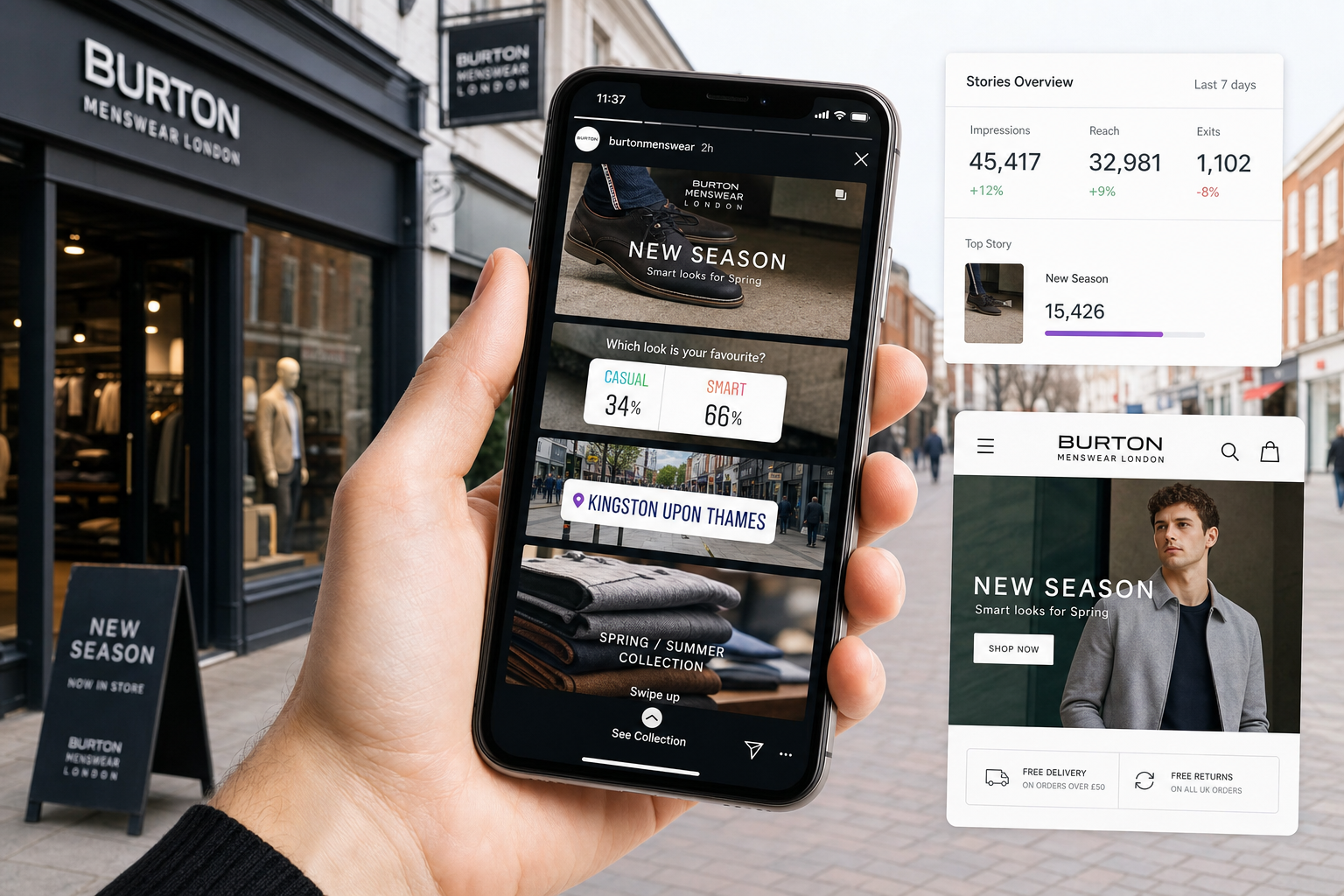
In April 2018, Instagram Stories are particularly valuable because the format is still fresh enough to feel personal, but mature enough to offer practical marketing features. Businesses can use photos, short video, text overlays, location tags, hashtags, mentions, polls and Story adverts. Eligible accounts can also use link features to send viewers to a relevant page. Highlights, introduced recently, allow selected Stories to remain visible on a profile beyond the usual 24-hour window.
This combination makes Stories useful for more than simple brand awareness. They can help demonstrate expertise, show products in use, introduce staff, share timely updates, answer common questions and encourage customers to visit a website. The important point is to make each Story purposeful, rather than filling the space with disconnected updates.
What makes Stories different from normal Instagram posts
A standard Instagram post often needs to stand on its own. It may be designed to look carefully composed, sit neatly within a profile grid and attract engagement over a longer period. A Story, by contrast, is temporary, sequential and more relaxed. It can show the process behind the finished product, not only the finished product itself.
This makes Stories well suited to businesses that want to appear more approachable. A restaurant can show the preparation of a seasonal dish. A retailer can give a quick tour of new stock. A trades business can show a tidy completed job, provided customer privacy is respected. A professional services firm can explain a common question in three short frames. A charity can show a volunteer day as it happens.
Stories also encourage narrative. Instead of posting one image and hoping the caption does all the work, a business can build a short sequence: introduce the problem, show the solution, add a testimonial-style comment or question prompt, then direct people to the website for more detail. This structure is particularly helpful for services that require explanation, such as website design, branding, digital marketing or technical support.
Practical Instagram Stories marketing ideas
The strongest Stories are usually simple, timely and useful. They do not need to look like television adverts. In fact, Stories that feel too over-produced can lose some of the immediacy that makes the format work. What matters is clarity, consistency and relevance to the customer.
Show the human side of your business
People often choose a business because they feel confident in the people behind it. Stories are a natural place to introduce your team, show daily activity and explain what your organisation cares about. A short clip of a designer discussing a new website concept, a workshop preparing an order, or a team member answering a frequently asked question can all make a brand feel more accessible.
Demonstrate products and services
If your product is visual, use Stories to show scale, movement, detail and use cases. If your service is less tangible, break it into steps. For example, a website design company might show a wireframe sketch, a brand colour selection, a mobile layout preview and a final call to book a consultation. This helps potential customers understand the process before they make contact.
Use polls and questions informally
Poll stickers can be useful for light research and engagement. A local café might ask which cake should return at the weekend. A retailer might ask which colour customers prefer. A business-to-business organisation might ask which topic followers would like covered next. The purpose is not to run formal research, but to encourage interaction and learn what your audience responds to.
Promote timely offers and events
Because Stories disappear after 24 hours unless saved to Highlights, they suit timely information. Events, limited availability, new blog posts, appointment reminders and behind-the-scenes coverage can all work well. Avoid overusing urgency, though. If every Story is treated as urgent, customers will soon stop paying attention.
Connecting Stories to your website
Instagram engagement is useful, but most businesses need activity to lead somewhere. Your website remains the place where customers can read detailed information, compare services, make an enquiry, book, buy or learn more about your organisation. For that reason, Instagram Stories marketing should be planned with your website in mind.
If your account has access to Story links, use them carefully. A Story about a new service should link directly to that service page, not simply to the home page. A Story promoting an event should link to the event information or booking page. A Story sharing a blog post should lead directly to the article. The fewer steps a user has to take, the more likely they are to continue.
If your account does not have link access, you can still use Stories to support website visits. Refer clearly to the link in your profile, keep that link up to date and make sure the destination page matches the current campaign. You may also use a memorable page address in the Story text if it is short and easy to type. For example, a business might create a simple landing page for a campaign and mention it in the Story, provided the address is clear and not cluttered.
Your website must also be ready for mobile traffic. Stories are viewed on phones, so a user who taps through to your site expects fast loading, readable text and a simple route to action. A page that looks fine on a desktop computer but is awkward on a mobile screen will waste attention that was hard to earn. Review image sizes, page speed, button placement, forms and navigation before sending traffic from Stories.
Design considerations for a stronger Story presence
Good Story design does not mean every frame must be complex. It means each frame should be easy to understand within a second or two. Use clear contrast, legible text and consistent brand elements. A simple colour palette, recognisable typography and repeated layout style can make even informal updates feel professional.
Vertical composition matters. Images designed for a square feed post often do not translate well into Stories. Plan for the tall format, keeping important details away from the very top and bottom of the screen where interface elements may appear. If you are using text overlays, keep them short. Viewers should not have to pause repeatedly to understand the message.
Branding should be present but not overpowering. A small logo, consistent colour or familiar visual style is usually enough. The aim is to make the Story recognisable without making it feel like a static advert. For service businesses, consider a repeatable Story format such as quick tips, project snippets, myth-busting posts or weekly answers to customer questions.
Using Highlights as a mini navigation area
Highlights give businesses a way to extend the life of their best Stories. Instead of losing useful content after 24 hours, you can save selected Stories into named collections on your profile. This is helpful for new visitors who want to understand what your business offers before they follow, enquire or visit your website.
Think of Highlights as a small navigation area for Instagram. Useful categories might include Services, Reviews, Events, FAQs, Projects, New In, Tips or Behind the Scenes. Keep titles short so they display clearly. Cover images should look consistent and be easy to recognise. Do not overload Highlights with every Story you have ever posted; choose content that helps a new visitor make sense of your business.
For a company offering website design or digital strategy, a Highlight might explain the steps of a typical project: discovery, planning, design, development, launch and ongoing optimisation. For a retailer, Highlights might show product categories or seasonal ranges. For a venue, they might show rooms, menus, events and directions.
How Stories support SEO and wider digital marketing
Instagram Stories do not directly replace search engine optimisation. Search visibility still depends on a well-structured website, useful content, sound technical foundations, quality signals and relevance to user intent. However, Stories can support the wider search and digital marketing picture in several ways.
First, Stories can increase awareness of your content. If you publish a useful guide on your website, a Story can introduce the subject and encourage followers to read it. This can bring engaged visitors to the page and help your content work harder across channels. Secondly, Stories can strengthen brand recall. When customers later search for your business by name, clear and consistent branding across social media and your website can make you easier to recognise.
Thirdly, Stories can reveal what your audience cares about. If a particular topic receives replies, taps or poll responses, it may be worth turning into a blog post, FAQ page, service page or email topic. This is where social media marketing and SEO can work together: social interaction highlights questions, and your website can provide fuller answers that are discoverable through search.
For local businesses, location tags and relevant local content can also help make Stories more useful to nearby customers. While this should not be seen as a substitute for proper local SEO, it can support local awareness and encourage people to visit, call or search for you.
Domain names, campaign pages and trust
A clear domain name helps customers remember and trust your business online. If you are using Stories to promote a campaign, event or service, consider whether your web address is easy to read, easy to spell and consistent with your brand. Avoid awkward punctuation, confusing abbreviations or domain choices that could be mistaken for another organisation.
When registering domain names, choose options that support your long-term brand rather than short-lived trends. A UK business may consider whether a UK-focused domain is appropriate, whether the name matches the trading name, and whether common misspellings need to be protected. Keep registration details organised, ensure renewal dates are monitored and make sure the domain points to a secure, professionally maintained website.
Campaign-specific pages can be helpful, but they should usually sit within your main website rather than being scattered across unrelated addresses. This keeps trust, analytics and search value focused in one place. It also gives customers a clearer route from a Story to deeper information about your business.
Measuring whether Stories are working
It is tempting to judge Stories only by views, but views alone do not tell the whole story. A small, relevant audience that replies, taps through or visits your website may be more valuable than a large passive audience. Review metrics such as completion, replies, link taps where available, profile visits and website enquiries. Compare these with the purpose of each Story.
Set simple objectives before posting. One Story sequence may aim to increase awareness of a new service. Another may aim to drive visits to a blog post. Another may encourage event sign-ups. When the objective is clear, it becomes easier to decide whether the content worked and what to improve next time.
Use website analytics to assess traffic from Instagram where possible. Look at landing page behaviour, enquiry forms and conversion routes. If people arrive from Instagram but leave quickly, the issue may be the landing page rather than the Story itself. The best digital marketing results often come from improving both the social content and the website experience together.
Common mistakes to avoid
- Posting without a purpose: Each Story should have a reason, even if that reason is simple engagement or brand familiarity.
- Using too much text: Stories are fast-moving. Keep wording short and easy to read.
- Ignoring mobile website design: If a Story sends users to a slow or confusing page, interest will be lost.
- Over-promoting: Mix sales messages with useful, entertaining or informative content.
- Inconsistent branding: A recognisable visual style helps customers connect Stories with your wider business.
- Forgetting accessibility: Add text where spoken audio is important, as many people view Stories without sound.
Building Stories into a sensible content plan
Instagram Stories marketing works best when it is manageable. A business does not need to post constantly to benefit. Start with a simple weekly plan that reflects your actual capacity. For example, you might share one useful tip, one behind-the-scenes update, one customer question and one website content promotion each week.
Plan key campaigns in advance, but leave room for spontaneous updates. Stories are well suited to moments that feel immediate, so an overly rigid schedule can reduce their value. The balance is to know your themes, prepare assets where helpful and remain alert to opportunities that arise during the working week.
Make sure responsibility is clear. Decide who can post, who approves content where necessary, and what should not be shared. This is especially important for sectors where confidentiality, compliance or customer privacy matter. A simple internal guide can prevent mistakes and help maintain a consistent tone.
A useful format, not a complete strategy
Instagram Stories have become a genuinely useful marketing format, but they should not be treated as a complete digital strategy on their own. They are most effective when connected to a strong website, clear branding, useful content, sensible SEO, reliable domain management and a broader social media plan.
For UK business owners, the opportunity is to use Stories to make the organisation more visible, more approachable and easier to understand. Start with the questions your customers already ask, create short Story sequences that answer or illustrate them, and guide interested viewers towards the most relevant page on your website. With a practical plan and consistent execution, Stories can become a valuable part of your digital marketing activity in 2018.