
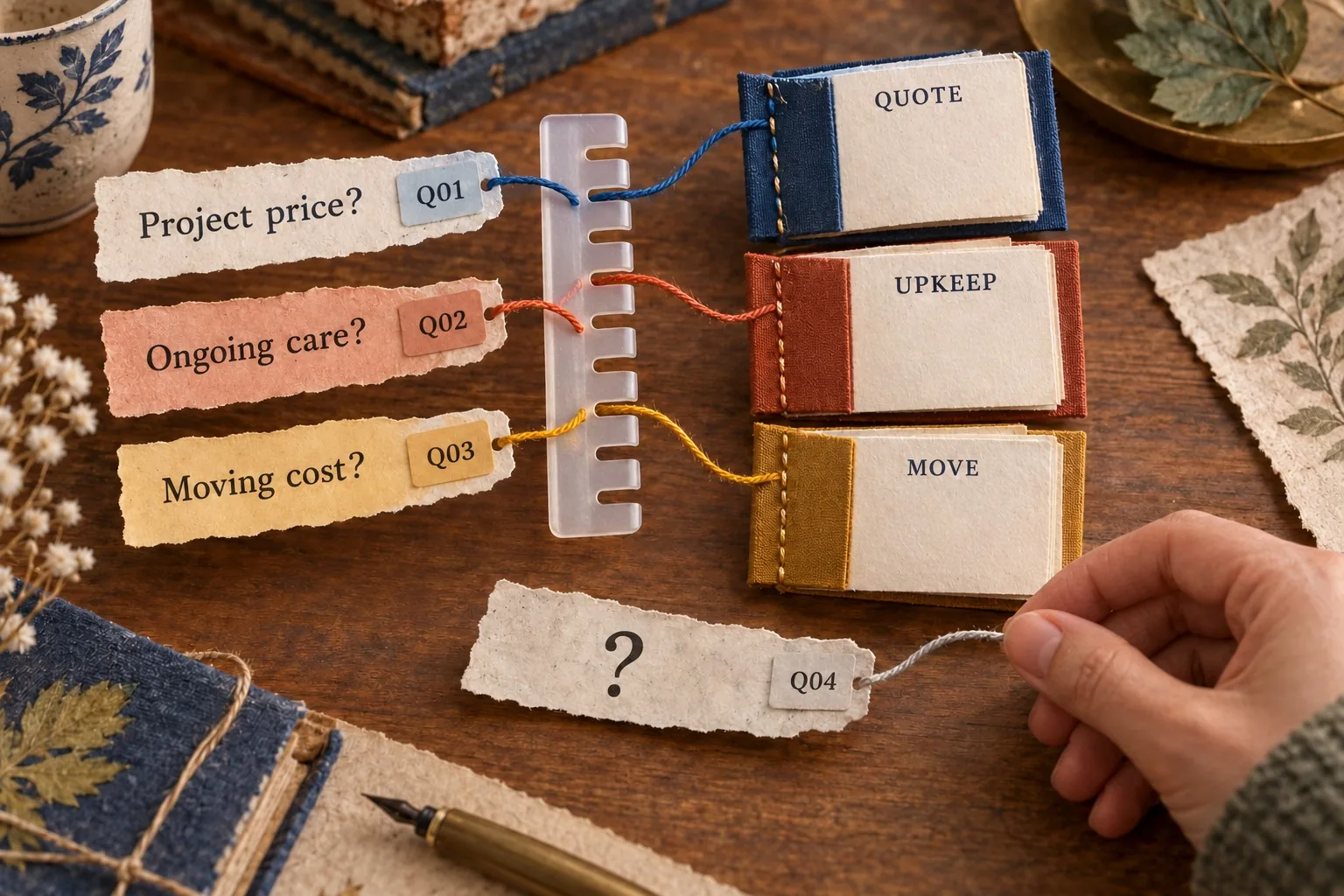
Customer questions are useful evidence for content planning, but they rarely arrive as a tidy list. They appear in emails, enquiry forms, sales notes and conversations. Several people may ask the same thing differently, while one message can contain several distinct concerns. AI can help organise this material, provided the team preserves the original meaning and checks the proposed groups.
The task is to turn recorded questions into useful content themes. It is not to ask a model to invent what customers probably want. Start with a defined collection, keep a route back to the evidence and involve someone who understands the service. That gives the business a stronger basis for choosing pages and articles that answer real needs.
Choose a clear collection period and scope
Decide which service, audience and period you want to examine. A collection covering recent website project enquiries answers a different question from one combining years of support tickets across every service. Define the purpose before gathering material.
Record where each question came from and how it was captured. A note written by a salesperson is an interpretation of a conversation, while a submitted form may preserve the customer's actual wording. Both can be useful, but they should not be treated as identical evidence.
Include the limits of the collection. Customers who contact the business are only part of the audience, and questions asked through an unrecorded telephone call may be missing. The resulting themes describe the material you analysed rather than a complete picture of everyone searching for the service.
Prepare material through an approved handling process
Use the business's approved tool and information handling arrangements. Decide which details are necessary for the analysis and remove unnecessary identifying or operational information from the working copy where appropriate. Ask the responsible person for advice when the material requires more careful treatment.
Give each observation a reference that lets an authorised reviewer find its source. Keep the source in the proper system, with access suited to the information. The analysis does not need to create a second unrestricted archive of customer correspondence.
Separate the question from surrounding instructions that do not belong in the analysis. A customer message is source material to interpret, not an instruction for the AI tool to change the task or reveal other records. The working brief should make that boundary clear.
Keep observations separate from interpretations
Capture what the customer actually asked before assigning a theme. If someone asks whether their existing email will keep working during a website move, retain that specific concern. Rewriting it immediately as general digital transformation can erase the practical need that content should address.
Distinguish observations from findings and actions, then group related observations. Keep the recorded question, the team's interpretation and the proposed content response identifiable. That separation allows a reviewer to check whether the proposed theme is supported by customer evidence. Our user research and evidence guide provides the related checks.
Split a message containing several questions into separate observations where useful, while retaining the relationship to the original message. A website enquiry might ask about timing, content preparation and hosting ownership. One broad project planning label may not capture all three needs.
Ask AI for a provisional grouping
Give the model a specific task and an output format the team can inspect. Ask it to propose groups, explain the basis for each group and list the observation references included. Require it to leave ambiguous items unresolved rather than forcing everything into a category.
Group these recorded customer questions by the practical information customers need. Use only the supplied observations. For each proposed theme, provide a short label, its defining question and the observation references assigned to it. Keep different buying stages separate where they change the information needed. List uncertain assignments and questions that do not fit. Do not invent customer quotations, frequencies or additional observations.
Use this as a starting brief and adapt it to your collection. Inspect the result against the source list. Check for missing references, duplicated assignments and labels that sound impressive but say little about the customer's problem.
Distinguish topic, intent and stage
Questions can share a topic while requiring different answers. An explanation of hosting, a comparison of hosting proposals and a guide to recovering a failed website all concern hosting. They belong to different tasks and may need different pages.
Ask the reviewer to identify what the person was trying to do. Were they learning a concept, comparing options, preparing a project or troubleshooting a problem? This makes content planning more precise than grouping every related word into a single long article.
Keep useful overlaps visible. A question about moving a website may involve hosting, email and domain control. Decide the main task and supporting relationships without pretending it has only one subject. The eventual article can answer the primary need and link to relevant supporting guidance.
Review the groups with service expertise
Give an experienced colleague the proposed themes and their assigned observations. Ask whether each group makes sense, whether the label reflects the evidence and whether important distinctions have been lost. They should be able to inspect the original material through its reference.
Consider a proposed theme called website cost. It might combine questions about an initial project quote, ongoing maintenance and the cost of migrating from another supplier. A reviewer can separate these because the customer decisions and accurate explanations differ.
Record merges, splits and unresolved items. Do not ask the AI to make the final editorial judgement solely because its output is neatly formatted. The business owns the service explanation and needs to verify what the proposed theme would imply.
Count evidence without exaggerating demand
If you report frequency, define what you counted. Several questions in one message, repeated messages from one customer and separate customers raising the same concern are different units. Choose the unit that fits the analysis and retain the underlying references.
Use a deterministic count of the reviewed assignments where possible, then reconcile it with the source list. Avoid accepting a generated frequency simply because it appears beside a plausible theme. The number should be traceable to the material you supplied.
Keep the interpretation proportionate. A common question in your enquiry records indicates a recurring issue in that collection. It does not establish search volume or prove that the whole market prioritises it. Combine it with appropriate search research and business knowledge before making broader claims.
Map themes to existing website content
Check whether the website already answers each reviewed question. Record the relevant page, where the answer appears and whether a customer can reasonably find it. An existing answer buried in an unrelated article may need a clearer link or a service-page explanation.
Distinguish a content gap from a navigation or wording problem. If customers repeatedly ask about the process despite an accurate process page, examine how the page is presented and connected to the enquiry journey. Another article may not solve the underlying difficulty.
Assign a suitable response: update a service page, improve a form hint, create a practical guide or prepare a clearer follow-up message. Content planning should improve the information journey rather than turn every observation into a separate blog post.
Create a brief that preserves the question
For each priority piece, state the customer's task, the question to answer, the relevant service facts and the evidence behind the theme. Add an intended next step and any supporting pages. This keeps the writer focused on an actual need.
Give an expert responsibility for checking factual claims and limitations. AI can help organise or draft, but the published explanation should reflect what the business can accurately say. Review the final page for clarity, appropriate internal links and a complete answer.
Giraffe Digital's digital strategy service can help connect customer questions to content and wider journeys. Used carefully, AI makes the first organising step easier while leaving evidence, interpretation and editorial decisions visible to the people responsible for them.
Frequently asked questions
How should we choose a clear collection period and scope?
Decide which service, audience and period you want to examine. A collection covering recent website project enquiries answers a different question from one combining years of support tickets across every service. Define the purpose before gathering material. Record where each question came from and how it was captured. A note written by a salesperson is an interpretation of a conversation, while a submitted form may preserve the customer's actual wording. Both can be useful, but they should not be treated as identical evidence. Include the limits of the collection. Customers who contact the business are only part of the audience, and questions asked through an unrecorded telephone call may be missing. The resulting themes describe the material you analysed rather than a complete picture of everyone searching for the service.
How should we keep observations separate from interpretations?
Capture what the customer actually asked before assigning a theme. If someone asks whether their existing email will keep working during a website move, retain that specific concern. Rewriting it immediately as general digital transformation can erase the practical need that content should address. Distinguish observations from findings and actions, then group related observations. Keep the recorded question, the team's interpretation and the proposed content response identifiable. That separation allows a reviewer to check whether the proposed theme is supported by customer evidence. Our user research and evidence guide provides the related checks. Split a message containing several questions into separate observations where useful, while retaining the relationship to the original message. A website enquiry might ask about timing, content preparation and hosting ownership.
How should we distinguish topic, intent and stage?
Questions can share a topic while requiring different answers. An explanation of hosting, a comparison of hosting proposals and a guide to recovering a failed website all concern hosting. They belong to different tasks and may need different pages. Ask the reviewer to identify what the person was trying to do. Were they learning a concept, comparing options, preparing a project or troubleshooting a problem? This makes content planning more precise than grouping every related word into a single long article. Keep useful overlaps visible. A question about moving a website may involve hosting, email and domain control. Decide the main task and supporting relationships without pretending it has only one subject. The eventual article can answer the primary need and link to relevant supporting guidance.
How should we count evidence without exaggerating demand?
If you report frequency, define what you counted. Several questions in one message, repeated messages from one customer and separate customers raising the same concern are different units. Choose the unit that fits the analysis and retain the underlying references. Use a deterministic count of the reviewed assignments where possible, then reconcile it with the source list. Avoid accepting a generated frequency simply because it appears beside a plausible theme. The number should be traceable to the material you supplied. Keep the interpretation proportionate. A common question in your enquiry records indicates a recurring issue in that collection. It does not establish search volume or prove that the whole market prioritises it. Combine it with appropriate search research and business knowledge before making broader claims.
How should we create a brief that preserves the question?
For each priority piece, state the customer's task, the question to answer, the relevant service facts and the evidence behind the theme. Add an intended next step and any supporting pages. This keeps the writer focused on an actual need. Give an expert responsibility for checking factual claims and limitations. AI can help organise or draft, but the published explanation should reflect what the business can accurately say. Review the final page for clarity, appropriate internal links and a complete answer. Giraffe Digital's digital strategy service can help connect customer questions to content and wider journeys. Used carefully, AI makes the first organising step easier while leaving evidence, interpretation and editorial decisions visible to the people responsible for them.