For many UK businesses, understanding domain names for local business growth starts with recognising that a domain is often the first piece of digital property a company owns. It appears on business cards, vans, shop signage, email addresses, social media profiles and search results. A well-chosen local business domain can make a company easier to remember, easier to find and easier to trust. A poor choice can make marketing harder than it needs to be.
Choosing a domain is not simply a technical task to complete before a website is designed. It is a branding decision, a search marketing decision and a customer service decision all at once. Whether you run a restaurant, accountancy practice, building firm, dental surgery, independent shop or professional consultancy, your domain name should support the way customers already think about your business and the way they search for your services online.
What a domain name does for a local business
A domain name is the readable address people type into a browser to visit your website. Instead of remembering a long string of numbers, customers can enter a clear name, such as your business name or a phrase associated with your service and location. It also forms the basis of professional email addresses, such as enquiries@yourbusiness.co.uk, which can make a stronger impression than a free personal email account.
For a local business, a domain name often has three important jobs. First, it helps people recognise the business. Secondly, it supports search visibility when used sensibly as part of a wider website and SEO strategy. Thirdly, it reassures customers that they have found the right organisation, particularly when they are comparing several local suppliers.
A strong domain name will not, on its own, guarantee good rankings in search engines. Search marketing in 2013 is shaped by many factors, including relevant content, quality links, a well-built website, local business listings and customer behaviour. However, a sensible domain can still provide a useful foundation for all of these activities.
Choosing between a branded and keyword-led domain
One of the first decisions is whether to choose a domain based on your business name, your service, your location, or a combination of the three. There is no single answer that suits every business.
A branded domain uses the trading name of the business. This is often the best option when your name is distinctive, already known locally or likely to be used in offline marketing. For example, a family-run florist with a memorable shop name may benefit from using that name in the domain, as customers who have seen the shopfront or a leaflet will be able to find it quickly.
A keyword-led domain includes words that describe the service or location, such as plumbing, solicitors, catering, Exeter or Leeds. This can make the purpose of the site immediately clear, particularly for newer businesses. However, it should be used carefully. Search engines have become better at recognising low-quality sites that rely too heavily on keyword-stuffed domain names. A domain such as qualitybathroomsbristol.co.uk may be clear, but a long and awkward string of words can look less professional and be harder to say over the phone.
In many cases, a balanced approach works well. A business might use its brand name while ensuring that page titles, headings and content explain the service and location. This keeps the domain clean while allowing the website to target local search terms properly.
Why locality matters in a domain strategy
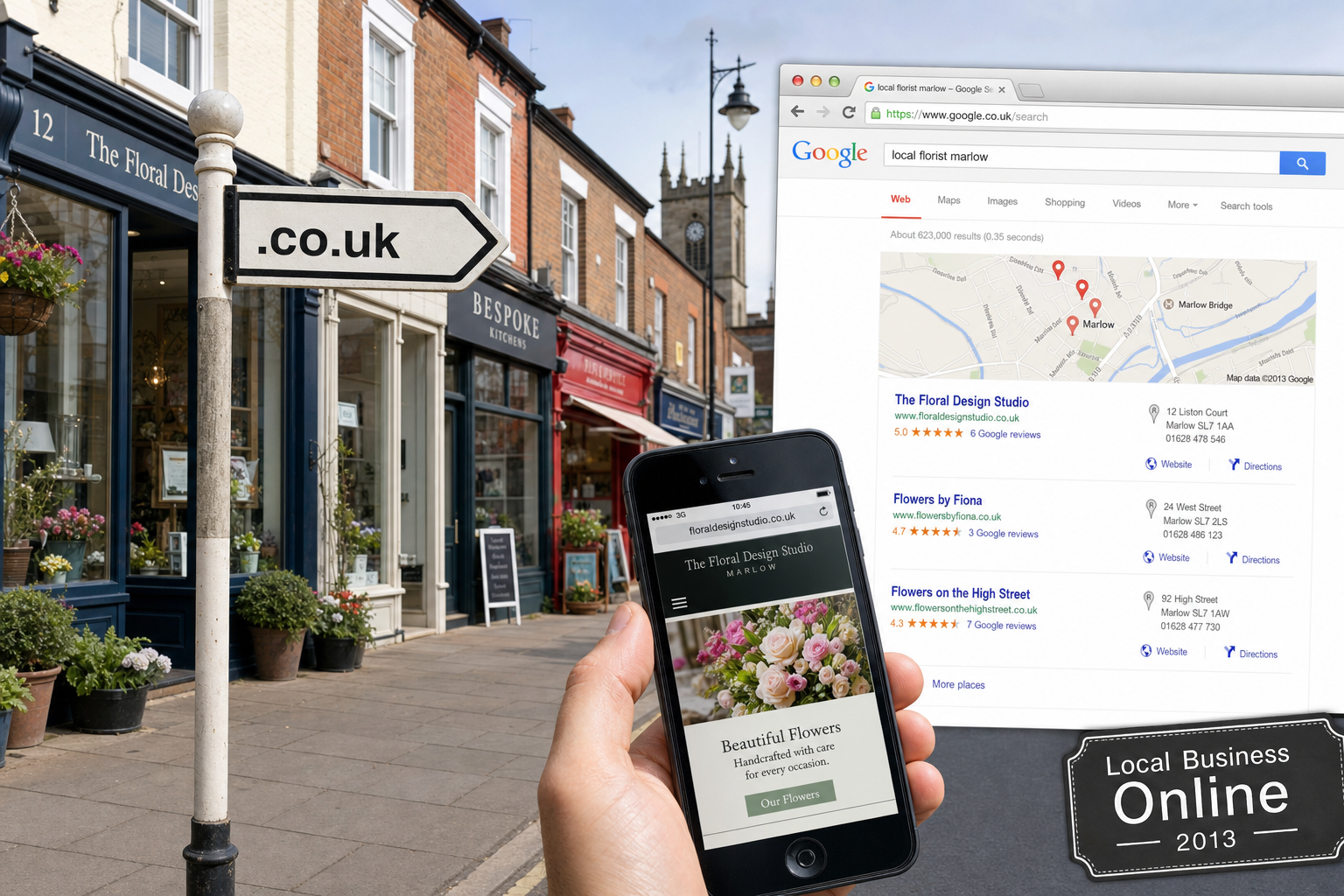
Local customers often search with place names. They may look for “web design Portsmouth”, “accountant in York”, “emergency plumber Reading” or “wedding photographer Kent”. A local business domain can help support this intent when it feels natural and credible.
If your business serves one town or city, including that location in the domain can be helpful, provided the result is still short and memorable. This is particularly useful for service businesses whose name is not widely known yet. If you serve several towns, however, a single location in the domain may become limiting. A company that starts in Brighton but later expands across Sussex might regret choosing a domain that suggests it works only in one part of the county.
It is also worth thinking about how customers describe the area. Some search by town, others by county, district or neighbourhood. The domain does not need to include every possible place name. Your website content, individual service pages and local landing pages can do that work in a more organised way.
.co.uk, .com and other domain endings
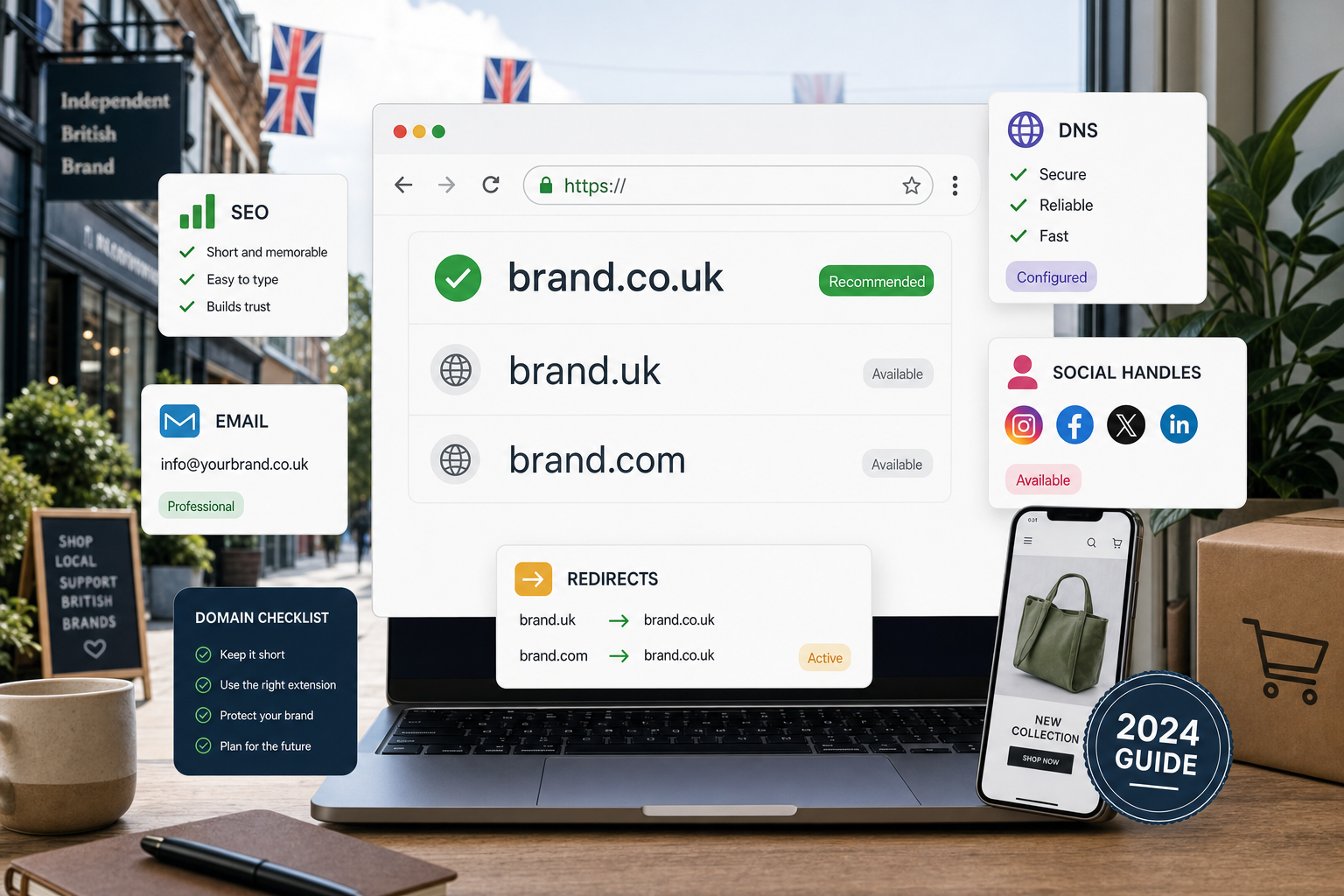
For most UK local businesses, a .co.uk domain remains a strong and familiar choice. It immediately signals that the business is UK-based and feels appropriate for companies serving British customers. A .com domain can also be valuable, especially if your business trades internationally, has ambitions beyond the UK or wants to protect its brand more broadly.
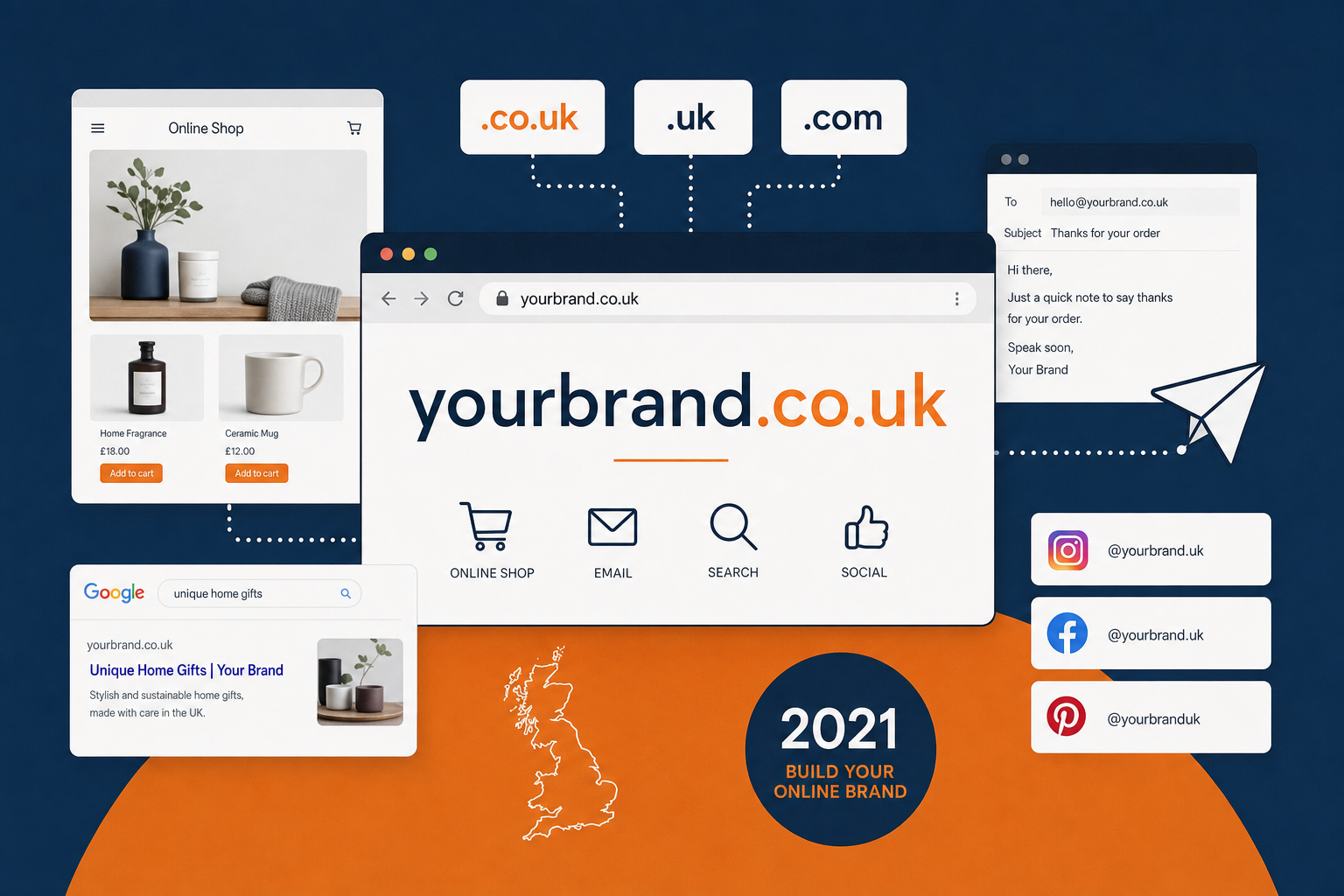
Where possible, it is sensible to secure the main versions of your domain to reduce confusion. If your customers are likely to type either .co.uk or .com, owning both can prevent lost enquiries. The website should usually use one main domain, with the other redirected to it. This avoids splitting search value and gives customers a consistent address.
Some organisations may consider endings such as .org.uk, particularly for charities, community groups or not-for-profit bodies. The key is to choose an ending that feels natural to your audience. A domain ending should build confidence, not create doubt.
Keep it short, clear and easy to share
A local business domain should be easy to read, say, spell and remember. This matters more than many business owners realise. Domains are not only clicked in search results; they are spoken in meetings, printed on leaflets, added to signage, included in radio adverts and typed into mobile phones.
Avoid unnecessary complexity. Long domains are more prone to typing errors. Unusual spellings may be memorable in a brand sense, but they can cause confusion if customers hear the name rather than see it. Numbers can also create uncertainty, as people may not know whether to type the numeral or the word. Hyphens can make some names clearer, but they are easy to forget and can look less polished when overused.
Before registering a domain, try saying it aloud. Ask whether a customer could understand it over the phone without further explanation. Print it on a mock business card or van panel. If it looks cluttered or takes too long to explain, it may not be the right choice.
Domain names and search engine optimisation
Search engines consider many signals when deciding which pages to show. A domain name is only one part of that picture. A website with useful pages, clear navigation, relevant headings, local contact details, good performance and trusted links will usually be in a better position than a thin website relying on a keyword-heavy domain.
That said, your domain can support SEO in several practical ways. A clear domain can improve click-through from search results because people can quickly understand who you are. A consistent domain helps customers and other websites link to you correctly. A professional domain used for email can also encourage suppliers, partners and local organisations to take your business seriously when linking to or mentioning your site.
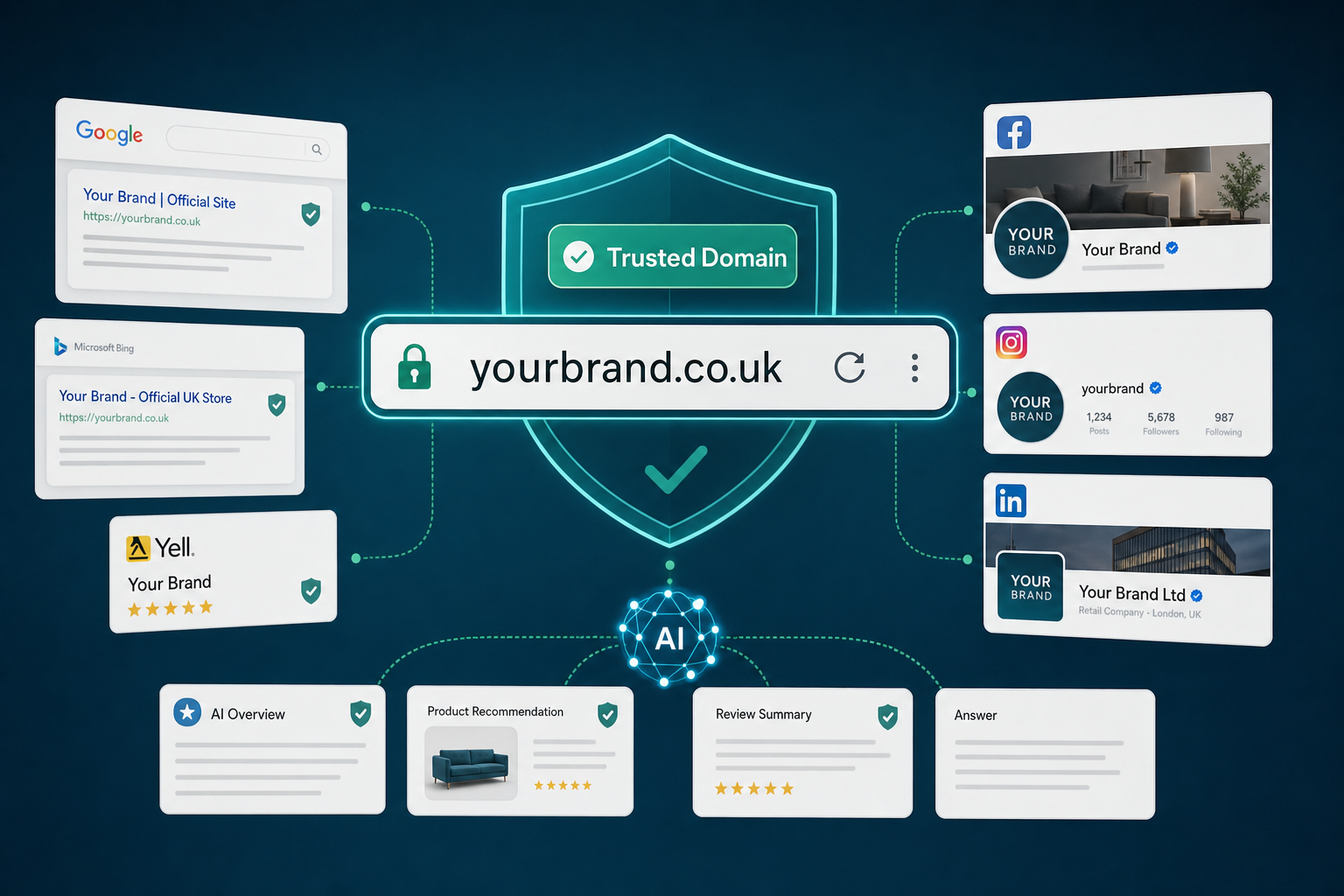
For local SEO, the domain should be supported by consistent business details across the web. Your name, address and telephone number should match on your website, local directories, maps listings and social media profiles. In 2013, many local customers find businesses through search results, maps and review-driven listings, so consistency is important.
It is also worth claiming and maintaining your local business presence on major search and social platforms relevant to your market. A complete listing with accurate opening hours, contact details, categories and a link to your website can help customers find you and support your wider local visibility. Your domain should be the same across these profiles wherever possible.
Using your domain in website design
A domain name should influence the way the website is planned. If the domain is brand-led, the home page and main headings should quickly explain what the business does and where it operates. If the domain already contains a service and location, the website should still build trust through strong design, clear copy, genuine contact details and useful content.
Good website design in 2013 should consider desktop visitors, tablet users and the growing number of people browsing on smartphones. A domain that is short and simple is easier to type on a small screen. Likewise, a site that loads efficiently and presents telephone numbers clearly can turn mobile searches into enquiries.
The domain should also be reflected in the structure of the website. Clean page addresses are easier to understand and share. For example, a page about kitchen fitting services might sit at a clear address such as /kitchen-fitting rather than a long string of numbers or symbols. This is helpful for users and can help search engines understand the site.
When planning a new website, it is also important to decide whether the site will use the www version or the non-www version of the domain as the main address. Either can work, but the choice should be consistent. The alternative version should redirect properly so visitors and search engines reach the same website.
Professional email and customer trust
One of the simplest advantages of owning a domain is the ability to use professional email addresses. For many local businesses, this is just as important as the website itself. An email address linked to your domain reinforces your brand every time you send a quote, invoice, appointment confirmation or enquiry response.
Role-based addresses such as enquiries@, bookings@ or support@ can help organise communication as the business grows. Individual addresses can also be used for staff. The important point is to keep email professional, reliable and consistent with the domain shown on your website and printed materials.
Customers may not consciously analyse your email address, but they do notice when a business looks well organised. A professional domain and email set-up can give reassurance before a customer has even visited your premises or spoken to you in detail.
Protecting your business and avoiding common mistakes
Domain ownership should be treated carefully. The domain should be registered in the correct business name or in the name of a responsible director or proprietor, with up-to-date contact details. If a designer, developer or marketing partner helps arrange the registration, make sure you understand who controls the domain and how it can be managed in future.
Keep renewal dates recorded and ensure that contact details remain current. A missed renewal can interrupt email, take the website offline and create unnecessary stress. It is also wise to store login details securely and make sure more than one trusted person in the business knows where essential information is kept.
Before registering a domain, check whether it could cause confusion with another business or brand. A domain that is too similar to an established company may create legal or reputational problems. It may also confuse customers and weaken your own identity. If your chosen name is central to the future of the business, consider taking appropriate professional advice on trade marks and branding.
Changing domain names without losing momentum
Sometimes a business needs to change its domain. This may happen because of a rebrand, a merger, a move from a free website address to a proper domain, or a decision to use a shorter and more professional name. A domain change can be successful, but it must be planned carefully.
The most important step is to redirect old addresses to the correct new pages using permanent redirects. This helps visitors who use old links and helps search engines understand that the content has moved. It is not enough simply to launch a new website and abandon the old domain.
You should also update important links and listings, including local directories, social media profiles, email signatures, printed materials and paid advertising. If your business has built up citations and links over time, the transition should be managed methodically so that customers and search engines receive consistent signals.
How social media fits with your domain
Social media can introduce people to your business, but your website and domain should remain the centre of your online presence. Platforms can change their layouts, rules and visibility, while your domain is a digital asset you control. The strongest approach is to use social media to build relationships and direct interested people towards useful pages on your own site.
Try to keep profile names consistent with your domain and business name where possible. If your website is called examplebusiness.co.uk, customers should be able to recognise the same organisation on Facebook, Twitter, LinkedIn or other relevant networks. Consistency reduces confusion and helps people move between your social profiles and website with confidence.
When sharing links, use pages that match the customer’s interest. A restaurant might link directly to its menu or booking page. A tradesperson might link to a gallery of recent work or a service page. A professional firm might link to a helpful article answering a common question. Your domain becomes more valuable when it leads to content that genuinely helps customers take the next step.
Checklist before registering
Before choosing a domain, work through a simple checklist. This can help you avoid decisions that feel convenient at the start but become limiting later.
- Is it easy to spell? Customers should be able to type it after hearing it once.
- Is it short enough for print and signage? Consider business cards, vans, shop windows and adverts.
- Does it reflect the business accurately? Avoid names that are too narrow if you plan to grow.
- Does it suit your local market? A town or county name can help, but only if it matches your service area.
- Is the domain ending familiar to your customers? For many UK firms, .co.uk is a natural choice.
- Can you use it for professional email? Think beyond the website and consider everyday communication.
- Is it distinct from competitors? Confusion can damage both marketing and customer trust.
- Can it support a well-structured website? The domain should sit comfortably with future service pages, blog content and campaigns.
Building long-term value from your domain
A good local business domain becomes more valuable over time. As customers bookmark it, suppliers link to it, directories list it and search engines crawl it, the domain gathers recognition. That value is strengthened by consistent marketing, useful content and a reliable website.
Think of your domain as the address of your online premises. Just as you would choose a physical location carefully, maintain signage and make it easy for customers to find you, your digital address deserves proper attention. It should be chosen with care, protected responsibly and used consistently across every marketing channel.
For UK business owners planning a new website, redesign or local SEO campaign, the domain name is a sensible place to begin. It sets the tone for your brand, supports your search marketing and gives customers a clear route to your services. Choose a domain that is practical, trustworthy and ready to grow with the business, and it will continue to support your digital marketing for years to come.